Every duty a planner assigns carries legal weight. It uses up driving hours, adds to working time, and depends on a valid licence, medical, and Driver CPC. One sickness call at dawn can unsettle the week's roster, the compliance position and a dozen driver messages at once. Spreadsheets handle each of these separately, so errors often surface at the roadside instead of in the office.
AI driver management treats them as one problem. An agent checks every limit before it offers work. It then confirms the change with the drivers affected and records why it chose them. At Mobisoft Infotech, we build these agents to sit alongside your existing fleet management software. Planners keep familiar tools and approve the decisions that matter.
That makes three questions worth settling before you build or buy. Which decisions should the agent take alone? Which data feeds are clean enough to trust? And what return is realistic for a fleet your size?
What Is an AI Driver Operations Agent?
It's software that runs the routine, rule-based parts of driver operations without waiting for a planner. It reads live data from tachographs, telematics, HR, and transport management systems. Then it acts within limits your team sets and records every decision.
The Four Domains It Covers
Most agents work across four connected areas. Each one feeds the others, so they work best when built together.
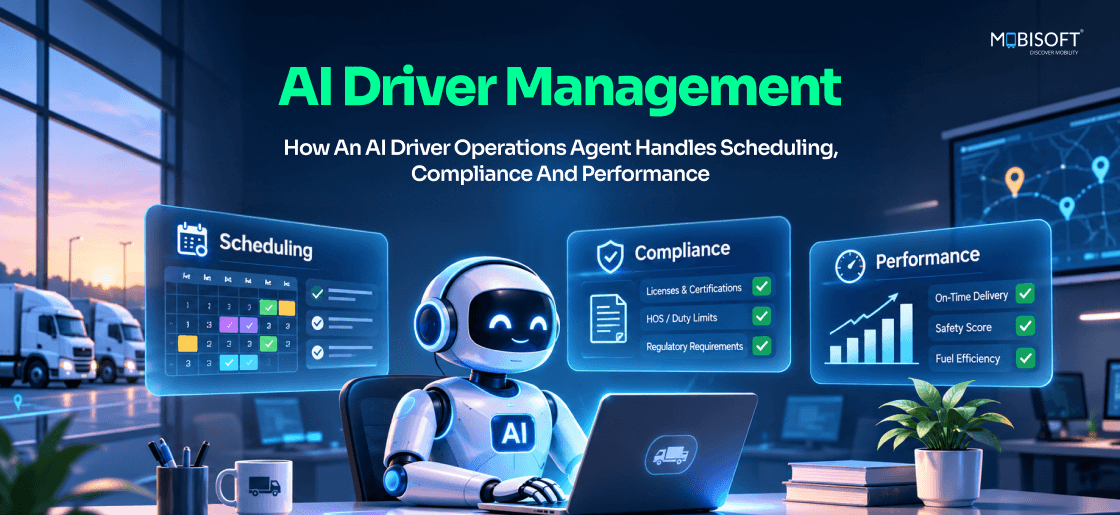
- Scheduling: The agent matches drivers to work using availability, qualifications, and hours remaining. If someone calls in sick at 5 am, it proposes a replacement before the depot opens.
- Compliance: It tracks drivers' hours, rest, licences, medicals and Driver CPC. It warns before a limit is reached and blocks any assignment that would break a rule.
- Communication: It sends confirmations, changes and reminders through the driver app, SMS or WhatsApp. It also answers routine questions and handles duty swaps.
- Performance: It combines telematics, delivery, and check data into a fair view of each driver. Managers get coaching notes instead of raw scores.
In practice, this is driver management automation with guardrails. Each domain often runs as a specialist agent, and a supervisor coordinates them. Our guide to AI agent orchestration explains how that coordination works.
What the Agent Should Not Decide
Some decisions stay with people. The agent doesn't make disciplinary or dismissal decisions, and it never overrides a legal limit for convenience. Fitness-to-drive judgements and driver disputes also belong to managers.
Those calls sit at the core of fleet workforce management, so people keep them. The boundary matters legally too. The Data (Use and Access) Act 2025 rewrote the UK GDPR rules on automated decisions from 5 February 2026. Significant decisions made solely by automated means now need safeguards. People must be told, be able to contest the decision, and get human review. We'd design those checkpoints first and automate around them. That's how our artificial intelligence development team approaches every agent build.
Who Benefits Most
The case is strongest for operators with 30 or more drivers. At that size, no planner can hold every driver's hours and qualifications in mind. Transport directors, heads of driver operations and fleet managers usually own the decision.
Recruitment is getting harder again. In the Department for Transport's survey for April to June 2026, 28 percent of HGV businesses reported driver vacancies. That was up from 25 percent the quarter before. With fewer drivers available, every legal hour you can use matters more.

Domain 1: Automated Shift Allocation
Daily allocation is the most visible job in driver operations. It's also the most time-consuming. Planners match each driver's licence categories and hours to routes with their own vehicle and timing needs. Then something changes, and the work starts again.
Where Manual Scheduling Breaks Down
Spreadsheets and phone calls work at 20 drivers. Beyond that, four weaknesses tend to appear.
- Hidden hours: Planners can't see rolling weekly totals at a glance, so they estimate.
- Familiar favourites: Work flows to trusted drivers, who run close to their limits while others sit idle.
- Late changes: A sickness call at 5 am sets off a chain of phone calls.
- Missed checks: A driver gets a route needing a qualification they lack, and nobody notices until the depot.
How Does AI Automate Driver Shift Allocation?
Automated shift allocation runs as a continuous loop. It has five parts, each with one job.
- Driver state model: A live record of each driver's hours, rest, qualifications, and location.
- Work requirement model: A structured view of each route's vehicle type, start time, and customer window.
- Optimisation engine: A solver that ranks eligible drivers for each duty against fleet-wide goals.
- Re-optimiser: A watcher that recalculates whenever the TMS, telematics, or driver app reports a change.
- Executor: A component that confirms assignments and updates every connected system.
Large language models aren't the right tool for the optimisation itself. A constraint solver handles that maths far more reliably. The language model explains the result in plain words for the planner and driver.
Can AI Assign Drivers Based on Availability and Compliance?
Yes. Compliance becomes a hard rule inside the solver. Any driver who would break a limit leaves the eligible pool before ranking starts. AI driver scheduling then picks the best legal option from those left.
Take a Thursday route with 9 hours of planned driving. One driver has used 50 of 56 weekly hours, so the agent excludes them. Another has already used both 10-hour days this week, so the solver caps them at 9. The route goes to a third driver, with the reason logged. That logic is what separates modern driver scheduling software from a static roster.
Many operators connect this layer to wider planning. Our transporter operations management solution shows how planning, dispatch, and execution can share one data model.
Duty Swaps Without the Phone Calls
Swap requests are among the most frequent coordination tasks. A typical one reads, "Can't do Saturday, can anyone take my route?" Manually, a coordinator finds a willing colleague and checks both drivers' hours. Then they update the schedule by hand.
An agent handles routine swaps end to end. The driver requests a swap in the app, and the agent finds eligible colleagues. Once someone accepts, it confirms the swap is legal. It updates the schedule and tells both drivers. The coordinator steps in only for exceptions.
Balancing Hours Across the Fleet
Good driver shift scheduling software does more than prevent breaches. It spreads legal hours across the whole pool. Manual rosters often lean on the same reliable drivers every week.
An agent uses objective data instead. That lowers individual fatigue risk and puts unused legal hours to work. How much will utilisation improve? It depends on your starting point. We'd measure a four-week baseline before setting any target.
Domain 2: Compliance Monitoring Before the Breach
Compliance is a daily duty for every driver and vehicle. Manual checks usually find problems after they've happened. Driver compliance management works better when the system looks ahead. It should stop a breach before the duty starts.
The UK Rules an Agent Has to Encode
GOV.UK now calls the former EU drivers' hours rules "assimilated rules." They cover most goods vehicles over 3.5 tonnes in the UK. They also cover journeys to, from or through the EU. Vehicles exempt from them fall under the GB domestic rules.
| Rule set | Key limits |
| Assimilated drivers' hours | 9h daily driving (10h twice a week), 56h weekly, 90h fortnightly |
| Breaks and rest | 45 min after 4.5h driving, 11h daily rest (9h up to 3 times) |
| GB domestic rules | 10h driving, 11h duty per day |
| Working time | 48h weekly average, 60h single-week maximum |
| Tachograph downloads | Driver card every 28 days, vehicle unit every 90 days |
| Driver CPC | 35h training every 5 years |
| Group 2 medical | At 45, every 5 years to 65, then yearly |
Two details catch many systems out. Working time includes loading and paperwork, yet periods of availability don't count towards it. Driver CPC also has two tracks now. Since December 2024, UK-only drivers can hold a National Driver CPC. EU work still needs the International version.
What Changed in 2026
Three recent changes affect how automated driver scheduling and compliance checks should be configured.
- Vans on international work: Since 1 July 2026, vans over 2.5 tonnes on international hire-and-reward work need a Smart Tachograph 2. Drivers' hours rules now apply to that work.
- Historical offences: DVSA examiners can fine drivers for hours offences from the previous 28 days. Penalties run in bands from £50 to £300 per offence.
- Data-led targeting: DVSA uses operator risk scores and remote data to choose whom to check. Some hours breaches can now be followed up through desk-based assessments.
Enforcement remains active. DVSA data for April to June 2026 makes the point. In that quarter, 2.8 percent of traffic checks on British HGV drivers ended in an hours prohibition. The bigger risk for operators is a referral to the traffic commissioner. That can put the operator licence itself at stake.
Pre-Infringement Monitoring
The design principle is simple. Predict the breach and prevent it, instead of detecting it and managing the fallout.
That takes a forward-looking model for each driver. The agent knows each driver's hours now. It projects where they'll stand when the current duty ends. Before any assignment goes out, it checks the plan against every limit. Driver compliance automation then takes one of three actions.
- Warn: Alert the planner and driver as a limit approaches, showing the time left.
- Reassign: Offer the duty to another eligible driver before anyone breaks a rule.
- Block: Stop an assignment that would cause a certain breach, such as an expired licence category.
Three Failure Modes the Agent Prevents
Each of these shows up in traffic commissioner decisions. Each is easy to prevent with live data.
The Licence or Medical Lapse
A driver's Group 2 entitlement expires because the five-yearly D4 medical slipped. Each side assumes the other has it in hand. Driver compliance management software sends alerts at 90, 60 and 30 days. On expiry, the agent won't assign that driver to any duty needing the lapsed category.
Licence status can come straight from DVLA. Its Access to Driver Data service gives approved organisations real-time entitlement and endorsement data. Drivers can also share a check code, which stays valid for 21 days.
Working Time Creep
Driving stays within limits, yet loading and waiting push working time towards 60 hours in a week. Tachographs capture driving well. Other work is often recorded poorly. The agent combines every working time category into one weekly figure and flags the trend early.
The Missed Weekly Rest Compensation
A driver takes a reduced weekly rest of 24 hours. The rules require that reduction to be made up en bloc before the end of the third following week. It must be attached to another rest of at least 9 hours. Paper tracking often misses this. With AI driver management, the debt carries forward automatically, and the compensating rest gets scheduled.
Reduced daily rests work differently. A driver may take up to three 9-hour daily rests between weekly rests, with no compensation needed. Encoding both rules correctly avoids false alarms as well as real breaches.
Most of this data already sits in tachograph tools, HR systems, and older TMS platforms. Connecting them cleanly is often the hardest step. Our guide to AI integration with legacy systems covers the practical options.
Domain 3: Automated Driver Communication
Communication is the highest-volume task in driver operations. A 100-driver fleet can generate hundreds of routine messages a day. Handled manually, they queue behind everything else the office is doing.
What Drivers Need From the Office
Driver frustration with the office tends to come down to four needs.
- Notice: Confirmed work far enough ahead to plan their lives.
- Reasons: An explanation whenever plans change.
- Answers: Quick replies to routine questions.
- Consistency: The same information for every driver at the same time.
What the Agent Handles in Communication
Automated driver communication covers the routine flow in both directions. People still handle anything sensitive.
- Duty confirmations: Sent 72 to 96 hours ahead with the route and vehicle, then resent after any change.
- Change alerts: Push notifications that include the reason, with human follow-up for major changes.
- Reminders: Alerts tied to each driver's real expiry dates, escalated to a manager when ignored.
- Duty swaps: The full swap workflow, with edge cases routed to a coordinator.
- Routine queries: Answers drawn from approved policies, such as "When is my next CPC course?"
- Incident reports: An instant acknowledgement with next steps, followed by human investigation.
The Driver App as the Hub
The driver app is where the agent's work becomes visible. It shows schedules and collects availability. Walkaround checks and defect reports live there too. Without strong adoption, an AI driver operations agent loses its main channel. We'd target at least 80 percent active use before relying on it.
Privacy and Lawful Monitoring
Drivers accept monitoring more readily when it's open and limited. The ICO's guidance on monitoring workers sets clear expectations. Employers should define the purpose before monitoring starts and be transparent with workers. High-risk processing needs a data protection impact assessment, and telematics monitoring often qualifies.
We'd build four principles into the design.
- Minimisation: Collect only the data each function needs.
- Purpose limits: Don't reuse compliance data for unrelated decisions.
- Transparency: Tell drivers what's collected and what it can affect.
- Rights: Let drivers see and correct their own data.
EU rules add another layer. The AI Act treats systems that allocate tasks based on individual behaviour, or that monitor and evaluate workers, as high-risk. The Digital Omnibus on AI moved those obligations to 2 December 2027. EU-facing operators can use the time to add oversight.
Domain 4: Performance Monitoring and Coaching
In many fleets, feedback arrives only after a complaint or a collision. Good behaviour goes unnoticed, and problems surface late. Driver performance monitoring works better when it's continuous and looks at leading indicators.
Data Sources That Feed the Picture
The agent combines several feeds, each updating at its own pace.
- Telematics: Speed, harsh braking, idling, and fuel use, often in near real time.
- Tachograph records: Infringements, missing records and rest compliance, updated at each download.
- TMS events: On-time departures and deliveries, logged per delivery.
- Walkaround checks: Completion rates and defects found, per check.
- Fuel cards: Transaction patterns and efficiency trends, usually daily.
- Incidents: Involvement and fault assessments, per report.
- Customer feedback: Complaints and commendations linked to specific deliveries.
Building a Score Drivers Will Trust
Which events should actually count against a driver? Raw scores rarely get that right, and they quickly create resentment. Harsh braking for a pedestrian who steps out differs from harsh braking caused by inattention. Fair driver performance analytics follow four design rules.
- Context: Adjust for route type, traffic, and weather before comparing anyone.
- Peer groups: Compare drivers on similar routes and vehicles.
- Trends: Weight sustained patterns over one-off events.
- Explanation: Show drivers which events moved their score.
Drivers should also be able to challenge an event they think was misread. That supports the safeguards UK GDPR now requires for significant automated decisions.
From Data to Coaching
Data only matters if it changes a conversation. A dashboard alone can't do that. Before a review, the agent prepares a short brief for the manager. It shows the driver's eight-week trend and two or three specific events with context. It also lists strengths worth recognising.
Fuel is often where coaching pays back fastest. The Department for Transport's SAFED training programme reported average fuel savings of around 10 percent for truck drivers. Keeping part of that gain through ongoing coaching is realistic. We'd still use a more conservative figure in any business case.
Technical Architecture: The DRIVER Model
A production agent is a set of specialised components sharing one data layer. The DRIVER model is a simple way to describe them. It's also a useful checklist when you evaluate any AI fleet management platform.
- Data integration: Connects tachograph, telematics, TMS, HR and licence systems. It turns their events into one live state for drivers and vehicles.
- Rules engine: Encodes hours, working time, and licensing rules as machine-checkable constraints. It needs a named owner, because the rules change.
- Intelligence layer: Runs the solver for scheduling and language models for messages and queries.
- Verification workflow: Routes decisions needing a human to the right person and records the outcome.
- Execution layer: Sends notifications and updates connected systems once a decision is approved.
- Reporting layer: Shows compliance status and agent performance to leadership.
Each layer can run as its own agent with clear permissions. That's the practical meaning of agentic AI for fleet management. Specialist agents act within set limits, while a supervisor coordinates their work.
Integration Risks to Plan For
How clean is your qualification data today? Integration usually takes longer than any other part of the build. Each system type carries a typical data quality risk.
- TMS and route planning: Vehicle requirements often sit in free text instead of structured fields.
- HR systems: Qualification records are frequently incomplete.
- Tachograph analysis: Download frequency varies, and some fleets don't download daily.
- Telematics: Data needs normalising when a fleet uses more than one provider.
- Licence checking: Manual processes may only check every quarter.
- Vehicle check apps: Low adoption leaves holes in completion data.
We'd audit each feed before the build starts. Fixing data at the source costs less than working around it later.
Where Dispatch Fits
Scheduling decides who works which duty. Dispatch handles what happens once the day begins. A dispatch assistant can reassign jobs after a breakdown and warn customers about delays.
Say a vehicle fails its walkaround check at 6 am. The assistant finds a spare vehicle and re-sequences the affected drops. It then updates each customer's arrival time. Because it uses the same compliance model as scheduling, no recovery plan breaks a driver's hours. That's what real dispatch automation looks like.
What Does the ROI Look Like? A Worked Example
The return comes from several smaller gains. The model below uses illustrative assumptions. Replace each one with your own data before building a business case.
The example operator runs 95 drivers and 78 vehicles from three depots in food distribution. Three planners handle scheduling, compliance, and communication with spreadsheets and phones.
| Benefit | Assumption | Annual value |
| Planner time | 3 planners at £42,000 fully loaded. Half their time is routine admin, and the agent automates 60 percent of that | £37,800 of capacity |
| Driver retention | 20 percent attrition reduced by 3 points, so about 3 fewer replacements at £6,000 each | £18,000 |
| Agency cover | Better hours visibility avoids 3 agency driver days a week at a £100 premium | £15,600 |
| Fuel | 3 percent saving on £1.2 million annual fuel spend | £36,000 |
| Total annual benefit | £107,400 |
This example assumes £85,000 to build and integrate, plus £28,000 a year to run. Year one of AI driver management comes out close to break-even here. Payback arrives in about 13 months. Three-year net present value at 8 percent is roughly £120,000.
Two items stay out of the total on purpose. Avoided fines are real but small, since DVSA fixed penalties top out at £300 per offence. The larger value is protecting the operator licence, which no honest model can price. Planner time also counts as capacity. It becomes cash only if you redeploy or reduce roles.
How the Benefit Mix Changes With Fleet Size
- Under 50 drivers: Compliance protection and planner time usually lead.
- 50 to 250 drivers: Retention and agency savings become material.
- Over 250 drivers: Fuel and utilisation gains scale with the fleet and often lead the case.
Implementation: Phasing and Change Management
Successful rollouts follow a consistent pattern. They phase the work and fix integration first. They also bring planners along from the start.
A Phased Rollout
- Phase 1, data and compliance (8 to 12 weeks): Connect tachograph, licence, and HR data. Then switch on pre-infringement alerts.
- Phase 2, scheduling (6 to 10 weeks): Introduce AI driver scheduling recommendations that planners approve, plus automated swaps.
- Phase 3, communication (4 to 6 weeks): Launch the driver app and automated confirmations.
- Phase 4, performance (6 to 8 weeks): Add multi-source scoring and coaching briefs.
- Phase 5, wider autonomy (ongoing): Lower approval thresholds for routine decisions as trust builds.
Why start with compliance? It delivers visible protection quickly. It also builds the clean driver data that scheduling depends on.
Bringing Planners With You
Most failed AI driver management rollouts struggle with adoption. The technology is rarely the problem. Experienced planners know their drivers, and their concerns about context are often valid.
- Shadow mode: Run the agent alongside planners for several weeks and compare choices.
- Visible reasoning: Show why each recommendation was made, in plain language.
- Graduated authority: Let the agent act alone only on decision types it has handled well.
- Override logging: Record when planners overrule it, and use those cases to improve the rules.
Picture a planner reading "Driver A hits 56 hours on Saturday, so Driver C gets the route." They can verify it in seconds. That transparency builds trust faster than any training session.
How Mobisoft Infotech Builds Driver Operations Agents
Mobisoft Infotech's AI Product Engineering practice builds bespoke driver operations agents for transport and logistics operators. We also work with technology businesses building fleet platforms and other AI agents in logistics. Each system fits the client's regulatory scope and operating patterns.
Our team brings working knowledge of drivers' hours, tachograph and DVSA requirements into the architecture from day one. We build integrations across the TMS, telematics and HR systems UK and European operators use. We also design for planner adoption, with transparent logic and graduated authority.
Auditability runs throughout. Every assignment, alert, and block records its timing and the data behind it. It also records the alternatives considered and who confirmed the decision. That's the standard fleet workforce management needs in an audit-heavy industry.
Start With the Hours You Can't See
Faster rosters aren't the main prize in driver operations. The bigger gain is knowing, before work goes out, that every assignment is legal. With fewer drivers available and the DVSA able to look back 28 days, legal hours are your scarcest resource.
Three steps can start this month:
- Pull four weeks of tachograph and working time data. Count how often drivers came within an hour of a limit.
- List every licence, D4 medical, and Driver CPC expiry for the next six months in one place.
- Track how many hours planners spend each week on swaps, sickness cover and hours checks.
Those three numbers give you a baseline. They show where AI driver management would protect you first and what it's worth. Once an agent goes live, measure the same figures again. If they haven't moved, fix the rules engine or the data feeding it before adding anything else.

Frequently Asked Questions
How long does it take to set up?
Most rollouts run in phases over six to nine months. Compliance data comes first, since it gives fast protection and cleans the records scheduling depends on. Scheduling, communication and performance tools follow in later phases. Each phase starts once the last is stable. Your AI driver operations agent rollout plan sets these milestones early.
How does it affect drivers day to day?
Drivers get clearer schedules, earlier notice of changes and quicker answers to routine questions. Confirmations and reminders arrive through the driver app or SMS, and duty swaps can be requested without a phone call. Drivers also see why a change was made and can challenge decisions that affect them. Our automated driver communication tools aim to reduce admin, not add pressure.
Which driver decisions should an AI agent handle alone, and which stay with planners?
Routine, rule-based work can run automatically: duty swaps that pass hours checks, driver confirmations, and compliance warnings. Disciplinary action, fitness-to-drive judgements and driver disputes stay with managers. This keeps planners in control of every exception. Our team designs approval checkpoints before any automation, so decisions stay contestable and reviewable under UK GDPR.
Where should we start: compliance or driver shift scheduling software?
Start with compliance. Phase one delivers visible protection in eight to twelve weeks through pre-infringement alerts. Driver shift scheduling software then runs in shadow mode beside planners before it takes approvals. Our artificial intelligence development services scope each phase against your integration audit, so the rollout starts with the data you can trust.
Is AI driver management only for large fleets?
The value grows with fleet size. Operators with 30 or more drivers usually feel the strain first, because no planner can track every driver's hours and qualifications from memory. Smaller fleets can still benefit from automatic licence and medical reminders. Our team can start with the features that match your biggest pain point and expand as the fleet grows.
This content is for informational purposes only and may include AI-assisted research or content generation. While we strive for accuracy, information may evolve over time. Readers are advised to independently verify critical information before making decisions.

Nitin Lahoti
Read more
Nitin Lahoti is the Co-Founder and Director at Mobisoft Infotech. He has 15 years of experience in Design, Business Development and Startups. His expertise is in Product Ideation, UX/UI design, Startup consulting and mentoring. He prefers business readings and loves traveling.
 Nitin Lahoti
 November 17, 2026