Claude Haiku 5.5 lists at $0.10 per million input tokens on Anthropic's pricing page. Haiku 4.5 is priced at $1. Opus 5.5 costs $4 per million input tokens, while Opus 4.1 lists at $15. Token prices keep falling. Yet most AI budgets still treat the token bill as the whole cost.
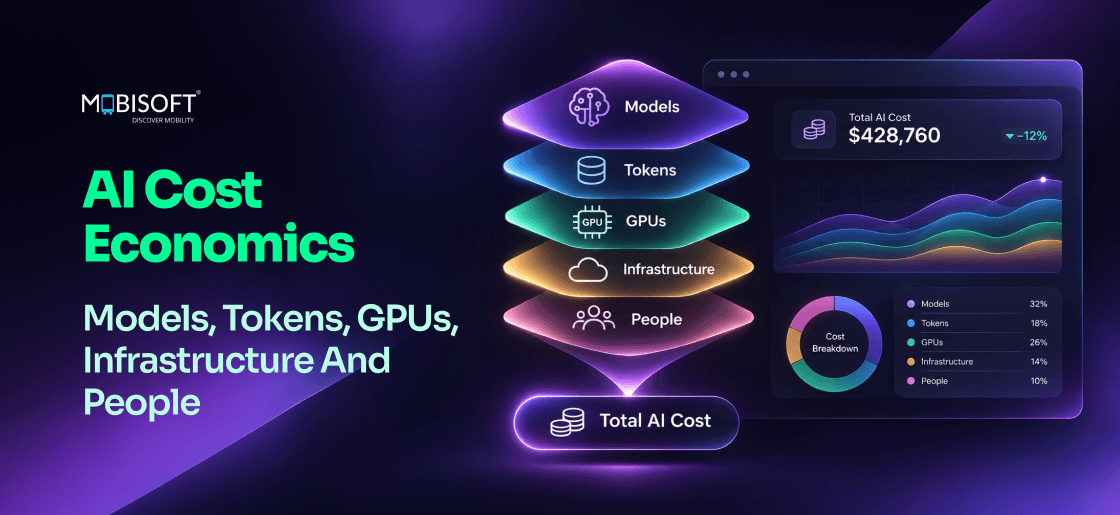
As a result, AI cost optimization often targets the smallest line. In a mid-scale product, the model API is one of five cost layers. Data pipelines, GPUs, and operations tooling sit beside it. In our worked model, people account for close to 90 percent of the total. We price all five layers per AI-powered action. Our AI strategy consulting services start from that five-layer view, so the budget reflects what the product will really cost to run.
This post covers each layer with current list prices and worked numbers. By the end, you'll be able to estimate cost per action and how to reduce it.
How Much Does It Cost to Run an AI Model in Production?
Ask a product team what its AI feature costs. Most will quote the API invoice. That figure is accurate, but it covers only one of five layers. The cost of artificial intelligence in production is the sum of all five.
- Model API and inference: This covers per-token charges or compute for self-hosted models. Estimates often rely on demo prompts, which run far shorter than production prompts.
- Data and retrieval: This covers pipelines, embeddings, vector databases, and re-ranking. Preparing real enterprise data often takes months that no plan included.
- Compute and GPUs: This covers fine-tuning, evaluation runs, batch jobs, and self-hosted serving. Teams often provision for peak load and pay for idle capacity.
- AI operations: This covers tracing, evaluation, prompt management, guardrails, and cost monitoring. It's frequently unbudgeted until the first quality incident.
- People: This covers ML, data, platform, product, and compliance time. Plans often count two engineers when the work needs five or six people.
Proportions vary by product. Once a dedicated team runs the feature, people costs tend to dominate. In the worked example later in this post, they make up about 90 percent of monthly cost.
How complete are your own numbers? Ask your finance lead one question. "What's our cost per AI-powered action, and is it falling as usage grows?" If either half of the answer is unknown, your enterprise AI cost isn't visible yet. Build-versus-buy and model choices then rest on estimates.
Layer 1: LLM Token Pricing and What You Pay Per Call
Token prices are the most widely published number in AI. They're also easy to misread. The rate card is rarely the issue. Production volume is, because it runs far above what development prompts suggest.
How AI Token Cost Is Calculated
Every major provider bills per token. Input tokens cover everything sent to the model. That includes the system prompt and any retrieved documents. Output tokens cover the response, including any reasoning tokens the model generates. Your AI token cost per call is each token count times its rate, added together.
Output is the more expensive half. Across the models below, input costs one-sixth to one-fifth of the output rate.
Token counts also differ by model. Anthropic's pricing page notes that Claude 4.7 and later models use a newer tokenizer. It produces about 30 percent more tokens for the same text. So a cost model built on one provider's counts won't transfer cleanly to another. Our generative AI consulting services team compares models on your real prompts before you commit to one.
AI Model Pricing by Tier Right Now
These are standard list prices from each provider's official pricing page at the time of writing. Each cost per million tokens is shown before batch or cache discounts. We'd read LLM token pricing by tier first, because routing decisions happen at that level.
| Tier | Example models | Input | Output | Best for |
| Premium frontier | Claude Fable 5.2, GPT-6 Astra | $10 | $50 | Hardest reasoning and long agent runs |
| Flagship | Claude Opus 5.5, GPT-6.1 Sol, Gemini 4 Argon | $4 | $20 | Complex reasoning, coding and multi-step agents |
| Mid-tier | Claude Sonnet 5.5, GPT-6.1 Terra, Gemini 3.8 Flash | $2 | $10 | Most production workloads |
| Small and fast | Claude Haiku 5.5, GPT-6 Luna, Gemini 3.1 Flash-Lite | $0.25 | $1.50 | Classification, extraction, routing |
| Open-weight | Llama 4 Scout, gpt-oss-120b, gpt-oss-20b | GPU time | GPU time | High, steady volume you host yourself |
Three conditions affect these rates.
- Claude Haiku 5.5 charges $0.10 input and $0.50 output for prompts up to 100,000 tokens. Longer prompts cost $0.50 and $2.50.
- Gemini 4 Argon rises from $2 and $10 to $4 and $20 on December 1.
- Gemini 3.8 Flash has an introductory rate of $0.75 and $3.75 through December 31. It doubles from January 1.
Any AI model pricing figure is a snapshot. We recommend rechecking rates every quarter. Pin the exact model version in your cost model too.
Why Production Usage Outgrows Your Estimate
Development prompts are short, but production prompts grow. Four factors push token volume, and with it LLM inference cost, up after launch.
- System prompts expand. A 300-token prompt gathers rules and examples until it passes 1,500 tokens.
- Retrieved context accumulates. A RAG system may inject eight chunks where three would answer the question. Our guide to context engineering for LLMs explains how to keep that context focused.
- Calls multiply. One user action can trigger a retry, two tool calls, and a self-check.
- Outputs lengthen. A prompt edit that adds "explain your reasoning" can double output tokens.
Take an agent that plans, searches twice, drafts, and then checks its answer. That's five calls for one request. Each call carries the full system prompt. Cost per request rises fivefold while traffic stays flat.
Worked Example: Contract Analysis at 50,000 Users
Here's a worked AI token cost example with illustrative numbers. A legal tech SaaS adds contract analysis for its 50,000 monthly users. Each user runs two analyses a month.
- Volume is 100,000 calls a month.
- Each call sends 2,800 input tokens. That's an 800-token system prompt plus a 2,000-token contract.
- Each call returns 400 output tokens.
- The model is Claude Sonnet 5.5, at $2 input and $10 output per million tokens.
Input costs $560 a month, and output costs $400. The base bill is $960. Add 15 percent for retries and 20 percent for prompt growth, and it reaches about $1,325. That's roughly 1.3 cents per analysis.
At $29 per user, the product earns $1.45 million a month. The API line is under 0.1 percent of revenue. In this case, AI cost per token isn't the main risk. The data pipeline and the team behind the feature cost far more. Agent-based features behave differently, because one request can trigger many model calls. Our guide to AI agent cost optimization covers that case in depth.
Layer 2: Data and Retrieval Infrastructure
Most production AI products answer questions about a company's own data. That requires pipelines, embeddings, and a vector database, plus a retrieval layer on top. Teams often file this work under the data platform budget. It still exists only because of the AI feature.
Where the Data Engineering Money Goes
A demo usually runs on a few dozen clean PDFs. Production runs on scanned contracts and SharePoint sites with inconsistent metadata. Email archives with mixed attachments add more work. Preparing that content for retrieval is often the first unplanned cost.
Here's a worked example with illustrative numbers. A data engineer and an ML engineer spend 10 to 16 weeks on ingestion and chunking. We'll use the fully loaded UK costs from the people section. On those figures, the pair costs about £4,200 a week. That's £42,000 to £67,000 before a single user sees the feature.
We recommend placing this line in the business case from day one. It belongs in your AI implementation cost, even when the data team does the work. Our artificial intelligence development services scope this data work before any model is chosen.
Vector Database Pricing Compared
Vector database bills depend more on the pricing model than on the vendor. Some charge per operation, while others charge for reserved capacity. In most products, this line is a small part of total AI development cost.
- Pinecone Standard bills for storage plus read and write units, with a $50 monthly minimum. Its documentation says a query uses 1 read unit per GB of namespace size. So a larger index makes every query more expensive.
- Weaviate Cloud Flex starts at $45 a month and bills on vector dimensions stored.
- pgvector on Amazon RDS costs your Postgres instance plus storage. It suits teams already on PostgreSQL.
- Qdrant runs on Qdrant Cloud or your own compute. It suits cost-sensitive, high-query workloads.
- Milvus runs on your own infrastructure or on Zilliz Cloud. It suits very large collections with complex filtering.
Sizing a Vector Database: A Worked Example
Consider a corpus of 500,000 documents. It splits into 2 million chunks of about 125 words. The figures below are illustrative and use published list prices.
| Item | Calculation | Result |
| Raw vector storage | 2M vectors × 1,536 dimensions × 4 bytes | About 12.3 GB |
| Pinecone storage | 12.3 GB × $0.33 per GB-month | About $4 a month |
| Searches | 100,000 user queries × 5 searches each | 500,000 a month |
| Pinecone reads, single namespace | 500,000 × about 12 read units × $16 per million | About $98 a month |
| Pinecone reads, 1 GB tenant namespaces | 500,000 × about 1 read unit | About $8, so the $50 minimum applies |
| Self-hosted Qdrant | AWS r6i.xlarge (32 GiB) at $0.252 an hour | About $184 a month, plus operations time |
| One-time embedding | 2M chunks × about 166 tokens × $0.02 per million | About $7 |
What stands out? Index layout affects the bill more than vendor choice. Embedding is a minor part of AI implementation cost, at about $7 for the full corpus. Self-hosting pays off only at much higher query volumes. Even then, count the engineering hours needed to run it.
Data Pipeline Costs Teams Miss
The database invoice is small next to the work around it. These items rarely appear in a first estimate.
- Complex PDFs and scans need OCR or layout-aware parsing, often billed per page.
- A new embedding model means re-embedding and re-indexing the full corpus.
- Document permissions must flow into retrieval. Without them, users see content they shouldn't.
- Freshness jobs re-ingest changed files on a schedule, and someone monitors them.
- Retrieval quality needs its own test set, separate from answer quality.
Each item recurs. We budget them as ongoing AI maintenance cost.
Layer 3: AI GPU Cost for Fine-Tuning and Self-Hosted Inference
GPUs enter the budget in two ways. Fine-tuning adapts a model to your domain, once or periodically. Self-hosted serving replaces per-token pricing with per-hour pricing. Which one are you paying for? The answer decides most of your AI GPU cost.
How Much Does GPU Infrastructure Cost for AI?
GPU cloud pricing varies widely between hyperscalers and specialist providers. These are on-demand list rates at the time of writing, normalized to one GPU-hour.
| GPU | Memory | AWS on-demand, us-east-1 | Specialist clouds, on-demand | Typical use |
| NVIDIA L4 | 24 GB | $0.805 (g6.xlarge) | Varies | Small-model inference |
| NVIDIA L40S | 48 GB | $1.861 (g6e.xlarge) | From $0.79 (RunPod) | Mid-size inference, LoRA fine-tuning |
| NVIDIA A100 | 80 GB | About $3.43 (p4de.24xlarge ÷ 8) | $1.19 to $2.79 (RunPod, Lambda) | Fine-tuning 13B to 70B models |
| NVIDIA H100 | 80 GB | $6.88 (p5.4xlarge, or p5.48xlarge ÷ 8) | $1.99 to $3.99 (RunPod, Lambda and others) | Large-model serving and training |
Azure lists its eight-GPU ND96isr H100 v5 at $98.32 an hour. That's about $12.29 per GPU. On RunPod, H200 GPUs start at $3.59 per GPU-hour. B200 GPUs start near $5.49.
H100 prices have also stopped falling. IntuitionLabs reports that AWS Capacity Block rates for the p5.48xlarge rose between August and October. They went from $5.19 to $5.97 per H100-hour. Nebius raised its on-demand H100 rate from $3.85 to $4.50 on October 1. We'd budget GPU rates with a buffer for the coming year.
Spot capacity is the main discount for jobs that can pause. In US East, AWS spot prices for a p5.48xlarge have run about $12 to $17 an hour. On-demand, the same instance costs $55.04. Spot suits fine-tuning and evaluation with checkpointing. Latency-sensitive AI inference belongs on on-demand or reserved GPU instances.
Model Training and Fine-Tuning Costs
Fine-tuning is far cheaper than pretraining. It isn't free, though, even with open weights. Here are our planning estimates per run for a job of about 10,000 examples. Benchmark run times on your own data before relying on them.
| Model size | Method and GPUs | GPU-hours per run | Cost per run, specialist cloud | Cost per run, AWS |
| 7B to 8B | LoRA or QLoRA, 1 × L4 or L40S | 2 to 4 | Under $5 | $2 to $8 |
| 13B to 20B | QLoRA, 1 × A100 80GB | 4 to 8 | $5 to $14 | $14 to $27 |
| 30B to 34B | LoRA, 2 × A100 80GB | 16 to 32 | $19 to $57 | $55 to $110 |
| 70B | LoRA, 4 × A100 80GB | 64 to 128 | $76 to $229 | $220 to $439 |
The GPU bill per run is small. Most model training and fine-tuning spend goes on repeated runs, dataset curation, and evaluation. We plan for five to ten runs per project. Even so, one engineer-week costs more than all of them.
Managed options have narrowed. OpenAI's pricing page states that fine-tuning is closed to new users. Existing users can continue for the coming months, at $25 per million training tokens for GPT-4.1. Google offers supervised tuning for Gemini through Vertex AI.
When Fine-Tuning Is the Wrong Investment
A common request is "The answers are off, so let's fine-tune." Many quality problems are actually prompt or retrieval problems. Fine-tuning won't fix those.
Fine-tuning helps when prompting can't hold an output format steady. It helps with domain notation the base model keeps getting wrong. It also lets a small tuned model match a large one on classification or extraction. That brings lower cost and lower latency.
It doesn't fix missing facts. A tuned model still invents what it doesn't know, and retrieval handles grounding better. Weak reasoning usually calls for a stronger base model.
We recommend investing in this order. Start with prompt engineering. Next, build an evaluation set and improve retrieval. Each step costs engineering time, the most controllable part of your AI development cost. Fine-tune only when a measured quality shortfall remains after all three.
How Much Does It Cost to Host an LLM?
Self-hosting replaces token bills with GPU hours. Is it cheaper? This worked example uses illustrative numbers for a high-volume classification task. It handles 2 million queries a month, each with 500 input and 100 output tokens.
| Item | API option | Self-hosted option |
| Model | Claude Haiku 5.5 | gpt-oss-20b, which runs in 16 GB using MXFP4 quantization |
| Tokens or compute | $100 input plus $100 output | 2 × L4 on AWS, always on for redundancy, about $1,175 |
| Engineering upkeep | Minimal | About 8 hours at $100 an hour, so $800 |
| Monthly total | About $200 | About $1,975 |
At this volume, the API costs about one-tenth as much. It works out to about $100 per million queries. On that basis, self-hosting breaks even near 20 million queries a month. The estimate assumes each L4 handles about 20 queries per second. Benchmark that figure on your own traffic.
Two points explain the result. Production serving runs around the clock, so idle hours are billed too. Low small-model API prices have also pushed the break-even point much higher.
Model quantization makes self-hosting possible on modest hardware. Llama 4 Scout has 109 billion total parameters. Meta states it fits on one H100 with int4 quantization. Memory depends on total parameters, so a "17B active" label doesn't mean it fits a 24 GB card. Before choosing hardware, run your evaluation set against both options. A cheaper model that misses your quality bar isn't a saving.
Layer 4: AI Operations and Observability
This layer is missing from most first budgets. The need usually stays hidden until real users start depending on the product. After launch, it keeps your AI maintenance cost predictable.
What the AI Ops Stack Includes
Suppose support forwards a screenshot. It reads, "Your assistant told a customer our refund window is 90 days." Can your team find that call within minutes? They'd also need its prompt and retrieved context. The operations stack makes that possible.
- Tracing logs every model call with its inputs and outputs, plus latency and cost.
- An evaluation pipeline scores outputs against a test set after each change.
- Prompt management versions prompts, so a faulty edit can be rolled back.
- Cost monitoring tags each call by feature and customer.
- Guardrails filter unsafe inputs and outputs, including prompt injection attempts.
AI Ops Tooling Costs
Managed tools in this category are mature and reasonably priced. These are list prices at the time of writing.
- Tracing: Langfuse is open source under MIT. Langfuse Cloud costs $29 a month on Core and $199 on Pro. LangSmith Plus costs $39 per seat per month.
- Evaluation: Braintrust Pro costs $249 a month.
- Prompt management: It's included in Langfuse and LangSmith plans.
- Cost monitoring: Helicone Pro costs $79 a month, and Team costs $799, plus usage.
- Guardrails: Open-source options include NVIDIA NeMo Guardrails and Llama Guard.
Langfuse Pro, Braintrust Pro, and Helicone Pro together cost about $530 a month before usage fees. That's modest next to the LLM inference cost and engineering hours they help you control.
Build or Buy Your AI Ops Tooling
We recommend buying in most cases. Building makes sense in two situations. One is a data residency rule that prevents sending traces to a third-party service. The other is a scale where managed fees clearly exceed self-hosting costs.
Building tracing and evaluation in-house can take two to six months of senior ML engineering time. At about £122,000 a year fully loaded, that's £20,000 to £61,000 in salary. Ongoing upkeep comes on top. A managed stack costs a few hundred dollars a month.
We follow this sequence.
- Enable managed tracing on launch day, before the first incident.
- Build a small evaluation set in month one, before the first system prompt edit.
- Tag costs by feature during development. Retrofitting attribution later is harder.
- Add guardrails before external users arrive.
Effective AI cost optimization depends on this layer. Without per-call data, every other lever relies on guesswork.
Layer 5: People, the Largest Line in Enterprise AI Cost
AI plans rarely leave out headcount. They undercount it. A plan may budget for two engineers. The product then needs four engineers and a data engineer, plus part of a product manager. Security reviews it periodically too. Some of that time also sits in other departments' budgets.
A Worked Team Cost Model
The table uses London base salary assumptions from salary guides and job-board data. For reference, ITJobsWatch puts the London data engineer median at £75,000. That covers the six months to mid-November. We add about 28 percent for on-costs. Employer National Insurance alone is 15 percent of pay above £5,000. Pension, benefits and equipment make up the rest.
| Role | Base salary assumed | Fully loaded | FTE | Annual cost |
| ML or AI engineer | £95,000 | £122,000 | 2.0 | £244,000 |
| Data engineer | £75,000 | £96,000 | 1.0 | £96,000 |
| Backend or platform engineer | £80,000 | £102,000 | 1.25 | £127,500 |
| AI product manager | £85,000 | £109,000 | 0.75 | £81,750 |
| MLOps or DevOps engineer | £90,000 | £115,000 | 0.75 | £86,250 |
| Data scientist | £75,000 | £96,000 | 0.5 | £48,000 |
| Security and compliance | £90,000 | £115,000 | 0.2 | £23,000 |
| Total | 6.45 | £706,500 |
ML engineers own prompts, model integration and the evaluation pipeline. Data engineers own pipelines and the vector database. Platform engineers handle caching, rate limits and cost controls. The product manager designs evaluations and explains model limits to stakeholders.
Salaries outside London usually run lower, so replace these with your own pay bands. Now compare the total with infrastructure. The contract feature's four technical layers cost about $2,600 a month. That's roughly £23,000 a year. Even if the team splits its time across four such features, people still dominate the AI development cost.
Hidden People Costs
Some people costs never reach the AI budget. For example, contract summaries may need a senior lawyer's review before each prompt change. That time lands in another cost center.
- Domain experts review outputs and label evaluation data.
- Engineers carry on-call duty for model incidents, including vendor outages.
- Legal and compliance teams review new use cases and data flows.
- Every prompt or model upgrade triggers a regression run that someone reviews.
- New hires take months to learn your prompts, evaluations, and failure modes.
We recommend logging these hours against the feature they support. It's the only way to see the full people cost.

How Do You Calculate AI Total Cost of Ownership?
Total cost of ownership comes down to one unit metric. That's the cost per AI-powered action, compared with the value each action earns. When value per unit exceeds cost per unit, scaling creates value. When it doesn't, each new user adds to the loss. This metric turns the cost of artificial intelligence into a figure finance can compare with revenue.
A Unit Economics Model With All Five Layers
Here is the contract analysis feature again, with illustrative numbers. It runs 100,000 analyses a month and takes a quarter of the team's time. Pounds convert at $1.33.
| Layer | Monthly cost | Cost per analysis |
| 1. Model API | $1,325 | $0.013 |
| 2. Data and retrieval | $600 | $0.006 |
| 3. Compute (evaluation runs, amortized tuning) | $200 | $0.002 |
| 4. AI ops tooling | $450 | $0.005 |
| Subtotal, technical layers | $2,575 | $0.026 |
| 5. People (25% of £706,500 a year) | About $19,600 | $0.196 |
| Total | About $22,150 | About $0.22 |
Suppose pricing tests show the feature justifies about $3 of the $29 subscription. With two analyses per user, that's $1.50 of value per analysis. The feature returns about 6.8 times its full cost.
Now remove Layer 5. The same feature appears to return 58 times its cost. Unit economics that leave out people overstate margins roughly eightfold.
What Is the True Cost of Implementing AI in a Business?
It's this full stack, measured per unit and tracked monthly as usage grows. Your AI implementation cost at launch matters less than the trend. The real test is whether cost per action falls as volume rises. If it doesn't, find the layer that grew.
Which mistakes most often distort that trend? Five come up repeatedly in AI budgets.
- Counting only the API invoice and leaving people out of the unit cost.
- Sizing token volume from demo prompts instead of production traces.
- Reusing token counts across providers, despite tokenizer differences.
- Ignoring dated price changes, such as the Gemini increases on December 1 and January 1.
- Treating data preparation as a one-time project when parsing and re-indexing recur.
Most organizations move through five stages of cost visibility.
- Level 0: AI spend sits inside general cloud and engineering costs. There's no basis for a scaling decision.
- Level 1: API invoices are tracked, but not by feature. Cost drivers stay hidden.
- Level 2: API costs are split by feature. People costs are still missing.
- Level 3: All five layers are attributed, with a unit cost per feature.
- Level 4: Usage forecasts guide capacity and spend, usually with a dedicated AI FinOps owner.
The move to Level 2 often follows a surprise invoice or a renewal review. Level 3 is the hardest step, because adding people costs makes margins look worse. We still recommend it. A business case built on Level 3 numbers holds up under board scrutiny.
Six Levers for AI Cost Optimization
How often does your team review AI spend? Cost work on AI products is an ongoing engineering discipline, much like performance tuning. The six levers below follow the order of return we'd typically expect. Not every lever fits every product. Each one still deserves a deliberate test.
Lever 1: Route Each Request to the Cheapest Capable Model
Sending every request to a flagship model is the most common source of overspend. A routing layer sends each request to the cheapest model that meets the quality bar. Routing can work by feature, by complexity score, or by confidence. With confidence routing, the small model answers first. It escalates only when it's uncertain.
Current AI model pricing makes this lever powerful. Claude Opus 5.5 lists at $4 input and $20 output per million tokens. Claude Haiku 5.5 lists at $0.10 and $0.50. That's a 40-fold price difference. Measure quality on your evaluation set before and after any routing change.
Lever 2: Compress, Cache and Cap Your Prompts
Merging duplicate rules and removing outdated examples can shrink a system prompt considerably. Every token removed saves money on every call.
Caching covers the static part that remains. Anthropic bills cache reads on Opus 5.5 and Sonnet 5.5 at 5 percent of standard input. Most other Claude models are billed at 10 percent. In the contract example, caching the 800-token system prompt cuts that portion from $160 to about $8 a month. Savings depend on your cache hit rate, so measure it first.
Output deserves the same attention, since it's the expensive half. A clear instruction such as "Answer in under 120 words," plus a token limit, keeps responses short.
Lever 3: Move Deferrable Work to Batch
Nightly enrichment, weekly reports, and background tagging don't need instant responses. Anthropic, OpenAI, and Google all price batch requests at half the standard rate. Moving these jobs halves their AI token cost with no visible change for users. Start by sorting call types into "needs an answer now" and "can wait an hour."
Lever 4: Improve Retrieval Precision
Say each call injects eight retrieved chunks of 400 tokens. A re-ranker that keeps the best four saves 1,600 input tokens per call. Answers often improve too, because the model receives less irrelevant context. This lever lowers the vector bill and the token bill together.
Lever 5: Right-Size Your GPU Infrastructure
GPU fleets are often sized for a peak that rarely occurs. Autoscaling inference down during quiet hours is the first fix. Spot capacity for fine-tuning and evaluation is the second. AWS p5 spot prices in US East have run about 70 to 78 percent below on-demand. Moving non-urgent work to specialist clouds also lowers AI GPU cost. Their H100 rates start well below AWS.
Lever 6: Make Your Team More Productive
People are the largest layer. They're also the hardest to reduce without losing output. The practical alternative is to help the same team run more features. Mature tracing, evaluation, and deployment automation lower the cost of maintaining each new feature.
AI FinOps as an Operating Practice
AI FinOps applies cloud financial management to AI spend. Four practices form the core. We recommend adding them one at a time.
- Tag every model call and GPU hour by feature and cost center.
- Publish a daily cost-per-action dashboard for each feature.
- Review routing monthly to find requests an expensive model handles unnecessarily.
- Set spend alerts so a review starts before the invoice arrives.
One engineer and one finance partner can run the monthly review. It's one of the least expensive ways to keep enterprise AI cost under control.
AI Cost Optimization in Practice: Two Worked Scenarios
Both scenarios are hypothetical. They use current list prices and illustrative volumes. You can rerun the math with your own numbers.
Scenario 1: Routing a Document Pipeline
A fintech platform processes 1.2 million documents a month. Every call goes to Claude Opus 5.5. Each call sends a 1,100-token system prompt and a 1,900-token document. It receives a 500-token answer. The monthly API bill is about $26,400.
Tracing shows that 70 percent of calls are simple field extraction. The team routes those to Claude Haiku 5.5. It also trims the system prompt to 420 tokens and caches it on the remaining Opus calls.
| Cost line | Before | After |
| Opus 5.5, all documents | $26,400 | None |
| Haiku 5.5, 70% of documents | None | About $405 |
| Opus 5.5, 30% of documents | None | About $6,940 |
| Cache savings on the Opus share | None | About −$575 |
| Monthly total | About $26,400 | About $6,770 |
That's about 74 percent off the LLM inference cost. Haiku's AI cost per token is one-fortieth of Opus's, which accounts for most of the savings. Nearly all the remaining spend sits in the complex 30 percent. Testing Sonnet 5.5 on part of that work is the logical next step.
Scenario 2: Finding the Feature That Loses Money
A B2B SaaS company runs three AI features but has never split their costs. The board asks, "At what customer count does AI become profitable?" Nobody can answer.
The team adds tracing tags for feature and customer tier. It then allocates engineering time from sprint records. The first full-stack report produces two illustrative findings.
- AI email drafting costs £0.34 per draft, fully loaded. Mostly the lowest-priced tier uses it, so it loses money.
- The AI account health score costs £0.12 per calculation. All tiers use it, and it comes up in upsell conversations.
The fixes are commercial. Email drafting moves to the premium tier or becomes a paid add-on. The health score gets more roadmap time and a place in premium marketing. Heavy users move to usage-based pricing. None of these decisions were possible while AI costs sat inside one cloud invoice.
How Mobisoft Infotech Helps Teams Control AI Costs
Mobisoft Infotech's AI Platform Engineering practice builds the cost visibility that AI cost optimization depends on. We work with CTOs, heads of AI platform, and finance directors. Each needs to answer board questions on AI spend with data.
Our engagements start in production. We instrument the live system to capture real call logs, prompt sizes, output lengths, and retry rates. We then build a cost model from that data. It's attributable by feature and customer, and it updates as usage changes.
From there, we focus on the changes that reduce enterprise AI cost the most. That usually means model routing, prompt compression, and people cost attribution. Our team has built production AI products in financial services, healthcare, logistics, legal, and enterprise SaaS. That's why we pair engineering depth with unit economics.
Start With Your Cost per Action
Cheaper tokens won't fix an AI budget. Each price cut increases the share of spend in layers nobody tracks. Those are mainly data work and the team behind the product. Real AI cost optimization begins when all five layers appear in one number per action.
Three steps can start this month.
- Pull last month's traces for your top three AI features. Calculate cost per action, including a people share from sprint records.
- Tag every model call by feature and customer tier before your next release.
- Test a cheaper model against your busiest feature's evaluation set.
Token prices will likely keep falling, and every cut makes the other four layers a bigger share of the bill. The teams that stay in control won't be the ones with the lowest rate card. They'll be the ones that know their cost per action and watch it every month. When usage doubles, that number should fall. If it rises, one of the five layers has grown, and the trend shows you where to look.

Frequently Asked Questions
What hidden costs should we expect in enterprise AI cost planning?
Most plans undercount people, data preparation, and operations. Preparing scanned contracts can take months, and re-indexing and permission checks recur. Teams often need five or six people where two were planned. Our artificial intelligence development services scope this work early, before the build begins, so your enterprise AI cost reflects reality.
How long does data preparation usually take before an AI feature is ready?
Data preparation often takes 10 to 16 weeks for ingestion and chunking, especially with scanned files and inconsistent metadata. That work is rarely in the first plan. Our artificial intelligence development services begin with a data assessment, so timelines are realistic and the team knows which documents need OCR, layout parsing, or permission mapping.
How should we budget for ongoing AI maintenance?
Plan for recurring work after launch: freshness jobs that re-ingest changed files, retrieval test sets, guardrail updates, and re-embedding when models change. Treat these as ongoing spend, not one-time setup. We set up tracing and cost tagging from the start, keeping your AI maintenance cost predictable and quality issues easy to trace.
Do we need to build our own AI operations tooling?
Usually not. Managed tracing and evaluation tools cost a few hundred dollars a month, while building them in-house can take two to six months of senior engineering time. Build only when data residency rules block third-party traces or when scale makes managed fees exceed self-hosting. Our team sets up managed tooling on launch day, giving per-call visibility before the first incident.
Should we fine-tune a model or rent GPUs ourselves?
It depends on volume and quality gaps. GPU cloud pricing varies widely, and spot capacity can cut training costs for interruptible jobs, but latency-sensitive inference usually belongs on on-demand instances. Fine-tune only when prompting and retrieval fail your evaluation bar. Our team models both options against your real traffic, so you choose on measured cost.
This content is for informational purposes only and may include AI-assisted research or content generation. While we strive for accuracy, information may evolve over time. Readers are advised to independently verify critical information before making decisions.

Nitin Lahoti
Read more
Nitin Lahoti is the Co-Founder and Director at Mobisoft Infotech. He has 15 years of experience in Design, Business Development and Startups. His expertise is in Product Ideation, UX/UI design, Startup consulting and mentoring. He prefers business readings and loves traveling.
 Nitin Lahoti
 November 17, 2026