Enterprises face a peculiar dilemma in 2026. Widespread AI investment clashes with the reality of confined pilot projects. Real organizational impact remains elusive because the move from AI pilot to production depends on strategy and execution.
Our focus here is distinct. We are not discussing how to build AI applications. Instead, we examine the more demanding human and operational challenge of scaling AI in enterprises. For enterprises succeeding with Claude, the model is only part of the story. Their real achievement lies in redesigning people, processes, and governance around it.
This is a breakdown of that seldom-discussed architecture. It explores what separates companies that scale Claude enterprise AI programs from those that permanently stall. The difference is no longer technical. It is deeply organizational.
How Do Enterprises Move AI from Pilot to Production?
Moving AI from pilot to production requires more than selecting a capable model. Enterprises must connect AI initiatives to measurable business outcomes, prepare reliable data and integrations, establish governance and human oversight, and redesign workflows for adoption. Production readiness also requires continuous evaluation, monitoring, and operational ownership.
Ready to Move Beyond Your AI Pilot?
Identify the architecture, governance, and implementation priorities needed to move your enterprise AI initiative toward production.
Explore AI Strategy Consulting
Why Enterprise AI Pilots Fail to Reach Production
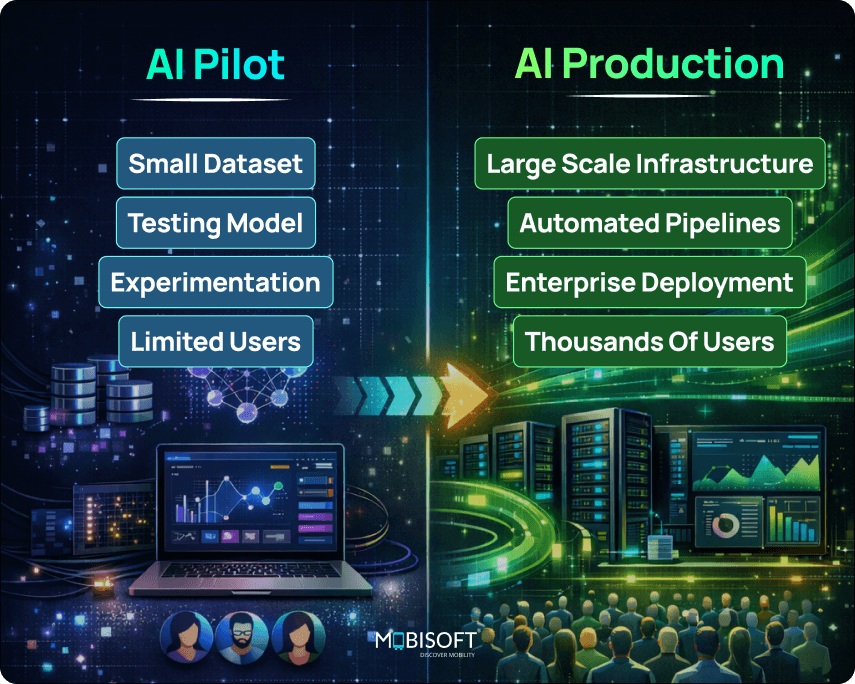
Conventional analysis often points to technical limitations. The real obstacles in 2026 are far more human. Enterprise AI deployment succeeds or fails on what surrounds the model. Production readiness includes technical reliability, operational responsibility, and organizational adoption. The table below shows how a pilot differs from production AI.
AI Pilot vs Production: Key Differences
| Factor | AI Pilot | Production AI |
|---|---|---|
| Objective | Test feasibility | Deliver measurable business value |
| Data | Limited or curated datasets | Governed, changing enterprise data |
| Integrations | Isolated test connections | Secure operational integrations |
| Governance | Limited evaluation controls | Documented policies and oversight |
| Ownership | Project or innovation team | Named business and technical owners |
| Monitoring | Ad hoc testing | Continuous quality and reliability checks |
| Success metrics | Prototype performance | Business impact, quality, cost and adoption |
ROI Blind Spots
Companies frequently judge AI pilots using outdated metrics. They seek direct headcount reduction, a narrow lens that misses Claude's true value. This model can accelerate processes, improve quality, and support complex decision-making. When these contributions are not measured, pilots appear to fail despite their potential benefits.
Data Readiness Crisis
A pilot can flourish in a controlled setting with curated data. It then confronts the chaotic reality of enterprise data environments. Many organizations still lack AI-ready data practices. When Claude encounters siloed, inconsistent, or poorly structured operational data, performance stumbles. The gap between clean test data and messy live data remains a fundamental barrier. Well-designed context pipelines help close that gap, and this guide to context engineering for LLMs explains how.
The Deployment Illusion
Investment often favors technical development, with adoption treated as an afterthought. Enterprises should give equal focus to both. Without deliberate design for how teams will use and trust Claude, even the most elegant solution gathers dust. This imbalance between creation and integration is a classic reason for stagnation.
Uncontrolled AI Usage
Employees in many organizations use unsanctioned AI tools every week. This fragmented activity creates security risks and undermines centralized scaling efforts. It reveals a clear demand that the official pilot has not yet met, allowing disjointed usage to proliferate.
The Governance Lag
As enterprises introduce AI into operational workflows, enterprise AI governance becomes increasingly important. Systems that retrieve sensitive information, call external tools, or influence business decisions require clear access controls, evaluation procedures, monitoring, and escalation paths. The rise of autonomous, agentic workflows adds urgency, because governing these dynamic systems requires a different approach than monitoring static tools. Claude's model-level safety mechanisms, including Anthropic's Constitutional AI approach, can support responsible use. They do not replace an organization's security policies, compliance obligations, or human oversight.
The NIST AI Risk Management Framework and ISO/IEC 42001 give teams a structured starting point, and Anthropic's documentation covers Claude's safety guidance. Clear ownership matters as well. This discussion of who owns intelligence in an AI system shows why.
Ultimately, scaling Claude is a cultural and organizational challenge. The technology is ready. Our business practices are catching up as companies attempt to scale AI in enterprise environments.
How Scaling Enterprises Are Structuring Themselves
Successful enterprises no longer force AI into old frameworks. They redesign their operating model around it, with Claude often serving as the central intelligence layer within enterprise generative AI.
How the Hub-and-Spoke Model Supports Enterprise AI Scaling
A hub-and-spoke AI operating model combines centralized governance with decentralized implementation, which supports scaling AI in enterprises. A central AI team defines shared standards, security controls, reusable components, and evaluation practices. Individual business units apply these resources to their own workflows. They own their specific initiatives and remain accountable for adoption and business outcomes.
This solves a critical problem because central teams cannot possibly meet every unit's unique demand. Claude fits well here as a unified, enterprise-wide model. Business units customize their application within governed parameters, ensuring consistency and reducing fragmented model management.
For example, an enterprise AI team might maintain approved model access, integration templates, and evaluation guidelines. The customer support team can then develop an AI-assisted ticket triage workflow using those shared resources while retaining ownership of service quality and escalation procedures.
The Enterprise AI Studio
This central hub often manifests as an internal AI Studio. It is less a development shop and more a library of certified, reusable assets.
Think of it as a curated repository for proven Claude prompts, workflow templates, and integration patterns. A marketing team can deploy a compliant copywriting agent much faster by building atop this foundation. The Studio speeds delivery and applies quality and governance standards consistently. Organizations that want outside support can explore generative AI development services to build these assets.
Human-Agent Coordinators
- AI Workforce Managers coordinate teams where Claude agents and humans collaborate. They assign tasks based on complexity, risk, and required judgment.
- Prompt & Workflow Engineers build and maintain the organization's library of conversational patterns and agentic sequences for Claude.
- Quality Stewards monitor output for alignment, bias, and compliance across all live deployments.
- AI Adoption Leads translate technical potential into business routine and manage the change curve for each department.
Winning organizations treat Claude AI adoption as a workforce redesign program. They are architecting a new way of operating, with Claude embedded in its core. Entry-level roles are being reconsidered as Claude handles routine cognitive work, allowing human talent to focus on higher-order analysis and creativity. The structure enables scale.
MCP as Enterprise AI Infrastructure
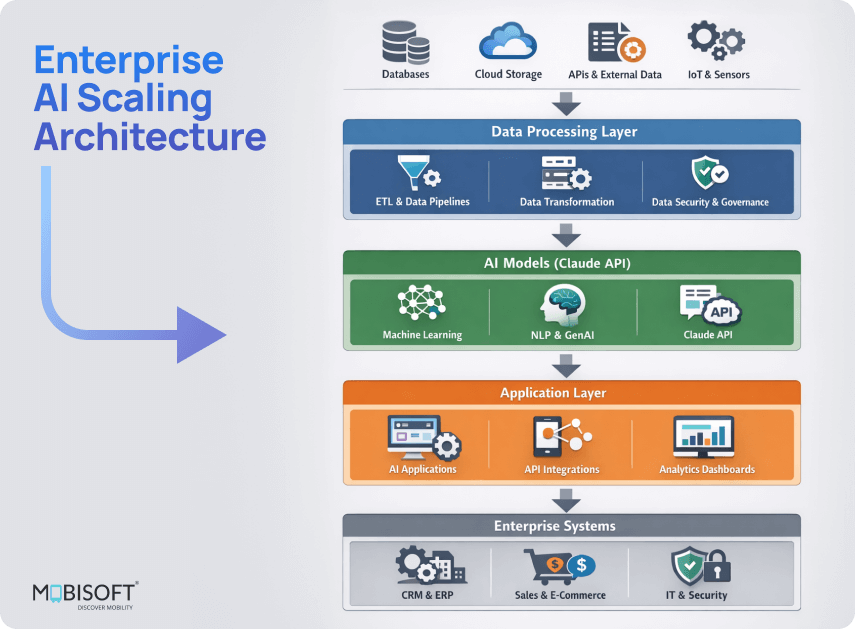
What Is Model Context Protocol (MCP)?
Model Context Protocol (MCP) is an open protocol for connecting AI applications to external tools, data sources, and services through standardized interfaces. In enterprise environments, MCP can help teams build reusable integrations, but security, access control, reliability, and monitoring still require explicit implementation.
Anthropic introduced MCP to simplify connections between AI applications and external systems. Organizations can use MCP-compatible integrations with Claude and other supported AI applications to reduce repeated integration work and create more consistent tool-access patterns. For the full architecture, see the official MCP documentation. For a production view of Claude systems, read this guide to Claude AI architecture for production systems.
The Compounding Effect
Before MCP, each new business unit often demanded a new integration project. Now, a single, governed MCP server for a system like Salesforce can become a reusable asset. Work can compound, because later deployments reuse existing connectors and cost less than the first.
The Hidden MCP Risk
This power creates a new vulnerability: credential sprawl and shadow MCP servers. Teams deploying ungoverned connectors can bypass security controls, creating significant risk. The tool designed for scale becomes a liability without proper AI governance.
Security Considerations for Enterprise MCP Integrations
Teams should put these controls in place before they expand MCP connectors.
- Approved MCP server inventory: Keep a register of every MCP server in use, with a named owner for each.
- Authentication and authorization: Verify who or what is calling each server and what that caller may do.
- Least-privilege access: Give each connector only the permissions its workflow needs.
- Credential management: Store secrets in a managed vault and rotate them on a schedule.
- Logging and monitoring: Record tool calls and review them for unusual activity.
- Tool approval and human oversight: Require a person to approve actions that change data or move money.
- Protection against prompt injection and untrusted tool responses: Treat every tool response as untrusted input, because a malicious document or web page can carry hidden instructions.
Reframing MCP Strategy
Treating MCP as a casual tool builds a technical ceiling. But as a centralized, governed infrastructure, it creates a scaling multiplier. Organizations building this disciplined foundation now are creating a durable foundation for Claude.
Building AI Agents Across Enterprise Systems?
Explore how custom AI agents and secure integrations can support complex business workflows.
Explore AI Agent Development Services
Workforce Readiness and Change Management
The toughest wall to scaling Claude is built by people, not technology. Many enterprises struggle silently with this human dimension.
AI Capability Deficit
- A skills deficit is among the most common obstacles to integration.
- This gap is not about coding. It is about learning to partner with Claude as an agentic colleague.
- Necessary new skills include agent orchestration, workflow design, and ethical oversight of AI-generated outputs.
Training Without Adoption
- Standard training programs create awareness but rarely change daily work habits.
- Employees learn about AI tools in theory but return to legacy processes that have no place for Claude.
- Successful organizations redesign the work itself, embedding Claude AI workflows into core tasks and updating performance goals to require its use.
Adoption by Design
- An effective AI adoption strategy must run alongside technical development, not after it.
- Involving employees in co-creating their own Claude workflows builds essential trust and ownership.
- Functional prototypes for user testing before rollout identify real friction points and build confidence.
- Incentive structures must visibly reward effective human and AI collaboration to motivate change.
- Clear communication about role evolution, not just job security, directly addresses team concerns.
Teams Powered by Claude
- The goal is a collaborative partnership, not a replacement. Claude manages high-volume cognitive tasks.
- This allows human teams to focus on strategic judgment, creative exploration, and complex relationship management.
- A new key performance indicator, human-AI collaboration effectiveness, measures the quality of this integrated partnership.
From AI Metrics to Business Value
Many enterprises measure the wrong outcomes, which in itself prevents scaling. They track activity, not impact. Sound AI ROI measurement starts by separating the two.
Activity vs Impact
Teams often report on AI-centric data like token usage or query volume. These metrics might illustrate workload, but they do not speak to business leaders. They fail to answer the fundamental question of value. When executives see reports filled with technical statistics but no clear connection to organizational goals, funding for Claude AI expansion stalls. This disconnect sustains pilot purgatory.
The Adaptation Dip
Informed organizations plan for a productivity J-curve. They communicate upfront that initial integration will cause a temporary dip as teams adapt and workflows are reconfigured. This expectation prevents the premature abandonment of enterprise AI scaling efforts during the natural adaptation phase. Following this period, performance accelerates, compounding in value as institutional knowledge and reusable Claude assets grow.
Compounding AI Returns
Claude's value compounds as adoption deepens. Early deployments, such as tested prompts, workflow templates, and integration patterns, build the institutional assets. Each subsequent use case tends to deploy faster and at lower cost, leveraging this shared foundation. The scaling journey itself, therefore, becomes progressively more efficient.
Which KPIs Should Enterprises Track After AI Deployment?
| Metric | Measures | Why It Scales |
|---|---|---|
| Decision Velocity | Speed of business decisions with Claude. | Shows strategic impact. |
| Task completion rate | Percentage of eligible tasks completed successfully. | Shows whether workflows hold up beyond the pilot. |
| Cycle time | Time required to complete a business process. | Proves operational efficiency gains. |
| Output quality | Accuracy or usefulness against defined criteria. | Protects trust in the results. |
| Human escalation rate | Frequency of handoffs requiring human review. | Shows where Claude needs more support or oversight. |
| Cost per successful task | Total operating cost relative to completed outcomes. | Aligns spend with business deliverables. |
| User adoption | Actual use within the intended workflow. | Confirms teams rely on the solution. |
| Human Effort Reallocation | Move from routine to strategic work. | Quantifies workforce transformation. |
| Business impact | Changes in revenue, service quality, cost or productivity. | Connects AI activity to executive goals. |
Production AI success should be measured against business outcomes and operational quality, not model usage alone. Teams should establish a baseline before deployment and review performance over time to distinguish genuine improvements from increased AI activity.
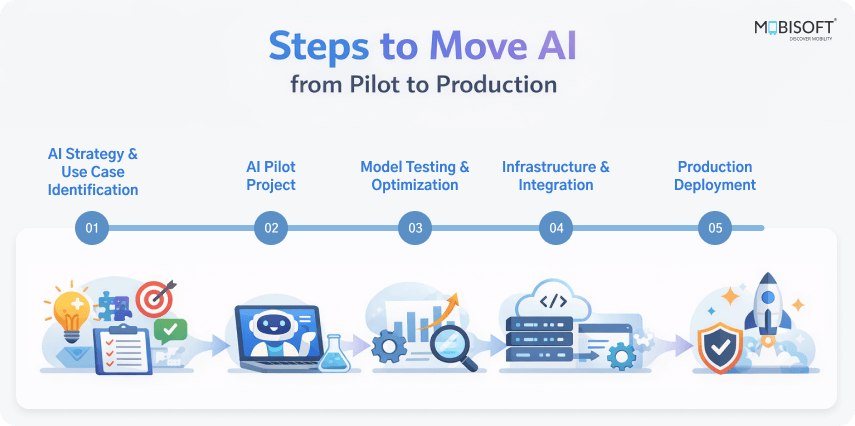
How to Move an Enterprise AI Pilot into Production: 7 Steps
A clear AI implementation roadmap turns the ideas above into action. This AI pilot to production strategy works best when teams complete each step before they start the next. It improves the odds of success, though it cannot guarantee them.
Step 1: Define a Measurable Business Outcome
Identify the workflow problem and select measurable success criteria such as processing time, quality, cost per completed task, or customer satisfaction. For example, a support team might aim to shorten ticket resolution time while keeping customer satisfaction steady. Teams that need help with scoping can use AI strategy consulting services.
Step 2: Assess Data and Integration Readiness
Review data availability, quality, permissions, system dependencies, and integration requirements before expanding the pilot. For example, a finance team should confirm which records Claude may read and who approves that access.
Step 3: Establish Production Architecture
Design the application around appropriate model access, secure integrations, fallback behavior, evaluation pipelines, monitoring, and scalability requirements. A sound AI production deployment plan defines what happens when a tool call fails or an answer looks unreliable. Agent-based workflows need extra care, and AI agent development services can support that work.
Step 4: Implement Governance and Security Controls
Define access policies, data-handling requirements, risk assessments, audit logging, and incident-response procedures. Assign an owner to each policy so that someone answers when a control fails.
Step 5: Set Human Oversight and Escalation Boundaries
Identify decisions that require approval, particularly those involving sensitive information, financial impact, regulatory requirements, or irreversible actions. For example, an AI agent might draft a refund while a person approves any amount above a set limit.
Step 6: Prepare Teams and Redesign Workflows
Train employees, assign process owners, update operating procedures, and test the workflow with real users before broad rollout. A small group of frontline users can expose friction before the wider launch.
Step 7: Monitor Performance and Expand Gradually
Track reliability, output quality, business outcomes, cost, and user adoption. Expand deployment only when predefined production-readiness criteria are met.
Turning Claude into Core Infrastructure
The window for tentative experimentation has closed. We now observe the emergence of a partnership in which human and artificial cognition work together as a single operational system. Moving from AI pilot to production now separates lasting value from stalled experiments. Claude, with its MCP support and constitutional framework, gives enterprises useful building blocks for integration and responsible use. Those building blocks do not replace an organization's own controls.
Use MCP's standard structure to make tool calls and audit trails consistent, which reduces custom integration work. Governance still needs defined policies, access controls, and human oversight. The model's output is secondary to its function as a reasoning interface between your data and your operations. Teams that want hands-on support can explore enterprise AI development services for production implementation.
Scaling Claude means building on shared infrastructure, clear governance, and trained teams. Prioritize workflows where Claude's protocol-level advantages compound. This is how you convert a powerful model into permanent infrastructure.
Some lessons here apply to any enterprise AI program, such as governance, data readiness, and adoption design. Others, such as MCP integration and Claude's safety approach, are specific to Claude.
Planning Your Enterprise AI Rollout?
Discuss your use case, existing systems, and production-readiness challenges with Mobisoft's AI engineering team.

Frequently Asked Questions
Why do enterprise AI pilots fail to reach production?
The AI pilot to production journey often stalls because organizations have not resolved data quality, integration complexity, governance, operating costs, or workflow ownership. A successful demonstration does not prove that an AI application can operate reliably with real users, changing data, and production security requirements.
How long does it take to move an AI pilot into production?
The timeline for enterprise AI deployment depends on the complexity of the use case, data readiness, integrations, security requirements, and organizational approvals. A narrowly scoped workflow may progress faster than a regulated, multi-system deployment. Enterprises should define readiness criteria rather than relying on a fixed timeline.
What is MCP, and why is it useful for enterprise AI?
Model Context Protocol (MCP) provides a standardized way for compatible AI applications to connect with external tools and data sources. Enterprises can use it to support reusable integration patterns, although authentication, authorization, monitoring, and governance must still be implemented and maintained.
How do enterprises measure AI implementation ROI?
Effective AI ROI measurement compares measurable business outcomes with implementation and operating costs. Relevant indicators include cycle-time reduction, output quality, cost per completed task, employee adoption, and customer experience. Measurements should be compared against a pre-deployment baseline.
What is the hub-and-spoke model for enterprise AI?
The hub-and-spoke model supports scaling AI in enterprises by assigning shared AI standards, governance, and reusable infrastructure to a central team while allowing business units to implement approved use cases. It aims to balance enterprise-wide consistency with local ownership, operational expertise, and faster adoption.
When should humans review AI-generated decisions?
Human review is particularly important for high-impact, uncertain, sensitive, or irreversible decisions. Organizations should establish risk-based escalation thresholds, approval responsibilities, and audit procedures. Low-risk workflows may permit greater automation when adequate testing, monitoring, and safeguards are in place.
This content is for informational purposes only and may include AI-assisted research or content generation. While we strive for accuracy, information may evolve over time. Readers are advised to independently verify critical information before making decisions.

Pritam Barhate
Read more
Pritam Barhate, with an experience of 14+ years in technology, heads Technology Innovation at Mobisoft Infotech. He has a rich experience in design and development. He has been a consultant for a variety of industries and startups. At Mobisoft Infotech, he primarily focuses on technology resources and develops the most advanced solutions.
 Pritam Barhate
 March 10, 2026