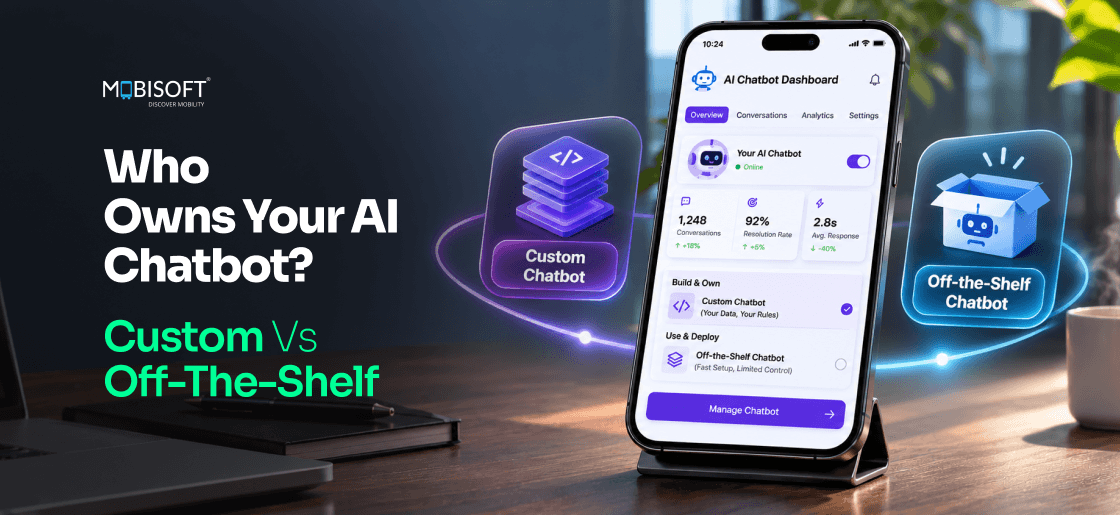
Choosing an AI chatbot is not simply a decision between buying software and building a custom solution. AI chatbot ownership also determines how much control an organization has over its customer data, workflows, integrations, operating costs, and future technology choices.
A subscription chatbot may offer faster implementation, while a custom application can provide greater flexibility and control over business-specific processes. However, building a custom chatbot does not automatically mean owning the underlying AI model.
This article compares the custom vs off-the-shelf chatbot options. It explains what businesses actually own, how ownership differs across deployment approaches, and how to evaluate the long-term costs and trade-offs of each option.
Who Owns the Intelligence in an AI Chatbot?
Ownership depends on the chatbot architecture, provider agreements, and model licenses. For AI chatbot data ownership, businesses generally retain rights to their own data, subject to applicable contracts, while software vendors control proprietary platforms and models. A custom chatbot can provide greater control over application code, prompts, integrations, and workflows without transferring ownership of a third-party foundation model.
Most Chatbot Decisions Are Framed as Tooling Decisions
Many teams start here. They evaluate platforms based on features, price, and deployment speed. They are shopping for a tool. This feels practical and immediate.
Misplaced Priorities
This tooling mindset prioritizes immediacy. It seeks to solve a discrete pain point, like deflecting FAQ tickets, with minimal fuss. The focus rests on the capability of the software itself, not on its deeper relationship with your company's unique processes and data. The question is "what does it do," not "how does it become part of us."
Hidden Operational Costs
Viewing AI as a tool leads to predictable outcomes. You get a discrete application, not an integrated system. It creates another point solution that your team must manually bridge to other systems. This fragmentation generates ongoing maintenance, limits automation scope, and transforms a potential asset into perpetual overhead.
Architecting for Scale
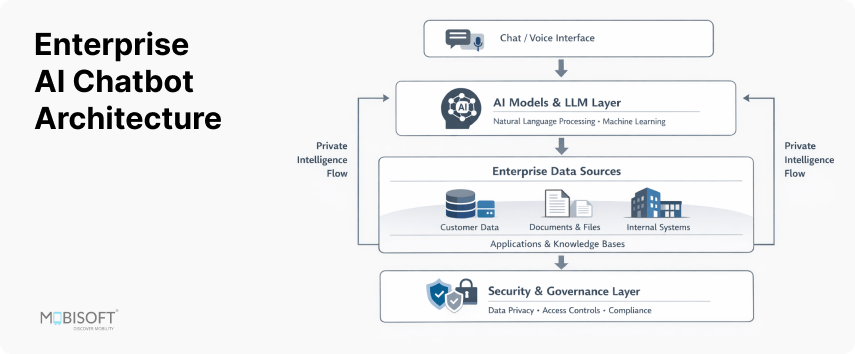
The alternative is to frame the decision as one about strategic infrastructure. You are not procuring a tool. You are architecting a new intelligence layer for your operations. This shifts every evaluation criterion. You now prioritize native integration depth, ownership of logic, and scalability of capability. The goal is not to install software, but to engineer a core component of your business. Sound AI chatbot architecture starts with this framing, and teams planning that layer can explore AI chatbot development services.
AI Chatbot Ownership: What Does Your Business Actually Control?
The matrix compares three common deployment approaches. It separates what the business controls from what the provider controls.
| Component | SaaS Chatbot | Custom Chatbot Using a Model API | Self-Hosted Open-Weight Model |
| Foundation model | Provider controls model | Model provider controls model | Organization hosts model; rights depend on license |
| Application code | Usually vendor-controlled | Generally customer-controlled if contract assigns rights | Generally customer-controlled |
| Business workflows | Configurable within platform | Greater customization and control | Greater customization and control |
| Prompts | Depends on platform and contract | Usually controlled by application owner | Usually controlled by application owner |
| Customer data | Rights and handling depend on contract | Rights and handling depend on contract and provider terms | Greater hosting control; legal obligations remain |
| Evaluation data | Depends on export and contract terms | Can be maintained by customer | Can be maintained by customer |
| Integrations | Vendor-supported connectors | Custom integrations | Custom integrations |
| Model portability | Depends on platform | Possible with adaptation | Depends on model format, license, and infrastructure |
Self-hosting does not automatically transfer copyright or ownership of model weights. Hosting control, usage rights, and intellectual-property ownership are different concepts. License terms also vary by model, and some licenses restrict commercial use.
The practical question is not whether a business owns every component of its chatbot. It is whether the organization has sufficient control over its data, workflows, integration architecture, evaluation process, and ability to change providers when requirements evolve.
Custom AI chatbot development usually means connecting a model API to your own application, and generative AI development services cover that integration work.
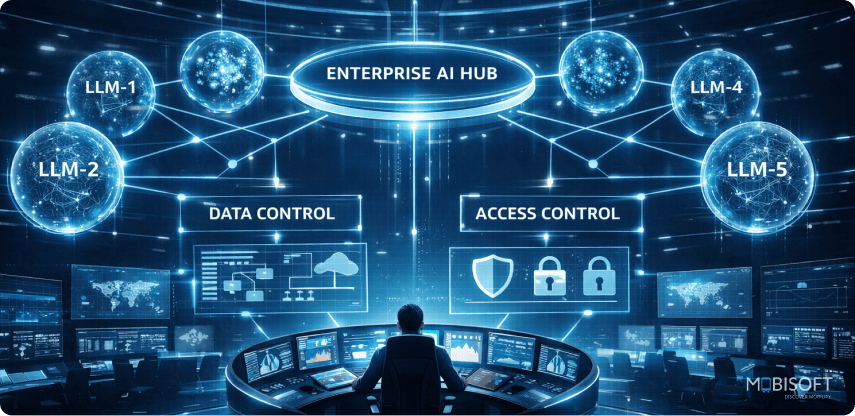
Some enterprises also give teams access to several models in one workspace through an enterprise multi-LLM platform.
Want More Control Over Your AI Chatbot?
Explore how custom chatbot architecture can support your business workflows, integrations, and data requirements.
The Hidden Cost Nobody Budgets For: Integration Debt
That attractive off-the-shelf chatbot promises a quick start. What it does not mention is the integration debt silently accumulating beneath the surface. It builds fastest in AI chatbot integration work.
The New Silo Problem
Your enterprise likely already manages a collection of disconnected applications. Introducing another isolated tool rarely solves this. It often becomes just another silo, forcing your team to build and maintain bridges to your core systems.
The Real Cost: Developer Time
The immediate expense is measured in developer hours. Teams spend effort making an external tool communicate with your CRM or ERP. Data preparation and ongoing API management add unplanned work. These costs are easy to miss in an initial budget.
How Chatbot Integration Debt Develops
Integration debt arises when a chatbot depends on fragile connectors, duplicated data pipelines, manual workarounds, or platform-specific configurations. Over time, these dependencies can increase maintenance effort and make platform changes more difficult.
Continuous Debt vs. Compounding Value
Custom integration presents a different calculus. It requires more consideration upfront. Yet it can build compounding value by weaving the chatbot directly into your operational fabric. The critical difference is this. With generic solutions, integration can become a continuous operational debt, demanding patches and workarounds. Custom integrations need maintenance too, so the debt is smaller only when the design is sound.
How to Reduce Integration Debt
- Use documented APIs and standardized integration patterns.
- Separate chatbot logic from business-system integrations.
- Maintain clear data contracts and access controls.
- Monitor connector reliability.
- Document dependencies and export procedures.
- Test provider-switching scenarios before committing to long-term architecture.
Agentic AI Is Changing What Chatbots Can Do
We are moving from simple chatbots to what is often called agentic AI. In this model, AI doesn't just answer. It acts.
Modern chatbot platforms increasingly offer AI agents, tool integrations, and workflow automation. The main difference between SaaS and custom approaches is therefore not whether agentic capabilities exist, but how much control an organization has over orchestration, permissions, integrations, evaluation, and operational behavior.
Reactive vs Proactive AI
Rule-based bots follow fixed rules and react to requests. Agent-based designs can reason over context and act on it. A custom architecture lets you encode your own business logic into that behavior. This is the core architectural gap.
Workflow Orchestration Layer
Multi-agent systems, where specialized AI agents work together, are becoming more common. A custom solution can orchestrate workflows across your CRM, ERP, and databases. A simpler bot may reach its limit and hand the task to a human.
Beyond Question Answering
You are no longer automating responses. You are automating entire complex processes. Enterprise conversational AI at this level touches many systems at once. The enterprises building custom architectures now are not just solving today's problems. They are preparing for operations where autonomous, intelligent systems carry more of the work.
When Custom AI Agents May Be Appropriate
Custom agent development may be useful when workflows require multiple internal systems, specialized approvals, business-specific rules, or complex operational coordination. Teams in that position can work with AI agent development services.
The Most Valuable Knowledge in Your Company Isn’t Documented
Your company's expertise lives in the minds of your veteran employees, in their nuanced understanding of problems and their intuitive solutions. It is your organization's true intellectual capital. Standard bots, built for common questions, often cannot capture this deep, contextual knowledge.
The Limits of Generic Bots
These tools are designed to find documented answers. They navigate knowledge bases, but the wisdom that comes from experience is often undocumented.
It exists in stories, in past decisions where the reasoning mattered more than the outcome, and in specialized problem-solving patterns unique to your company.
Most off-the-shelf systems have no framework to capture this. It cannot model the 'why' behind a veteran's choice.
Capturing Expert Reasoning
A custom conversational AI changes this dynamic. It can be designed to learn from these interactions.
Imagine a system that engages with experts, capturing their thought processes and contextual nuances during real problem-solving.
New hires could query it not for a manual, but for guided reasoning based on decades of accumulated institutional experience.
Turning Insight Into Value
This moves the function from cost-saving to value creation. It actively preserves the expertise that forms your competitive edge.
While generic tools manage information, a custom solution can curate and perpetuate understanding.
It turns operational memory into a strategic asset, ensuring that vital wisdom remains within the organization, accessible and actionable for the future.
Protecting Internal Knowledge and Customer Information
Before using internal communications, customer conversations, or employee records in an AI chatbot, organizations should assess privacy requirements, contractual restrictions, retention policies, and access permissions.
Start with approved knowledge sources and apply data minimization. Not all internal information should be used for retrieval, model training, or automated decision-making.
Questions to Ask Your Chatbot Provider
These questions test a provider's claims on AI chatbot data ownership and AI chatbot security before you sign.
- Who controls and processes conversation data?
- Is customer data used for model training?
- What retention and deletion controls exist?
- Can data be exported?
- Where is information processed and stored?
- Which subprocessors have access?
- What happens to data when the contract ends?
Standardization Is Efficient, but It Also Makes You Forgettable
Optimizing solely for efficiency often standardizes the very experience you are trying to elevate. When multiple competitors use identical off-the-shelf platforms, their customer interactions converge. Your brand becomes indistinct.
- Many generic bots rely on uniform templates, which can restrict your unique conversational logic and heritage.
- Custom solutions architect dialogue flows that mirror your proven customer engagement principles.
- This encodes your specific escalation pathways and tonal adaptability into the system's core.
- It helps every automated exchange reinforce your brand's particular values and expertise.
- The bot evolves into a consistent digital ambassador, building recognition and implicit trust.
- You protect a key competitive moat by ensuring your automated voice is unmistakably yours.
Consequently, this is a strategic choice, not a technical one. An off-the-shelf bot completes tasks. A custom chatbot, however, deliberately advances your brand's position with every single interaction it conducts. It is the difference between being heard and being remembered.
AI Chatbot Total Cost of Ownership: SaaS vs Custom Development
We must move beyond initial price tags. The true financial picture of a chatbot emerges across years, not quarters. Quick deployment narratives can be misleading. A clear-eyed view of chatbot total cost of ownership reveals a different story.
| Cost Category | SaaS Chatbot | Custom AI Chatbot |
| Initial setup | Configuration and onboarding | Design, development and testing |
| Platform charges | Subscription or usage-based fees | Infrastructure and third-party service charges |
| Model inference | Included or separately billed | API or self-hosting costs |
| Integrations | Connector fees or customization | Development and maintenance |
| Security | Vendor controls plus customer responsibilities | Customer controls plus provider responsibilities |
| Monitoring | Vendor features and internal oversight | Monitoring tools and engineering effort |
| Maintenance | Vendor-managed platform, internal administration | Engineering, upgrades and support |
| Migration | Export and replacement costs | Architecture and model migration costs |
How to Calculate Three-Year Chatbot TCO
Three-year TCO = Initial implementation cost + 36 months of recurring costs + integration and maintenance costs + expected migration or exit costs
A meaningful cost comparison must use the same expected conversation volume, service quality, integration requirements, security obligations, and support assumptions. Custom development can reduce some licensing dependencies but introduces ongoing engineering, infrastructure, evaluation, and model usage costs.
License Costs Over Time
Off-the-shelf platforms often rely on recurring fees that can scale with usage. You are renting capability, not building an asset. Integration costs can also remain. You may still pay for custom connectors and workarounds, in effect paying twice to make a generic tool fit.
The Capability Ceiling
Some platforms limit how much automation you can build. If they handle only straightforward queries, complex and valuable tasks remain manual. You may then invest in additional tools, creating a fragmented and costly patchwork of solutions.
Treating a chatbot only as a software subscription hides part of the cost. Some finance teams assess it as a capital investment instead. A higher initial investment can build lasting capability and control, but only if the organization can sustain the engineering, infrastructure, and evaluation work that follows. Custom builds on a model API also carry some AI chatbot vendor lock-in, because the model provider remains a third-party dependency.
When Off-the-Shelf Chatbots Do Make Sense
A balanced view is important. Generic platforms can be suitable in certain scenarios. The decision is less about right or wrong and more about alignment with specific business needs:
- An off-the-shelf bot works for validating core chatbot concepts without a major capital commitment upfront.
- It can capably manage simple, repetitive information requests that require no deep system integration.
- Smaller organizations with linear processes may find it sufficient.
- It functions as a useful interim solution while you architect a long-term, custom AI strategy.
- The approach struggles when you need nuanced intelligence embedded within complex B2B sales cycles.
- It may need extra review in regulated fields where compliance must be designed into the core logic.
- Any serious multi-platform integration effort quickly reveals the architectural limitations of a generic framework.
- If your customer experience is a key brand differentiator, you may benefit from more control.
Use an off-the-shelf platform for initial learning, then decide whether to transition. This phased move allows you to build strategic custom assets informed by real experience, not just theory. Many enterprises follow this path, as this guide on scaling AI pilots into production explains. The important question is whether you are buying a tool or building a capability.
Should You Build, Buy or Use a Hybrid AI Chatbot?
A build vs buy AI chatbot decision has a third option. The table compares all three.
| Approach | Best Suited For | Advantages | Trade-Offs |
| Buy | Standard FAQ and support workflows | Faster deployment, managed features | Platform constraints, recurring fees |
| Build | Complex integrations and differentiated workflows | Customization, architectural control | Development and maintenance responsibility |
| Hybrid | Organizations needing speed and customization | Combines managed services with custom components | Integration complexity and shared dependencies |
Custom development is not always the better choice. The right decision depends on requirements, operating capacity, and total cost.
Questions to Ask Before Choosing
- How many business systems must the chatbot access?
- Are data residency and privacy requirements important?
- How much customization is necessary?
- Who will maintain the solution?
- What is the expected conversation volume?
- How easily can the business export data or switch providers?
- Which costs will increase as usage grows?
Unsure Whether to Build or Buy?
Evaluate the trade-offs between managed chatbot platforms, custom development, and hybrid approaches.
Explore AI Strategy Consulting
The Decision That Actually Matters
A pre-built chatbot often functions as external middleware. It can sit apart from your core systems, relying on bridges and connectors. This can add latency and recurring maintenance. A custom solution is developed as a native intelligence layer. It uses unified APIs and encodes your business logic in the application around the model. This allows for genuine workflow orchestration, not just programmed responses.
The first option prioritizes rapid deployment. The second is designed for capability compounding, where each new integration increases the system's overall utility and autonomy. You are evaluating a finished product against an adaptable platform.
Ultimately, this is an infrastructure decision. Organizations that control their data, workflows, and integration architecture are better placed to adapt as AI changes. This control is not a feature you can purchase. It is a strategic outcome you engineer by choosing to build a foundational component, rather than outsourcing a point solution. For an enterprise AI chatbot, the stack around the model matters as much as the model. To see how a production system around a model is structured, read this guide to Who Owns Your AI Chatbot? Custom vs Off-the-Shelf.
Planning an Enterprise AI Chatbot?
Discuss your integration requirements, ownership priorities, security needs, and long-term operating model.
Frequently Asked Questions
Who owns the data in an AI chatbot?
AI chatbot data ownership and usage rights depend on the organization's contracts, the chatbot platform, and applicable laws. Businesses should review how providers process, retain, export, and potentially use conversation data. Owning the source data does not automatically mean controlling every copy or derivative stored within a third-party platform.
Does building a custom AI chatbot mean owning the AI model?
No. Custom AI chatbot development using a third-party model API generally gives the business control over its application and integrations, subject to contracts, but not ownership of the underlying foundation model. Self-hosting an open-weight model provides different levels of control governed by the model's license.
How much does a custom AI chatbot cost?
Costs depend on the chatbot's complexity, integrations, security requirements, model usage, infrastructure, and maintenance needs. Businesses should calculate both implementation costs and recurring expenses over several years rather than comparing development costs with SaaS subscription prices alone. A full chatbot total cost of ownership view covers both sides.
Is a custom chatbot better than an off-the-shelf chatbot?
Not always. The custom vs off-the-shelf chatbot choice depends on your needs. Off-the-shelf platforms can be suitable for standard support workflows and faster deployment. Custom development may be preferable for specialized integrations, complex processes, or greater architectural flexibility. A hybrid approach can also work when organizations need managed capabilities alongside custom components.
Can businesses switch AI chatbot vendors later?
Vendor switching is possible in many cases, but the effort depends on data export rights, integration design, proprietary workflows, and model dependencies. Businesses can reduce AI chatbot vendor lock-in by documenting integrations, retaining portable evaluation data, and avoiding unnecessary platform-specific customization.
What is the biggest financial mistake when choosing an AI chatbot?
Move from efficiency metrics towards strategic capability indicators. Measure the reduction in process hand-off points, the increase in fully automated complex workflow completion, and the consistency score for brand-compliant and regulatory-approved responses delivered by a Generative AI Chatbot. These track how the system enhances operational cohesion and institutional governance, not just ticket deflection.
This content is for informational purposes only and may include AI-assisted research or content generation. While we strive for accuracy, information may evolve over time. Readers are advised to independently verify critical information before making decisions.

Nitin Lahoti
Read more
Nitin Lahoti is the Co-Founder and Director at Mobisoft Infotech. He has 15 years of experience in Design, Business Development and Startups. His expertise is in Product Ideation, UX/UI design, Startup consulting and mentoring. He prefers business readings and loves traveling.
 Nitin Lahoti
 February 5, 2026