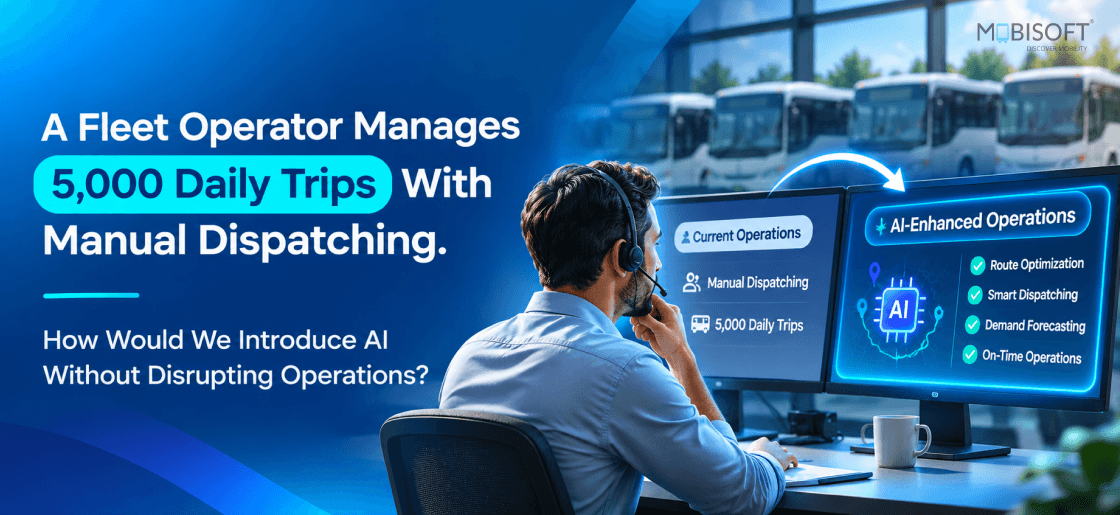
At 5,000 trips a day, one poor dispatch call rarely stays small. One late vehicle can push five later jobs past their windows. That's why AI fleet dispatch automation has to earn trust before it earns savings. The optimisation maths is mature and well proven. What's harder is the data, the integration work, and dispatcher confidence.
We'd suggest one test for any rollout plan. Could your team switch the AI off tomorrow and still run the day? At Mobisoft, we build each AI layer beside your existing dispatch management system. That's what keeps the answer yes. Dispatchers approve every assignment. Your current TMS keeps executing jobs exactly as it does today.
The sections below cover the architecture, a five-phase rollout, and the build-versus-buy decision. You'll also find a worked ROI example and common director questions. Use them to plan an introduction that your dispatchers will barely notice on day one.
Why Manual Dispatch Breaks Down at 5,000 Daily Trips
Most large fleets already run telematics, a TMS, and a route planner. Even so, dispatchers still make thousands of assignment calls by hand. These tools can see plenty, but they don't decide. Fleet dispatch automation targets that missing decision step.
How Much is the Operational Cost?
A skilled dispatcher matches vehicles to jobs quickly. Speed isn't the same as fleet-wide optimisation. Each manual call weighs a few nearby vehicles against one job. It rarely considers the whole queue at once.
Run a one-week time log in your control room. You'll usually find the working day splits into four buckets.
- Initial job assignment and scheduling, which often takes the largest share.
- Reactive rerouting when delays or vehicle faults hit the plan.
- Status calls and messages with drivers and customers.
- Handovers, reporting, and end-of-day paperwork.
The plan itself leaks cost too, and it's easy to miss. In September 2026, Samsara published an analysis of more than 4,000 fleets. About 75% of completed stops deviated from the plan by more than 10 minutes. How far does your own plan drift by mid-afternoon?
| Cost Area | Manual Pattern | AI Fit |
| Vehicle-to-job matching | Nearest suitable vehicle, one job at a time | High |
| Route planning | Fixed plans, slow rerouting under pressure | High |
| Demand and staffing | Rotas built on experience | High |
| Exception handling | Every alert lands on a dispatcher | Medium |
| Routine updates | Manual ETA calls and messages | High |
| Empty return legs | Backhaul spotted from memory | Medium |
| Breakdowns | Calendar-based servicing | Medium |
Why Existing Fleet Software Hasn't Solved It
Each tool you own does its job well. None of them was built to re-decide assignments all day. For example, a perfect morning plan can go stale by 10 am.
- Route planners optimise a known set of stops. Live dispatch never offers a problem that stable.
- Telematics platforms report positions and faults. They describe what's happening without suggesting a next step.
- TMS platforms handle orders, compliance and invoicing. Their routing modules usually rely on static optimisation.
What's missing is a decision layer. AI fleet management adds that layer on top of these systems. It re-solves assignments and routes as conditions change. Your current tools keep running underneath.
What AI Fleet Dispatch Automation Changes for Your Team
AI augmentation doesn't remove dispatchers. It changes where their hours go. Repetitive matching work contracts, while judgment-heavy work grows.
How the Dispatcher's Day Changes
For example, a dispatcher once built 40 collection assignments by hand. Now they review 40 ranked suggestions. Accepting a good one takes a click. Fixing a weak one takes a few seconds.
Freed time moves into work that people handle better than any model.
- Complex exceptions that the AI escalates because its confidence is low.
- Customer conversations about special requirements or disputed ETAs.
- Driver welfare issues and last-minute availability changes.
- Recovery planning when a breakdown hits a run of time-critical jobs.
Framing matters here. Dispatchers who expect replacement won't trust the system. Those who see it absorbing the tedious work will test it honestly. Which version will your team hear first?
Human-in-the-Loop Fleet Automation as a Design Rule
Human-in-the-loop fleet automation means the AI recommends and a person decides. On live trips, nothing moves without a dispatcher's approval. That rule protects the operation while the model learns your fleet.
Analysts do expect autonomy to grow. In March 2026, Gartner predicted something bolder. By 2031, it expects 60% of supply chain disruptions to resolve without human intervention. That's a long-range forecast. It isn't a sensible start for 5,000 live jobs tomorrow.
Gartner also warned in May 2026 about "agent washing" in planning software. The term describes vendors overstating how autonomous their tools are. We'd keep it in mind during demos. Which decisions does the system actually take, and which does it only suggest?
The Five Components of an AI-Powered Dispatch System
An AI-powered dispatch system isn't one model. It's five components that share live data and report to one dispatcher screen. Each can be switched off without stopping the others.
Demand Forecasting and Intelligent Fleet Scheduling
The forecasting engine predicts trip volume 24 to 72 hours ahead. It learns from your trip history, seasonality, and known calendar events. Urban fleets can add weather data as well.
Its output supports the planning meeting the afternoon before. Intelligent fleet scheduling turns that forecast into suggested rotas and pre-positioning moves. Say the model expects a 15% spike in Thursday collections near one depot. Planners can add two early starts there.
We'd recommend starting with this component because a wrong forecast costs little. Planners simply adjust it, as they adjust their own estimates today.
Assignment Optimisation Engine
This engine is where fleet dispatch automation does its heaviest work. It reads the live queue and vehicle status. Then it solves the matching problem across the whole queue. At this volume, it re-solves every 60 to 120 seconds.
It also respects your constraints. Take drivers' hours as an example. In Great Britain, assimilated EU rules cover most goods vehicles over 3.5 tonnes. Daily time at the wheel is capped at 9 hours, rising to 10 hours twice a week. A 45-minute break is due after 4.5 hours behind the wheel. The engine filters out any assignment that would breach those limits.
The output is a ranked list for dispatcher review. Some teams also test AI agents for fleet management that assign drivers within agreed limits. We'd keep those agents in recommend-only mode until override data shows they're reliable.
Dynamic Route Optimisation
Once a vehicle has its jobs, this engine plans the route. It pulls live traffic, incident feeds, and road restrictions from a mapping provider. HERE, Mapbox and Google Maps Platform all offer suitable APIs.
Google's Route Optimization API was formerly called Cloud Fleet Routing. It handles stop sequencing and fleet-wide assignment together. For example, a ring road closes at 7:40 am. Every affected van gets a revised route proposal, and the dispatcher approves each one. That's AI fleet management working inside the human approval step.
Exception Detection and Triage
This component watches the fleet for deviations. Late vehicles, fault codes, and ETA disputes all count. Drivers nearing their hours limit count too. Each event is sorted by severity.
Consider two events arriving at once. A van running eight minutes late triggers a standard customer update. No dispatcher gets involved. A breakdown affecting six later jobs is different. It reaches the dispatcher with a short brief and two or three suggested responses.
Predictive Maintenance
The maintenance module reads engine diagnostics, mileage, and brake wear. It flags vehicles with a rising failure risk before they leave the depot. Your workshop can then book the repair at a quieter time.
A useful model needs six to twelve months of diagnostic history. That's why we'd usually build it last. Does each depot keep its own fault records? Then centralising them comes first.
Designing the Dispatcher Co-Pilot Interface
The interface decides adoption more than any model behind it. A clumsy screen gets ignored, and an ignored system delivers nothing. AI-powered dispatch works when it feels like a faster version of the dispatcher's own workflow. Does your current screen pass that test?
Four Rules for the Co-Pilot Screen
- The AI recommends, and the dispatcher decides. Every suggestion can be accepted, edited, or rejected.
- Confidence is always visible. Each suggestion carries a score and a one-line reason.
- Overriding takes no longer than accepting. One click is enough, with no confirmation box.
- Exceptions come to the dispatcher. Nobody should need to scan a fleet map looking for trouble.
Here's a useful reason line. "Vehicle 847, 3.2 km from pickup, within hours limit, 94% confidence." Dispatchers can judge it in two seconds. Low-confidence suggestions look visibly different, so reviewers know where to slow down.
Why Override Speed Decides Adoption
Picture a busy morning with 30 jobs waiting. If rejecting a suggestion takes three clicks, tired dispatchers start accepting weak ones. The AI hasn't improved. It has simply become harder to argue with.
That's the real risk in a co-pilot design. We'd test override speed with dispatchers before launch. If it's slow, the release waits. Optional reason codes still help, because they feed the learning loop.
The same principle applies to haulage teams. Our guide to trucking dispatch software covers the HGV-specific features worth checking.
Fleet Management System Integration Without Replacing Your Stack
Good fleet management system integration lets the AI read from your tools. Approved decisions then flow back through them. Drivers keep their app. Your TMS keeps executing jobs. Only the source of each recommendation changes.
How to Automate Fleet Dispatch Without Replacing Existing Software
The AI layer typically connects to seven systems. Most links are standard API work, so they're rarely the problem. Effort depends on the age of each platform.
| System | Data Shared | Typical Effort |
| TMS | Orders, SLAs, delivery status | 4 to 8 weeks |
| Telematics and GPS | Positions, diagnostics, hours | 2 to 4 weeks |
| ERP and billing | Contracts, billing triggers | 3 to 6 weeks |
| Traffic and mapping APIs | Live traffic, incidents, restrictions | 1 to 2 weeks |
| Driver mobile app | Assignments, routes, proof of delivery | 3 to 10 weeks |
| Customer notifications | ETAs, delay alerts, confirmations | 1 to 2 weeks |
| Maintenance system | Service history, fault codes | 2 to 4 weeks |
We'd start with read-only feeds from the TMS and telematics platform. That's enough to run forecasting in shadow mode. Write-back comes later, once dispatchers trust the recommendations. For example, an existing driver app can often be extended through its SDK. That's usually faster than building a new one.
Our AI software development services cover this integration layer and the models. The connectors often take more effort than the AI itself.
Why the TMS Write-Back Takes Longest
Writing an approved assignment back into the TMS is usually the slowest task. Has your vendor tested write-back at this volume? Enterprise and legacy platforms have strict validation rules. Their data models are complex. Documentation often covers less than the sales material suggests.
We'd plan for about 50% more integration time than your vendor quotes. We'd also ask an engineer to test the real API first. A two-day technical check can save two months of rework.
Strong fleet management software integration also protects your fallback. If the AI layer goes offline, jobs still flow as before.
How to Introduce AI Without Disrupting Fleet Operations
Every phase in this plan has a safe failure mode. Nothing here can stop a working day. If the AI performs badly, dispatchers ignore it, and work carries on. That's how to implement AI in fleet dispatch operations without a bad Tuesday.
| Phase | Timing | What Changes | If It Fails |
| 0. Data foundation | Weeks 1 to 4 | Pipelines, audit, shadow forecasts | Nothing visible to stop |
| 1. Demand forecasting | Weeks 5 to 10 | Forecasts used in planning meetings | Manual planning continues |
| 2. Partial assignment | Weeks 11 to 18 | Suggestions for pre-booked jobs | Dispatchers override them |
| 3. Full queue and routing | Weeks 19 to 28 | Suggestions for all jobs, live reroutes | Team reverts to manual mode |
| 4. Maintenance and updates | Months 7 to 12 | Failure alerts, automated ETAs | Manual messages resume |
Phase 0: Build the Data Foundation
Dispatchers won't see anything new in this phase. The team connects the TMS and telematics feed to your trip history. Forecasts then run in shadow mode.
The data audit is the key output. For example, you'll probably find missing completion timestamps and GPS gaps. Job IDs that changed during past migrations are common too. None of it blocks the project. Each gap still needs mapping before anyone judges the model.
This phase also includes two weeks of dispatcher workflow sessions. We'd run them as two-way conversations. Dispatchers explain their hardest decisions. The project team explains what the AI will and won't do.
Phase 1: Use Forecasts in Planning Meetings
The forecast first appears in the afternoon meeting that plans the next day. Planners review predicted volume and suggested rotas. They adjust for anything the system can't know.
For example, a verbally agreed collection may not be in the TMS yet. A planner adds it. The forecast error then becomes a training signal. This is the first live test of intelligent fleet scheduling. It's low-stakes, and it exposes data issues the audit missed.
Phase 2: Recommend Assignments for Pre-Booked Jobs
Assignment suggestions now enter live work. They're limited to pre-booked jobs with generous windows. Dispatchers review each one. The TMS handles everything after that.
What does a healthy acceptance rate look like? A rate between 60% and 75% usually means the AI matches dispatcher judgment. Below 40%, the model is probably missing a constraint your team knows. Near-total acceptance in the first weeks deserves a closer look too. It can mean people are approving suggestions without reading them.
For example, suppose acceptance sits at 52% in week three. Read the override reasons before anyone retrains the model. Is the model wrong, or is a key rule missing from the data?
Phase 3: Extend to the Full Queue and Live Rerouting
Suggestions now cover every job category. Is your team ready for that jump? Dynamic rerouting and exception triage go live as well. This is where efficiency gains start to show.
With AI-powered dispatch across the full queue, dispatchers review decisions instead of building them. Say a vehicle fails at 2 pm with four time-critical deliveries aboard. The system proposes a recovery plan, and the dispatcher handles the customer calls. Any dispatcher can still revert to manual mode on any day.
Phase 4: Add Maintenance Alerts and Automated Updates
Predictive maintenance alerts start in this phase. Routine ETA notifications become automatic too. How will customers reply to a message no person sent? It's the first change customers and drivers notice directly.
Customers need to know the updates are automated and where to send queries. Drivers deserve an explanation before anything switches on. Fleet operations automation at this stage is mostly change management. It often takes longer than the engineering.
Build vs Buy: Choosing Fleet Dispatch Management Software
Commercial fleet dispatch management software has matured quickly. The real question is fit. Can a platform handle your constraints and your TMS without heavy workarounds?
What Commercial Platforms Do Well
Several platforms deliver strong routing value out of the box. Which of them already sits in your stack?
- Samsara combines telematics with route planning and dispatch tools. It added AI route planning features in 2026.
- Locus focuses on enterprise logistics and last-mile dispatch. Ingka Group, IKEA's largest retailer, acquired it in October 2025.
- Route4Me and OptimoRoute offer multi-stop route optimisation with live rerouting.
- Descartes serves large freight and 3PL operations with strong ERP integration.
- Motive suits North American freight fleets that need hours-of-service compliance built in.
- Onfleet and Circuit suit smaller last-mile fleets that want fast deployment.
Where Large Operations Hit Limits
At 5,000 trips a day, gaps tend to appear in four places. For example, a cold-chain pharma fleet works to temperature windows. An urban parcel fleet never sees those.
- Fleet-specific rules, such as customer-level vehicle matching or contract SLAs.
- Write-back into a bespoke or legacy TMS data model.
- Industry logic for hazmat, temperature control, or specialist handling.
- A co-pilot screen designed around your dispatchers' actual workflow.
A Simple Decision Framework
| Your Situation | Sensible Route | Typical Timeline |
| Standard fleet, mainstream TMS, routing focus | Commercial platform | 4 to 8 months |
| Complex constraints or legacy TMS | Custom system or platform plus custom modules | 6 to 10 months |
| Multiple depots and several TMS instances | Custom integration layer with commercial solvers | 8 to 12 months |
| Fleet technology company adding AI dispatch | Bespoke engine as a product component | 9 to 14 months |
Which row describes your plans for fleet dispatch automation? If you're torn between two, the constraint list usually settles it.
What AI-Assisted Development Changes
Mobisoft's engineering teams use AI-assisted development for integration code and testing. They also use it to prepare training data. That cuts the engineering cost of a bespoke system by 30% to 40%. Delivery typically takes 7 to 11 months. Traditional builds took 12 to 16.
The economics move with it. At this scale, a platform licence often costs £180,000 to £350,000 yearly. A bespoke build typically needs £250,000 to £420,000 in Year 1. Running it then costs £60,000 to £100,000 a year. Does your fleet have constraints a platform can't model? Then the custom route often wins on cost.
Four Risks That Slow AI Fleet Dispatch Implementation
Most projects underestimate data preparation and dispatcher change management. If you plan for both early, an AI fleet dispatch implementation can finish in 10 months. Miss them, and it can stretch to 18.
Data Quality Is Worse Than Expected
Historical trip data in large fleets almost always has gaps. Have you checked yours recently? For example, GPS dropouts and inconsistent TMS entries are common. So are job IDs that don't match across old systems.
We'd commission the data audit as the very first Phase 0 task. Quantify each gap. Then decide whether to fix it or design around it. It isn't glamorous work, but it'll repay more than any other early task.
Dispatchers Feel Bypassed
Experienced dispatchers are proud of their craft. A system that suggests their assignments can feel like a threat. Wouldn't you feel the same?
Communication campaigns rarely fix it. Genuine involvement does. Human-in-the-loop fleet automation works best when dispatchers help design it. Let dispatchers influence the interface in Phase 1. Staff the Phase 2 pilot with volunteers. Volunteers give honest feedback. They're also the most credible advocates later.
TMS Integration Runs Late
The write-back problem covered earlier is the most common source of delay. A vendor quote based on documentation alone isn't often accurate. Say your TMS vendor quotes six weeks. We'd plan for nine and test the API in week one.
Average Gains Hide Uneven Results
For example, pre-booked jobs with wide windows usually see the biggest gains. Gains are smaller on last-minute bookings. They're also smaller on tightly sequenced multi-stop loads.
A blended average can mislead the board. Would a 12% fleet-wide figure tell you that urgent jobs barely improved? We'd report results by trip category instead. That view also shows where the next development effort belongs.
What the ROI Looks Like for a 5,000-Trip Fleet
An AI fleet management business case is easier to measure than most. Fuel, mileage, and SLA penalties already sit in your reports. The figures below form a worked example with illustrative numbers. Replace each assumption with your own baseline.
Worked Example Assumptions
- A UK distribution fleet of 400 vehicles runs 5,000 trips a day.
- It operates 300 days a year.
- Each trip averages 12 km at £0.45 per km.
- The team has 18 dispatchers costing £32,000 each, fully loaded.
- On-time performance sits at 76%.
- About 1% of late trips trigger a £180 penalty.
- Each vehicle has roughly one on-route breakdown a year, costing £600 in recovery.
- Every breakdown disrupts about 4.5 later jobs at £35 each.
Estimated Annual Benefit
- Mileage falls 8%, saving 4,800 km daily and about £648,000 a year.
- On-time delivery rises to 86%. That avoids about £270,000 in penalties.
- Dispatcher workload drops 20%, freeing 3.6 FTEs worth about £115,200.
- Predictive maintenance cuts on-route breakdowns by 30%, saving about £90,900.
Those gains come from AI-powered dispatch decisions repeated thousands of times a day. They total about £1.12 million a year. Now assume a £320,000 build and an £85,000 annual run cost. Year 1 spend is therefore £405,000.
Phase 3 goes live around month six. So only half the annual benefit lands in Year 1. That's still about £562,000, which covers Year 1 spend. At full run rate, the build pays back in about four months.
Customer retention isn't counted here. Why leave it out? Better on-time performance protects contracts, but it's hard to prove in advance. We'd show it as upside in the board paper.
What to Measure at Each Phase
- Average kilometres per trip, tracked by trip category.
- On-time delivery rate against each customer's time window.
- Acceptance rate of AI suggestions, split into accepted, edited, and rejected.
- Override reason codes, reviewed weekly with the dispatch team.
- Dispatcher hours per 1,000 trips.
- Unplanned breakdowns per week, which only move once Phase 4 is live.
- SLA penalty events per month.
Who'll own these numbers each week? We'd name one operations lead before Phase 2 starts.
Questions Fleet Directors Ask Before Starting
These questions come up in most evaluations of AI implementation in fleet management. The answers assume the phased, human-in-the-loop approach described above.
What Happens If the AI Recommends a Bad Assignment?
The dispatcher rejects it. The AI can't commit a live assignment. A person approves every one. A bad suggestion costs a few seconds of review.
For example, the AI might pick a driver with a known customer conflict. The dispatcher spots it, picks another van, and logs a reason code. That safety depends on override speed. Keep it to one click.
How Do We Introduce AI Into Existing Fleet Management Systems?
Start with read-only links to your TMS and telematics platform. That's the safest fleet management system integration pattern. Run forecasting in shadow mode, then bring it into planning meetings. Add live suggestions only after the data audit and dispatcher sessions are complete.
For example, a fleet on SAP TM could connect order data in week two. Live suggestions might not appear until week eleven. The wait is deliberate. It gives your team time to trust the numbers.
What Data Do We Need Before We Start?
You'll need 12 to 18 months of trip history. Each trip needs five fields.
- Origin point.
- Destination point.
- Vehicle assigned.
- Planned departure time.
- Actual arrival time.
GPS tracks and hours-of-service records improve model quality. Vehicle capacity data matters for assignment. Customer SLA terms and diagnostic history support triage and maintenance. Missing items narrow the early scope without blocking the start.
How Long Until We See Measurable Results?
Expect about 20 to 26 weeks until Phase 3 goes live. That's when gains become material. Phases 1 and 2 deliver real but modest gains on fewer trips.
Say a vendor promises full impact in eight weeks. That's usually the time to install software. Operational impact also needs data work and calibration on real trips. Any AI fleet dispatch implementation plan that skips them isn't realistic.
Can It Handle Multiple Depots and Mixed Vehicle Types?
Yes, and complexity usually increases the advantage. A dispatcher sees one depot's vehicles and queue. The engine, by contrast, sees every depot's vehicles at the same moment.
Consider an urgent job between two depots. Depot A has a free van nearby. Depot B has one 12 km further away with a better return load. The engine weighs both in milliseconds and shows the dispatcher why one wins.
Mixed vehicle types don't add much difficulty either. The engine holds your full vehicle catalogue as structured constraints. It checks every vehicle against every pending job in milliseconds.
Where to Start This Month
The safest AI fleet dispatch automation is the kind you can switch off any morning. Build toward that test from the first week.
Which of these three steps could you start on Monday?
- Export 12 to 18 months of trip history. Check the five core fields for gaps.
- Run a one-week time log with two or three volunteer dispatchers.
- Ask your TMS vendor for write-back API documentation, then have an engineer test it.
Mobisoft's free AI Fleet Dispatch Readiness Assessment Kit turns the first step into a half-day workshop. It includes a baseline template and a data quality checklist. You'll also get a constraint scorer and a change management playbook. Download it at www.mobisoftinfotech.com/fleet-ai-kit.
Once your baseline's ready, book a 90-minute Discovery Session with our fleet AI engineering lead. You'll get a written architecture recommendation and a TMS integration plan. Both use your own numbers.

Frequently Asked Questions
Can AI dispatch eventually approve routine jobs without our dispatchers?
Yes, but you'll earn it in steps. Pick one low-risk class, such as pre-booked collections with wide time windows. Allow auto-approval only after weeks of steady acceptance. A daily cap and one-click revert keep human-in-the-loop fleet automation intact for urgent jobs.
What driver privacy rules apply when we use AI for dispatch?
Under UK GDPR, GPS tracks tied to a named driver count as personal data. Large-scale monitoring like that usually triggers a data protection impact assessment. Don't switch on any feed before it's complete. Then restrict who can see individual driver scores.
How do we keep our AI dispatch forecasts accurate after launch?
Compare each forecast with actual trips, depot by depot, every week. A steady gap often means a new contract or depot. Retrain on those misses and on override reason codes. Review rotas from intelligent fleet scheduling each month, since demand moves.
How would Mobisoft Infotech keep our dispatch running if AI fails?
We'd add a heartbeat check that flags any silent feed. If the AI layer itself goes down, your TMS keeps running jobs. The system freezes live reroutes and holds the last approved plan. A dispatcher gets alerted through your fleet management system integration.
How do we test dispatch vendors using our trip data?
Give each vendor the same anonymised week of real trips from your TMS. Plant one trap, such as a depot that's closed Sundays. Compare each replay with what dispatchers chose that day. Score fleet dispatch management software on how closely it matches them.
Which in-house roles do we need to implement AI dispatch?
Name four people before starting any AI implementation in fleet management. An operations lead owns the weekly numbers. A data engineer opens access to the TMS and telematics feeds. Two senior dispatchers test every release, since they'll use it.
Can Mobisoft Infotech capture the unwritten rules our dispatchers follow?
We'd run constraint workshops with your senior dispatchers. They know things no system holds, such as a low bridge. Each rule becomes a hard limit or a soft preference. Override reason codes then reveal missing rules once AI-powered dispatch goes live.
Which safeguards protect our TMS when an AI layer connects?
Start with read-only credentials, so the AI can't change your TMS. Give each connector its own key with minimum permissions. Log every suggestion and override against a named user ID. Review those logs monthly with your security lead.
This content is for informational purposes only and may include AI-assisted research or content generation. While we strive for accuracy, information may evolve over time. Readers are advised to independently verify critical information before making decisions.

Nitin Lahoti
Read more
Nitin Lahoti is the Co-Founder and Director at Mobisoft Infotech. He has 15 years of experience in Design, Business Development and Startups. His expertise is in Product Ideation, UX/UI design, Startup consulting and mentoring. He prefers business readings and loves traveling.
 Nitin Lahoti
 November 25, 2026