
The most expensive line item in many manufacturing budgets is not equipment. It is an underutilized capability already embedded in the system.
Across facilities reporting strong utilization and stable demand, actual throughput still trails what the installed base should theoretically deliver. Equipment effectiveness varies by product mix, production efficiency fluctuates across shifts, and small coordination gaps compound into measurable output loss in modern smart manufacturing solutions environments.
Manufacturing capacity optimization at this level is more about system precision within smart manufacturing solutions environments. Capacity is constrained by sequencing logic, constraint interaction, startup stability, and decision latency. When these elements drift out of alignment, effective output declines even while machines remain occupied.
The opportunity is structural. By interrogating system-level throughput and aligning operational execution around true constraints, manufacturers can release significant latent capacity without new capital expenditure or extended ramp-up timelines, increasing manufacturing output without new equipment.
To see how structured execution frameworks enable this shift, explore our approach to smart manufacturing solutions.
The Invisible Factory: Why Significant Capacity Disappears
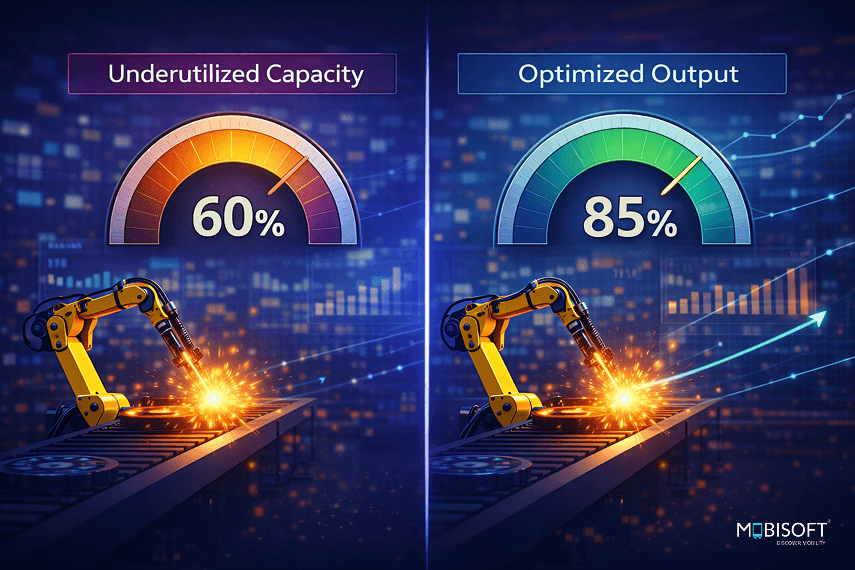
Hidden capacity rarely sits inside a single metric. It resides in how constraints interact, how transitions are structured, and how teams coordinate under pressure. A sharp diagnostic must therefore examine system behavior, not isolated performance numbers within ongoing Manufacturing digital transformation initiatives.
Lens 1: The Constraint Architecture
- View the constraint as a network condition, not a single machine. Product mix, supplier timing, and maintenance windows can reposition the true throughput limiter across shifts in complex industry 4.0 solutions environments.
- Run a stress test: if the current bottleneck doubled its speed tomorrow, which approval gate, process, or material dependency would restrict flow next?
- Track WIP accumulation and starvation patterns. Imbalanced buffers often indicate planning logic that alternately floods and starves the real constraint, making it harder to unlock hidden manufacturing capacity.
Lens 2: The Changeover Economics
- Evaluate changeovers as economic decisions. Duration matters, but frequency and sequencing logic often exert greater influence on manufacturing throughput within structured technology-driven manufacturing optimization programs.
- Challenge batch assumptions. Large runs may stabilize utilization while increasing inventory risk and reducing schedule responsiveness.
- Analyze transition clustering across the planning horizon. Smarter sequencing can lower total changeover burden without shortening individual setup steps.
Lens 3: The Cross-Functional Coordination Index
- Compare planned schedules with actual execution windows. Persistent deviation signals coordination gaps rather than equipment limits.
- Identify friction between production, maintenance, and quality priorities. Local risk optimization often suppresses system-level output even in facilities deploying industrial automation solutions.
- Measure decision latency. Delayed confirmations and reactive interventions compress effective production time, even when equipment remains available.
See how connected systems powered by industrial IoT solutions reduce coordination gaps across production environments.

The Data Infrastructure That Makes Hidden Capacity Visible

Capacity decisions are only as strong as the timing and structure of the data on which they are based. Visibility alone is insufficient. What matters is whether information arrives early enough and in the right context to influence throughput through data-driven manufacturing.
Real-Time Flow Data
Effective manufacturing analytics begin with live production counts, not end-of-shift summaries. Downtime must be categorized by root cause, not merely logged by duration. Quality signals should be tied to specific process parameters so deviations can be traced before they scale. Schedule adherence, measured continuously, exposes gaps between planning assumptions and operational reality. This level of precision enables data-driven manufacturing instead of retrospective explanations.
Decision-Point Visibility
Monitoring systems report what happened. Decision-support systems indicate what to adjust now. Decision-point data focuses on moments where sequencing, maintenance timing, or batch sizing can still be influenced. Reducing decision latency directly increases manufacturing throughput because corrective action occurs within the same production window.
Discover how intelligent AI solutions for manufacturing enhance predictive decision-making at critical constraint moments.
Closed-Loop Execution
Smart manufacturing does not require sweeping transformation programs. It requires a closed loop: data capture, structured analysis, targeted intervention, and impact validation. When this cycle becomes routine, hidden capacity analysis moves from periodic review to continuous operational discipline within advanced Smart manufacturing solutions frameworks.
Learn how advanced manufacturing data analytics frameworks turn real-time plant data into measurable throughput gains.
The Capacity Unlock Playbook: Four Levers That Release Trapped Output
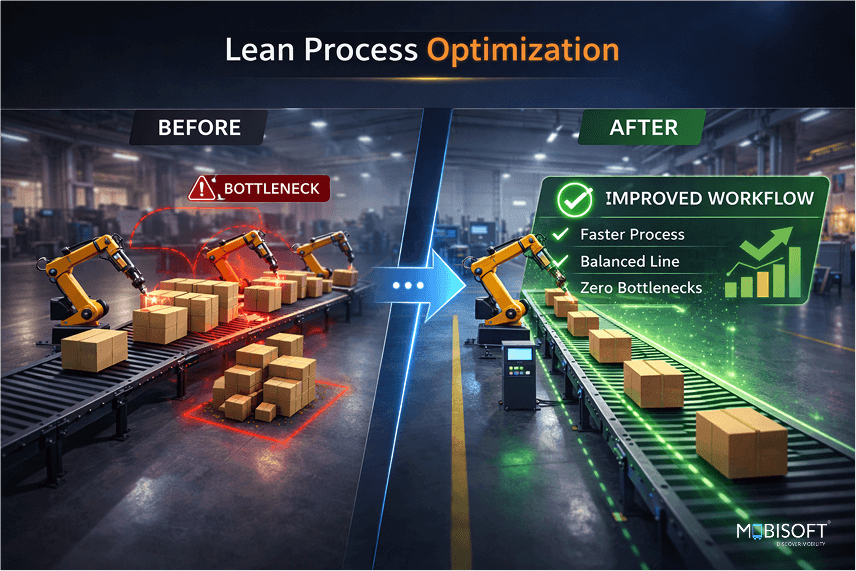
Once hidden capacity is visible, the question becomes structural: where does disciplined intervention create measurable throughput lift? Output expands when constraint time is protected, transitions are rationalized, maintenance is synchronized, and startup variability is compressed. The following levers focus on stabilizing the hours that truly determine weekly volume in smart manufacturing solutions environments.
Lever 1: The Constraint Schedule
- Design the weekly plan around the constraints’ available hours, not around total installed capacity. Every non-constraint activity must support its cadence within broader manufacturing process optimization efforts.
- Introduce time buffers before the constraint rather than inventory buffers across the plant, protecting flow without inflating WIP.
- Typical rollout: one pilot line over a month.
- Risk: senior overrides that disrupt constraint sequencing for short-term order expedites.
Lever 2: The Changeover Portfolio Strategy
- Audit transition patterns over a quarter to identify repetitive sequencing decisions that inflate total setup burden. Often, calendar logic causes more loss than setup mechanics in advanced industry 4.0 solutions environments.
- Consolidate compatible SKUs strategically, even if it requires commercial alignment on order timing.
- Typical rollout: planning recalibration within 6 weeks.
- Risk: optimizing single setups while ignoring cumulative transition load.
Lever 3: The Maintenance-Production Pact
- Rank assets by throughput criticality, not replacement value. Maintenance intensity should reflect constraint influence in facilities deploying industrial automation solutions.
- Move from calendar-based tasks to condition-triggered interventions where data reliability allows, strengthening data-driven manufacturing.
- Typical rollout: phased alignment over 8 weeks.
- Risk: reverting to reactive fixes during demand spikes.
Lever 4: The First-Hour Stability Protocol
- Measure ramp-up loss explicitly. The first production hour often determines rate stability for the remaining shift.
- Standardize material readiness, tooling verification, and parameter confirmation before the formal start time.
- Typical rollout: 3–4 weeks with operator input.
- Risk: treating startup checks as procedural rather than throughput-critical.
Understand how smart asset tracking and real-time insights strengthen maintenance precision and protect constraint performance.
From One-Time Gains to Continuous Capacity Creation
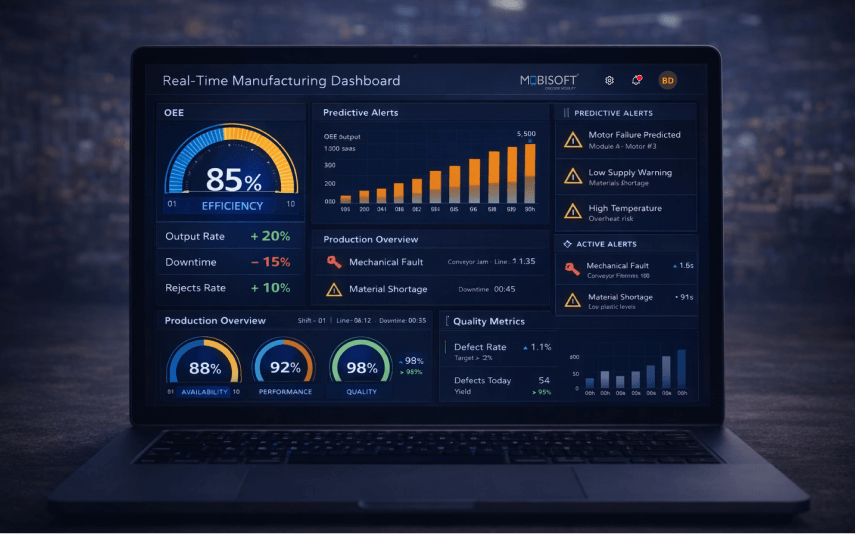
Short-term output lifts are common. Sustained gains are rarer. Capacity expands durably only when the organization builds the reflex to detect, prioritize, and institutionalize improvements before losses reappear during manufacturing digital transformation.
Visibility Systems
Ongoing capacity optimization depends on structured visibility into throughput drivers, not periodic reviews. Real-time performance tracking, constraint monitoring, and schedule adherence analysis must become routine management inputs supported by data-driven manufacturing systems.
Cross-Functional Discipline
Throughput is a shared outcome. Production, maintenance, planning, and quality must evaluate decisions through a common lens: impact on system flow. Formal problem-solving forums, anchored in constraint logic rather than departmental metrics, prevent recurring trade-offs that subsequently suppress output across integrated smart manufacturing solutions landscapes.
Standardized Throughput Work
Improvements degrade when they remain project-based. Documented sequencing rules, startup protocols, and maintenance prioritization standards embed gains into daily operations. Frontline operators play a central role here; their adherence and feedback determine whether manufacturing process improvement becomes a stable practice or a temporary performance. Continuous capacity creation ultimately reflects operational discipline sustained under normal demand pressures and technology-driven manufacturing optimization.
For enterprises operating distributed facilities, here’s how leaders are scaling digital manufacturing across multiple plants without compromising throughput stability.
Conclusion: The Capacity-First Growth Strategy
Hidden capacity is rarely a mechanical problem. It is structural, embedded in planning logic, coordination rhythms, and the protection of constraint time. When those elements are aligned, output expands without additional assets, extended lead times, or capital risk, enabling organizations to increase manufacturing output without new equipment.
Before approving the next expansion proposal, quantify how many constraint hours are truly protected each week. Examine how much startup instability, sequencing friction, and decision delay compress effective throughput. The gap between installed capacity and realized volume is often measurable and recoverable when leaders focus on how to unlock hidden capacity in manufacturing.
A capacity-first strategy strengthens margins, improves responsiveness, and delays unnecessary capital exposure. More importantly, it builds an operating system that scales intelligently. Growth then becomes a function of discipline and visibility, not equipment count. Explore how IoT mobile apps and connected technologies enable real-time plant-wide visibility and faster operational response
Key Takeaways
- Most plants operate below effective manufacturing throughput due to structural and coordination losses, not equipment shortages, even within advanced smart manufacturing solutions environments.
- Constraint hours, not total installed capacity, determine realizable output and revenue scalability in modern manufacturing digital transformation programs.
- Changeover frequency and sequencing logic often suppress capacity more than the individual setup duration, limiting broader manufacturing process optimization efforts.
- Startup instability and first-hour loss materially compress weekly production volume in complex industry 4.0 solutions settings.
- Decision latency reduces effective equipment effectiveness even when machines remain mechanically available, weakening the data-driven manufacturing impact.
- Real-time, decision-point data enables corrective action within the same production window across integrated industrial automation solutions.
- Cross-functional alignment is essential to protect constraint stability and prevent throughput erosion when organizations aim to unlock hidden capacity in manufacturing.
- Sustainable capacity gains require standardized operating logic, not one-time efficiency projects designed only to increase manufacturing output without new equipment.

Frequently asked questions
How can we estimate hidden capacity without launching a full-scale consulting project?
Start with a constraint-hour audit. Compare theoretical constraint availability with actual productive hours after changeovers, startup loss, and unscheduled stops. Then quantify schedule adherence and first-pass yield at that constraint. This focused review often exposes double-digit throughput gaps without complex modeling.
What financial metrics should validate a capacity-first strategy?
Link throughput gains to contribution margin per constraint hour rather than overall utilization. Evaluate working capital impact from smaller batches and reduced rework. When hidden capacity converts into sellable output without fixed cost expansion, return on invested capital typically improves faster than revenue alone.
How do we prevent commercial teams from disrupting constraint stability?
Introduce order acceptance rules tied to constraint load. Sales commitments should reflect real-time capacity signals, not aggregate plant utilization. Structured cross-functional reviews can align pricing, delivery promises, and sequencing logic so revenue growth does not destabilize throughput performance.
Is hidden capacity realistic in highly automated plants?
Yes. Automation reduces variability at the task level but does not eliminate sequencing errors, coordination delays, or startup inefficiencies. In fact, tightly coupled systems amplify the cost of misalignment. Even advanced facilities often underperform relative to their engineered cycle rates.
How should we approach hidden capacity in multi-plant networks?
Analyze capacity at both the site and network levels. A local constraint may not be the network constraint. Strategic load rebalancing across plants, aligned with logistics cost and service levels, can unlock system-wide throughput without adding assets.
What early signals indicate that hidden capacity has been exhausted?
Stable constraint utilization above planned targets, consistent first-pass yield, minimal schedule deviation, and compressed startup loss across shifts suggest structural limits are approaching. At that stage, incremental gains decline and capital investment decisions become more economically justified.

Nitin Lahoti
Read more
Nitin Lahoti is the Co-Founder and Director at Mobisoft Infotech. He has 15 years of experience in Design, Business Development and Startups. His expertise is in Product Ideation, UX/UI design, Startup consulting and mentoring. He prefers business readings and loves traveling.
 Nitin Lahoti
 February 27, 2026