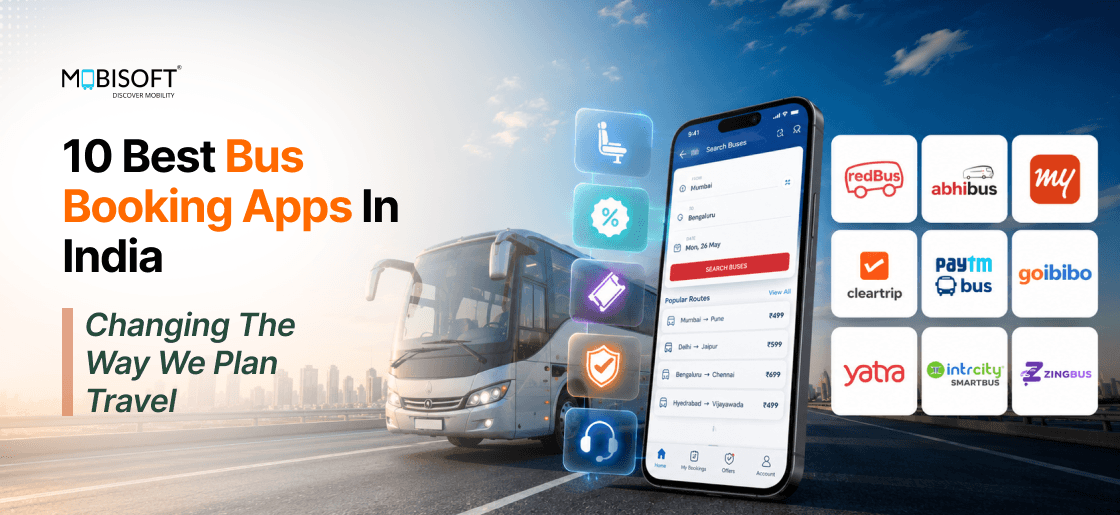
Booking a bus in India used to be a hassle till a few years ago. Stand in a queue outside a counter, or redial a booking office for the third time without the guarantee of an answer. A lot of that has improved gradually.
A chunk of that process has disappeared because bus booking apps in India got good enough, fast enough, that going back to a counter started to feel absurd. We've followed this space for a while now, on and off, and what keeps catching us off guard is the pace. redBus's own BusTrack numbers put intercity bus travel at roughly 140 million passengers between April and September 2025, a jump of about 25 percent from the year before. Small industries don't move like that.
What follows is the current list of the best bus booking apps in India. Some of the biggest names from a few years back are either obsolete or exist under a different owner entirely, and pretending otherwise doesn't help anyone booking a ticket tonight. If you're a traveler weighing online bus booking apps against each other, or you're the kind of founder who reads these lists to understand bus booking software before building something of your own, we tried to write the version of this piece we'd actually want to read.
Business Models Behind Bus Booking Apps
Two models, more or less, explain everything in this industry, and once you see the split, a lot of the smaller decisions each app makes start making sense. Most bus ticket booking apps in India fall into one bucket or the other.
Aggregator Model
No buses. That's really the starting point for understanding an aggregator. The company partners with operators who own the actual vehicles, builds the booking layer on top, and keeps a service fee for every ticket sold through it. redBus works this way. So do Abhibus and MakeMyTrip. There's an appeal to it beyond just avoiding maintenance costs, since scaling a software layer is a very different problem than scaling a fleet, and it tends to move faster.
Self-Owned Fleet Model
The other route is simpler on paper and harder in practice. An operator owns its buses already, so it builds a booking app directly on top of what it has. VRL Travels does this. So does SRS Travels. Margins usually come out higher here, mostly because there's no middleman fee eating into each fare, but growth is slower and more expensive, tied to how many physical buses a company can put on the road rather than how many partnerships it can sign.
| Model | Who Owns the Buses | Revenue Source | Growth Style |
|---|---|---|---|
| Aggregator | Partner operators | Service or commission fee | Fast, partnership-driven |
| Self-owned Fleet | The company itself | Direct ticket fare | Slower, capital-heavy |
Plenty of companies don't pick a lane cleanly, either. A fleet operator might run its own app and still list seats on redBus or AbhiBus at the same time, getting the direct relationship and the extra visibility without really giving up much. This blended approach seems to be where more of the market is heading, if we're honest, rather than staying a rare exception.
Leading Bus Booking Apps in India
redBus
RedBus started back in August 2006, founded by Phanindra Sama, Charan Padmaraju, and Sudhakar Pasupunuri. They started with a single bus operator and a handful of seats, but obviously didn't stay that small. The company now describes itself as India's largest online bus ticket booking service, with registered users somewhere north of 20 million and a network touching more than 3,500 operators, at least by its own count.
Older articles about redBus tend to skip past a fairly important detail, which is that it hasn't run as an independent company for years now. It joined the Ibibo Group back in 2013, and MakeMyTrip folded Ibibo into itself completely in 2017. Then, in December 2025, the NCLT signed off on formally merging RedBus India into MakeMyTrip India, so the two now operate as one entity rather than two brands under loosely shared ownership. Ask whether redBus competes with MakeMyTrip today and the honest answer is no, not in any meaningful sense, since they're the same company wearing two names.
There's more to it than bus tickets, too. Hotels, outstation cabs, pilgrimage packages, and a Google Maps integration for inter-city transit data all sit under the same app.
AbhiBus
AbhiBus showed up in 2008 under Sudhakar Chirra, right as India's bus travel market was still figuring itself out, disorganized in a way that's hard to picture now. Its bus reservation app infrastructure earned it a following early on, and AbhiMovies, an onboard movie streaming feature, felt oddly ahead of its time when it launched.
Ownership is really the story worth telling now. Ixigo bought AbhiBus in 2021, and Ixigo itself went public on the NSE and BSE in June 2024, with the stock debuting close to 48 percent above its issue price. Growth hasn't slowed since then either. Seventeen State Road Transport Corporation partnerships by 2025, and bus segment revenue reportedly climbing 47 percent year on year in a recent quarter. Whatever else you say about AbhiBus, it isn't coasting.
MakeMyTrip
It has grown into something much bigger than a bus company. The multi-dimensional company today covers Flights, hotels, trains, curated travel experiences, and buses. Deep Kalra founded it in 2000, initially chasing the US-India travel corridor before India-specific operations launched in 2005. The bus side of the business is much bigger today, due to its acquisition of redBus.
Cleartrip
Hrush Bhatt and Stuart Crighton founded Cleartrip in 2006, building it into a fairly clean, globally-minded travel platform covering hotels, flights, trains, and buses. Flipkart owns the India business now. What's changed more recently, and it's worth flagging since most write-ups miss it, is that Flipkart sold off Cleartrip's Middle East operations to Wego, a Singapore-based travel company, in a deal that came together across 2024 and 2025, while keeping India under its own roof. Bus bookings specifically stay fairly low-profile within Cleartrip's broader travel suite these days, well behind redBus or AbhiBus in visibility.
Paytm Bus Booking
It is actually a well-run digital payments & wallet business, founded by Vijay Sekhar Sharma in 2010. Bus ticketing was introduced later in 2015 through partnerships with existing aggregators. The advantage was a ready inventory rather than having to build fresh inventory. Also, since Paytm offers cashless payments, it could easily fill the unreserved bus segment almost overnight.
The feature is still there, tucked into the Paytm app and travel site alongside flights and trains. Paytm doesn't separate bus revenue in its financial filings, so pinning down current volumes independently isn't really possible, but the booking option itself remains live and functional.
Goibibo
Goibibo runs bus bookings as one more line item inside a much bigger travel app, and it shows. The product sits under the same MakeMyTrip Group umbrella as redBus, so structurally it's a sibling, not a competitor. Booking flows still work, city-specific fare offers still pop up now and then, and nothing about it feels broken. What's missing is momentum. No independent download or revenue data for its bus vertical has surfaced recently, which is itself telling. When a product is genuinely growing, someone usually reports on it. Goibibo's bus feature reads more like a maintained convenience for existing app users than a business anyone's actively pushing forward.
Yatra
From the start, Yatra has positioned itself more towards flights and business travel; bus booking remained an afterthought for it. This remains the case. The bus booking feature is available on Yatra.com. You can book your seat through it, but the lack of apparent effort and development investments that would be seen in the case of redBus or AbhiBus is obvious. There are no new funding rounds related to the bus bookings or new route announcements, which would indicate the company's focus on this area. Understandable as it might be considering the general focus of the business, but it should be considered by those who are looking for the best bus-booking service.
IntrCity SmartBus
IntrCity SmartBus was developed by RailYatri and in 2025 became a true example of a success story within the segment. A Series D round raised about 30 million dollars at a 140 million valuation with A91 Partners as its main investor. This is a clear sign of institutional interest in a company with a strong growth trajectory. FY25 revenue reached about 500 crore rupees, 67% up compared to the previous year, and the company already showed two years of profitability, measured as positive EBITDA. Monthly ridership exceeds 700,000 with about 600 daily runs and cooperation with over 50 operators in 13/14 hubs. The number of installations might not be comparable to that of redBus or AbhiBus, but the economics look really good.
Zingbus
This app is backed by Info Edge, and the trend of the revenues itself makes it interesting. Revenue of FY25 exceeded 150 crore rupees, and nearly 350 crore rupees in FY26, thus doubling the revenues in only one year. But even with 1+ million installations, it is still significantly lower than among market leaders. This is common for a company that is growing actively and not for a mature one. As for the main characteristics of the company, it offers many security options and live tracking of your transportation as its key advantages to appeal to young travelers that expect a technologically advanced approach to bookings rather than a simple ticketing process.
Emerging niche players
A handful of smaller names are worth knowing even without a full profile yet. LeafyBus and FreshBus both show up in IntrCity's own competitive framing, and FreshBus specifically has staked out ground as an electric-bus-focused operator, which is a genuinely different angle than anything else on this list. FlixBus has also brought its international brand into India. None of these three have public financial or download numbers solid enough to rank with real confidence right now, but they're the names most likely to matter more a year or two from now, and ignoring them entirely would miss where some of the real experimentation in this market is happening.
Fleet Operators With Their Own Booking Apps
Not everyone in this space runs on the aggregator model. Some of the country's more recognizable operators run their own booking channels directly, while still listing on third-party platforms at the same time, getting the benefit of a direct customer relationship without walking away from wider distribution.
| Operator | Base | Known For | Booking Channels |
|---|---|---|---|
| SRS Travels | Karnataka | Large fleet, strong South India presence | Website, Android app, aggregators |
| VRL Travels | Karnataka | One of India's largest private fleets | Website, Android and iOS apps, aggregators |
SRS Travels
K. T. Rajashekera founded SRS Travels, and its fleet now runs close to 5,500 vehicles, a familiar sight on Karnataka's highways at this point. Both online and offline booking exist side by side here, including a proper bus reservation system for schedule enquiries as well as seat booking. Running fleets at this scale isn't really possible without solid backend software for fleet management that coordinates vehicles, drivers, and maintenance schedules behind the scenes in ways passengers never see, though the bigger operators have clearly invested in exactly that over the past decade.
VRL Travels
Vijay Sankeswar founded VRL Travels, which now covers over 350 routes connecting close to 100 destinations, and it's frequently described as one of the single largest fleet owners of commercial vehicles anywhere in India's private sector. Aggregator partnerships sit alongside its own booking channels here too. A fleet this size is really a logistics operation dressed up as a travel company, and it depends on bus transportation software to keep scheduling, tracking, and dispatch functioning across hundreds of departures every single day.
Apps for Intra-City Commute
2019 looked pretty different for intra-city shuttles than 2026 does. A couple of names that used to anchor this exact section aren't around anymore in any real form, and repeating old claims about them wouldn't do anyone much good.
Ola acquired Ridlr, once marketed as India's first local transit app, back in 2018. Its features got absorbed into Ola Play, an in-app infotainment and services layer that Ola itself shut down in November 2022. As a standalone brand, Ridlr just isn't active anymore.
Shuttl had a similar fate, in a way. The office-commute shuttle service, once running tens of thousands of daily rides, was acquired by Chalo in 2021 through an all-cash deal, reportedly stemming from the financial strain the pandemic put specifically on daily-commute businesses.
| App | Status in 2026 | What Happened |
|---|---|---|
| Ridlr | Defunct | Acquired by Ola (2018), folded into Ola Play, shut down Nov 2022 |
| Shuttl | Absorbed | Acquired by Chalo (2021), no longer an independent brand |
| Chalo | Active | Live bus tracking and ticketing raised $45 million in 2023 |
Chalo
Chalo's actual focus is live bus tracking and digital ticketing for city and public transit. They also run a separate private office-shuttle business. A $45 million raise in 2023 has helped it expand into more cities since. If Ridlr or Shuttl were what you relied on, Chalo is probably the closest thing running today.
How Bus Booking Apps Actually Work
Worth pulling back the curtain briefly here, since most people use these apps constantly without ever wondering what's actually happening behind the search bar.
A route search isn't pulling from one tidy database somewhere. It's reaching into potentially hundreds of separate bus operator systems, each running its own backend, and stitching all of that into a single search result in real time. That stitching is really the whole value an aggregator brings to the table, and keeping that inventory sync accurate and current is a genuinely hard engineering problem, which is a big part of why bus booking app development tends to be more complicated than it looks from the outside.
Pick a seat, and the app holds that inventory temporarily while payment completes, then confirms things back to the operator's system almost instantly. Underneath that fairly simple-looking flow sits GPS-based live tracking, pricing engines adjusting fares by demand and booking timing, automated refund handling, and, increasingly, predictive systems trying to flag delays before they actually happen. None of it is meant to be visible, honestly. Good bus booking software is built to disappear.
Operators building their own systems, rather than leaning entirely on aggregators, need a stack that handles seat mapping, route and schedule management, payment gateway integration, SMS and push notifications, and often GPS fleet tracking too. That's a real technical lift, and it's exactly why so many smaller operators still choose to list through established aggregators instead of building all of this from scratch.
What to Check Before Choosing a Bus Booking App
With this many online bus ticket booking platforms fighting for attention, a few practical habits go a long way toward avoiding a genuinely bad travel day.
- Route and operator coverage for your specific journey matters more than an app's overall size does. A platform can be enormous nationally and still barely cover your particular route.
- Cancellation and refund terms are worth reading carefully, since they vary a fair amount between operators, even within the same app.
- Reviews for the specific operator tend to say more than the app's own star rating, which usually blends everyone.
- If you've got a connecting flight or train afterward, live tracking becomes genuinely useful, since delays happen often enough that knowing your bus's real position matters.
- Festival season and long weekends eat up seat availability days in advance, so booking earlier than feels necessary is usually the smarter call.
Comparing prices across two or three apps before booking is worth the extra few minutes, too. The same seat on the same bus can carry a different fare from one platform to the next, purely because of how each one structures its commission.
Wrapping Up
This industry has covered a lot of ground since 2019. Some names merged, some vanished outright, and an entirely new set of platforms stepped into the space they left behind. redBus and MakeMyTrip run as one company now. AbhiBus carries ixigo's public-market backing. Ridlr doesn't exist anymore, Shuttl lives on inside Chalo, and IntrCity SmartBus, along with Zingbus, have both carved out real territory in a market that, not long ago, looked fairly settled.
One thing hasn't moved, though. A genuinely hassle-free app is still what separates an easy travel day from a stressful one, regardless of whether it comes from an aggregator or a fleet operator's own bus booking software. Travelers get more choice now, and better tools than they've ever had. And for anyone building in this space, the door is still open, provided they actually know who they're competing against, and why a few of yesterday's biggest names simply aren't part of the picture anymore.

Frequently Asked Questions
Are online bus booking apps safe to use for payments?
Generally, yes, as long as you're sticking to platforms that are actually established. Encrypted payment gateways and tie-ups with regulated banks are pretty standard among the major bus booking apps in India now, not too different from what flight or train booking sites already do. That said, we'd still avoid entering card details over public WiFi, and a quick glance at the payment page for a secure connection indicator never hurts.
Can I cancel or reschedule a bus ticket after booking?
Cancellation policy can be quite flexible, but the amount you will receive back depends on several factors, including timing and even the operator that has sold you the tickets. Some of the operators impose a fixed rate regardless of whether you booked one month before departure or a couple of days ago. In any case, the rescheduling policy is not as uniform.
Why do prices for the same bus differ across apps?
Commission structures aren't identical across aggregators, and some run cashback or wallet promotions that others simply don't offer. Checking two or three apps for the same route before booking is a small habit that occasionally saves real money, particularly on popular overnight routes where the gaps tend to show up most.
Is it better to book directly through an operator's app instead of an aggregator?
Not always, though it depends on what you're optimizing for. Operator apps sometimes shave off a bit of fare since there's no aggregator commission built in, but aggregators generally win on route comparison, refund handling, and support that responds faster. If the route is unfamiliar, an aggregator's reviews and comparison tools usually end up more useful anyway.
What happened to Ridlr and Shuttl?
Ola bought Ridlr in 2018, folded it into a feature layer, and then discontinued that layer entirely in 2022, so the app doesn't exist independently anymore. Shuttl went to Chalo in 2021 and no longer runs under its original name, though Chalo has kept a similar city-transit purpose alive.
How far in advance should I book a bus ticket?
A day or two ahead is typically fine for ordinary weekday travel. Festival periods, long weekends, and popular tourist routes are a different story, since seats on premium buses tend to disappear well before the date, so booking at least a week out is the safer bet during those windows.
Do bus booking apps offer live tracking?
Most of the larger apps do offer some version of GPS-based tracking now, showing the bus's real-time location and an estimated arrival window. How well it actually works varies by operator, since tracking quality depends on the hardware the operator installs, not purely on the app doing the showing.
This content is for informational purposes only and may include AI-assisted research or content generation. While we strive for accuracy, information may evolve over time. Readers are advised to independently verify critical information before making decisions.

Pritam Barhate
Read more
Pritam Barhate, with an experience of 14+ years in technology, heads Technology Innovation at Mobisoft Infotech. He has a rich experience in design and development. He has been a consultant for a variety of industries and startups. At Mobisoft Infotech, he primarily focuses on technology resources and develops the most advanced solutions.
 Pritam Barhate
 March 28, 2019