Leaders often make decisions about their company’s future on polished tables, backed by data on large monitors. Yet the real work, the actual pulse of the company, often lives on a six-inch screen. This is the quiet divide where many well-intentioned plans for change stumble. This blog discusses a different path. The idea of a mobile app as part of mobile app development services is becoming obsolete when viewed as just another IT project. Think of it instead as a philosophy of business, a way to weave agility and intelligence into the very fabric of your operations. When done with purpose, these applications become the central nervous system of a truly modern enterprise. They connect data, people, and processes in a living, breathing system. This approach strengthens digital transformation efforts, helping build a company that is inherently more responsive, more intuitive, and ultimately, more human.
Rethinking Mobile Strategy for Real Enterprise Impact
For years, firms have operated under the idea of a dedicated mobile strategy. It sounds correct, doesn't it? A focused plan to conquer the small screen. But here is the uncomfortable truth. It encourages building isolated digital experiences, which have no connection to your core business. Even though they are nice-to-have extras, they are also often the first thing cut when budgets get tight.
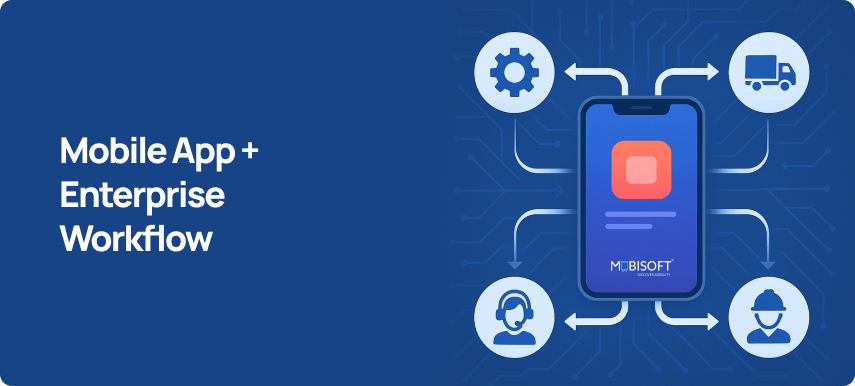
So what question should you be asking? It is not "what app should we build?" The truly revealing question is which of your critical business processes can you liberate? Which tasks fixed to a desk can become context-aware mobile applications in real-time,while being untethered? This question changes the entire conversation. You are no longer discussing features. You are talking about fundamental business capability. You are designing for the way work actually happens now in meeting rooms, on factory floors, and in the quiet moments between tasks.
Explore more about how Mobile App Development Services help businesses transform operations and enhance workforce efficiency.

Building a Real-Time Operational System with Mobile and IoT
For decades, enterprise data often felt like a historical archive. It told you what had already happened, presented in reports on a static screen. That model is breaking down. The modern business environment demands something far more dynamic.
Data as Intelligence
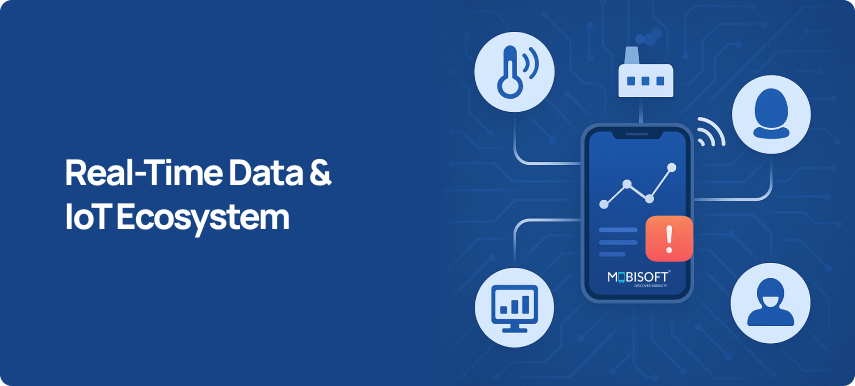
Imagine an operational nervous system instead. Beyond a simple network of devices, it is a living framework that senses, interprets, and reacts in real time. It gives an enterprise its sense of touch and its capacity for immediate response. Enterprise mobile app development places mobile technology at the core of this system, turning sporadic data points into a continuous flow of actionable intelligence. This enables real-time data insights that inform decisions at every level.
From Periodic Audits to Perpetual Awareness
Many organizations still operate on a cycle of check-ins, such as monthly inventory counts or quarterly reviews of asset performance. This creates a lag between perception and reality. A mobile-centric approach, especially when fused with IoT sensors, transforms this entirely. It provides enterprise automation and a state of perpetual awareness. Business leaders can know the exact location and status of any critical asset at any given moment.
Intelligence at the Point of Action
Condensing all business information into a phone screen is not helpful. The aim should be to deliver contextual information when and as needed. A sales representative, for example, receives a curated summary of a client's recent interactions moments before a meeting. These mobile-enabled workflows empower employees at the edge of the organization to make informed decisions without delay.
Dynamic Resource Orchestration
The on-demand model has reset customer expectations. Internally, the same principle applies to resource management. Mobile platforms enable the dynamic orchestration of people and assets. They allow for intelligent, real-time assignment of field technicians based on current location, skills, and available parts. Shared corporate resources, from vehicles to specialized equipment, are managed efficiently through mobile application development services. This reduces downtime and creates a fluid internal economy that responds to real demand.
Learn how Enterprise App Development Services create integrated operational systems that connect data, devices, and people.
The Role of Mobile Apps in Strengthening the Workforce
We often talk about productivity in the abstract. The real goal is something more profound. It is about enhancing human capability. The right mobile application development services do not just make tasks faster they make people more capable, more informed, and better connected to the tools they need.
A Portable Interface
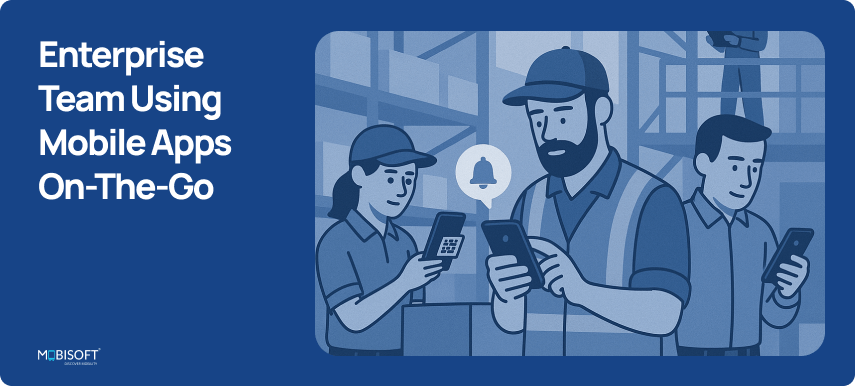
This is especially true for the vast segment of the workforce that does not have a fixed desk. For these individuals, a mobile device is not a secondary screen. It is their primary interface with the company itself. Providing them with a purpose-built application is not a luxury. It is fundamental to operational excellence. This is how you turn a tool into a teammate.
Access to Immediate Knowledge
Traditional training involves leaving the work environment to learn in a classroom. A mobile-first platform flips this model entirely. Learning becomes embedded in the flow of work. An employee can access a quick video tutorial moments before performing a new procedure. This mobile-enabled workflow drastically reduces skill gaps and builds confidence, respecting the employee's time and context.
Capturing Technical Wisdom
A veteran engineer could use a mobile device to create a short video guide for a complex repair. Another might annotate a digital overlay to clarify a tricky assembly process. This builds a growing library of institutional knowledge. Less experienced team members can solve problems they never could before. The application becomes a bridge across the experience gap, contributing to enterprise data intelligence and supporting digital transformation.
This approach transforms the relationship between people and technology. The device in hand stops being a distraction and becomes a lens for focus. It helps employees perform their best work by meeting them where they are, with what they need. It moves the conversation from process enforcement to human empowerment, completing the circle of mobile app development for businesses.
Discover strategies for enterprise-wide digital efficiency with Digital Transformation Services.
How Mobile Apps Build Stronger, Smarter Customer Relationships
For a long time, customer interaction was a series of isolated events. A purchase in a store. A call to a support line. A newsletter arriving in an inbox. These moments felt separate, both for the business and the customer. Mobile app development services change this dynamic completely. It creates the possibility for a continuous, persistent dialogue. The application sits right there in their pocket, a constant touchpoint that builds a deeper, more contextual relationship. This is not about broadcasting messages. It is about listening, learning, and providing value at every single touchpoint.
Think of the application as an always-on focus group. Every interaction provides a silent stream of feedback.
- The features users ignore tell you what is unnecessary.
- The path they take through the app reveals their true priorities.
- The support queries they type indicate where your products or services could be clearer.
This behavioural data is incredibly honest. It offers a raw look at what customers truly want, often before they can even articulate it themselves:
- Beyond feedback, these applications can create self-reinforcing value loops. They build ecosystems that customers never want to leave.
- A financial app does not just show a balance. It analyses spending, offers personalised saving tips, and can seamlessly connect users.
- A retail app moves beyond transactions to track purchase history. It will notify users of new brand release recommendations and sales.
- A fitness application could integrate with other health devices and suggest personalized meal plans from a partner service.
In each case, the application becomes more than a tool. It is an integral part of the customer's daily life and a durable source of value for the enterprise. It strengthens enterprise mobile app development, supports business process digitalization, and transforms the relationship from isolated transactions to continuous, valuable partnerships.
See real-world examples of How IoT Mobile Apps Transform Connected Ecosystems.
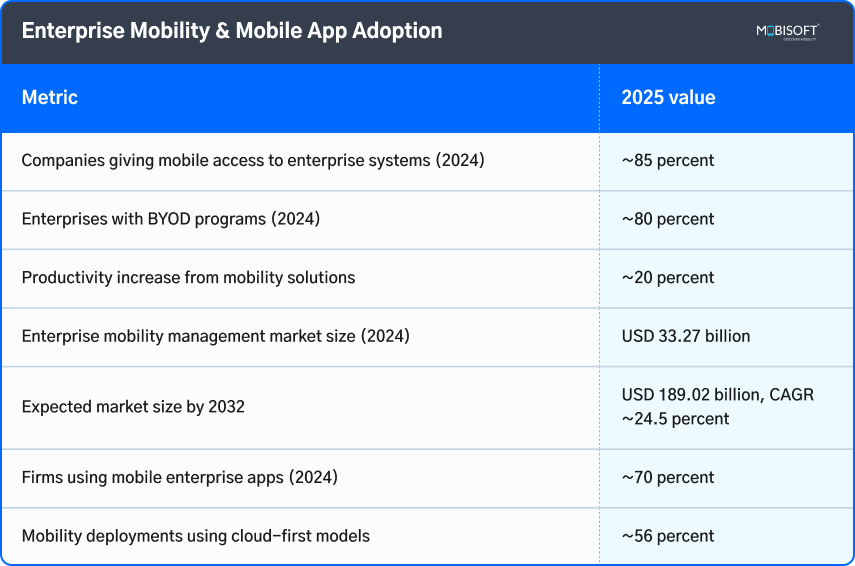
Enterprise Mobility & Mobile App Adoption
How to Overcome the Challenges of Enterprise Mobile Initiatives?
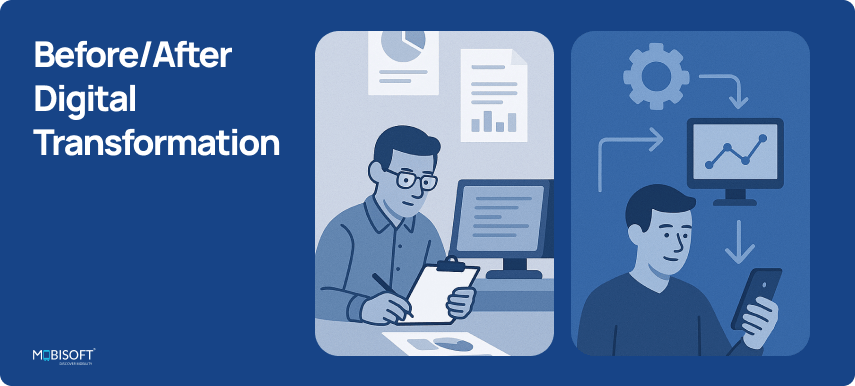
The vision of a seamless, intelligent application is compelling. The reality of its execution, however, is often where ambitious enterprise mobile app development projects meet their limits. Technology is rarely the primary obstacle. The true challenges are typically more human and architectural in nature. They lurk in the gaps between systems and in the difficult balance between convenience and control. Recognizing these hurdles is crucial for digital transformation and growth. It is the first step toward building something that lasts and delivers genuine value.
Integration Constraints
A beautiful app packed with features is useless in practice if it cannot connect to your core business systems. When an application exists in its own isolated world, the information inside it grows stale.
- The real solution is to make connectivity a primary feature from the very start.
- You need to build around a solid API strategy long before the main development even begins.
- The objective is a smooth, continuous conversation between your new mobile interface and the established backend systems, like ERP and CRM.
This ensures enterprise mobility solutions are effectively integrated into your operations.
Adoption Challenges
The human element is often the toughest hurdle to clear. You can develop the most technically perfect mobile application development services solution, yet still fail if your people do not willingly use it. Getting past this obstacle depends on demonstration and persuasion.
- It requires a genuine internal campaign that goes far beyond a basic instruction manual.
- You must communicate the direct advantages clearly, answering that essential question for each person: how does this make my life easier?
- Introducing game-like elements and providing immediate support can convert skepticism into active participation.
- The new process must feel noticeably simpler and more rewarding than the old routine, enabling business mobility solutions to flourish.
Mobile Security Risks
Mobile access naturally creates a security dilemma. The same convenience that gives an app its power also opens new points of vulnerability. A phone can be misplaced; a coffee shop Wi-Fi network is not secure. Addressing this requires a mobile-first digital transformation perspective
- Security cannot be a last-minute addition. It has to be a core ingredient in the application's blueprint from day one.
- The Zero Trust approach of never automatically trusting any user or device, regardless of their location, is a standard practice.
- Permissions to see data or use functions are granted sparingly, checked constantly, and adapted to the situation.
- This strategy safeguards critical business information while maintaining the smooth experience that makes the mobile app development services valuable.
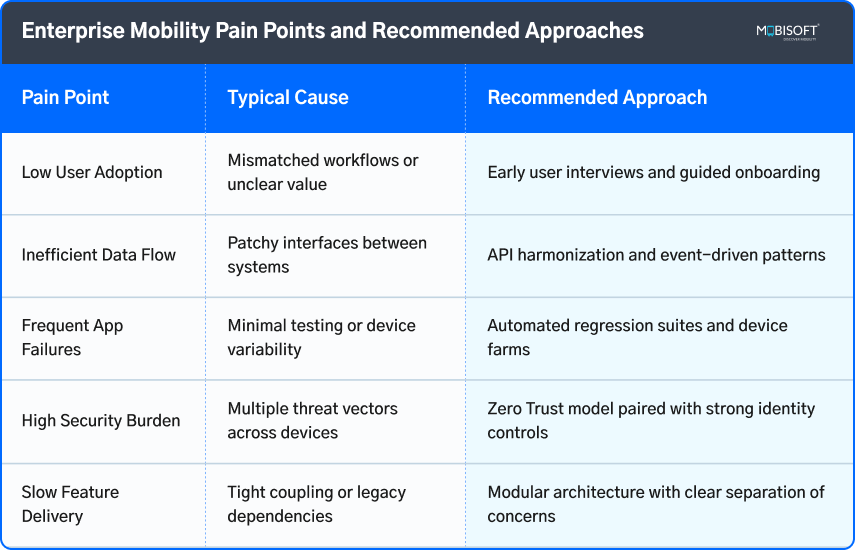
Understand key Enterprise Mobility Challenges and practical approaches for successful adoption.
Enterprise Mobility Pain Points and Recommended Approaches
Mobile-Driven Intelligence for Future-Ready Enterprise
The architectural decisions you make now will define your operational reality for the next decade. The choice is no longer about building an app. It is about committing to an API-first backbone, embedding Zero Trust security into your enterprise mobile app development, and treating behavioural data as a core asset. This means prioritizing deep backend integrations over surface-level features and designing for the deskless workforce from the outset. The goal is to erect that integrated business mobility solution layer we discussed, the one that turns sporadic data into a flowing nervous system. Procrastination here is not delay. It is actively choosing a legacy system. Your competitors are not waiting they are building their responsive, intelligent mobile-first digital transformation today. The future of your operations will be written in the code of these mobile app development services platforms. Make sure you are the author.
Read more on Digital Transformation and Business Innovation to see how mobility can drive long-term enterprise growth.
Key Takeaways
- Stop building mobile strategies. Start building enterprise mobile app development strategies with mobility woven through them like a central nervous system.
- Your goal is to liberate critical processes from the desk, making them context-aware and real-time.
- Think of data not as a historical report, but as real-time data insights that guide immediate action.
- The most powerful mobile application development services amplify your team's expertise, turning devices into indispensable partners for your deskless workforce.
- Your relationship with customers is no longer a series of transactions. It is a persistent dialogue hosted within your application.
- True integration requires an API-first backbone. As a core feature, it guarantees systemic interoperability.
- The hardest battle is not technology, but human adoption. The new workflow must feel easier and more rewarding than the old one.
- Security cannot be an afterthought. A Zero Trust model woven into the app's fabric protects data without complicating the experience.
- Ultimately, your enterprise's future agility is being defined by these architectural choices today.

FAQs
What does an API-first backbone actually mean for our development timeline?
It reallocates time from the middle to the beginning of the project. The initial design and integration phase expands, as engineering teams establish secure, scalable connections to core enterprise mobility solutions. This upfront investment prevents significant technical debt and accelerates all subsequent feature deployments on this established foundation.
How can we justify the investment in a mobile platform beyond basic ROI calculations?
The justification moves from pure efficiency to strategic capability. You should quantify the value of increased operational agility. For example, calculate the financial impact of a process cycle time reduction or the risk mitigation provided by real-time operational systems, which often delivers a greater long-term return than simple productivity gains.
Our legacy systems are robust but monolithic. How do we integrate without a full rebuild?
You start with a single thread by identifying one critical data source. Take live inventory levels, for example, and build a secure API gateway to expose just that information. This allows your mobile app development for businesses platform to pull essential data without destabilising the entire legacy environment. It is an important integration concept and offers minimal risk.
What is the biggest technical mistake companies make when building their first enterprise app?
They architect a standalone solution rather than a scalable platform. This occurs when teams build custom, one-off integrations and user interface components. The correct approach is to develop a reusable library of authentication, data synchronization, and UI modules from the start. Implementing this makes future enterprise mobile app development significantly more efficient.
Can a mobile-centric strategy truly work for industries with strict data compliance regulations?
It can, and often does, strengthen compliance. A properly implemented Zero Trust security model for mobile access provides stricter, context-aware authentication. It offers minute data control that many traditional network perimeter models don’t. This creates a more defensible security posture and generates clearer, more detailed audit trails for regulatory purposes.
We have a mix of company-owned and personal devices. How do we manage this securely?
The solution involves enterprise mobility solutions at the application level. By deploying a modern mobile application development services platform, you can create a secure container or workspace on any device. This method gives the business the security it needs, including the ability for a remote wipe of corporate data, while personal data remains completely separate and private.

Ritesh Patil
Read more
Ritesh Patil, one of the Co-Founders of Mobisoft Infotech, is the Director of Delivery. He has 10+ years of experience that includes Microsoft Technologies, Mobile Application Development, Project Management, Business Development and Account Management. He is an expert in project management and loves traveling and exploring new places.
 Ritesh Patil
 December 2, 2025