Four in five revenue leaders miss their forecast by more than 10%. The warning signs usually exist in the data. A champion stops replying, or a close date slips twice. A weekly review tends to catch either one after the damage is done. Reps also lose 28% of their week to non-selling work.
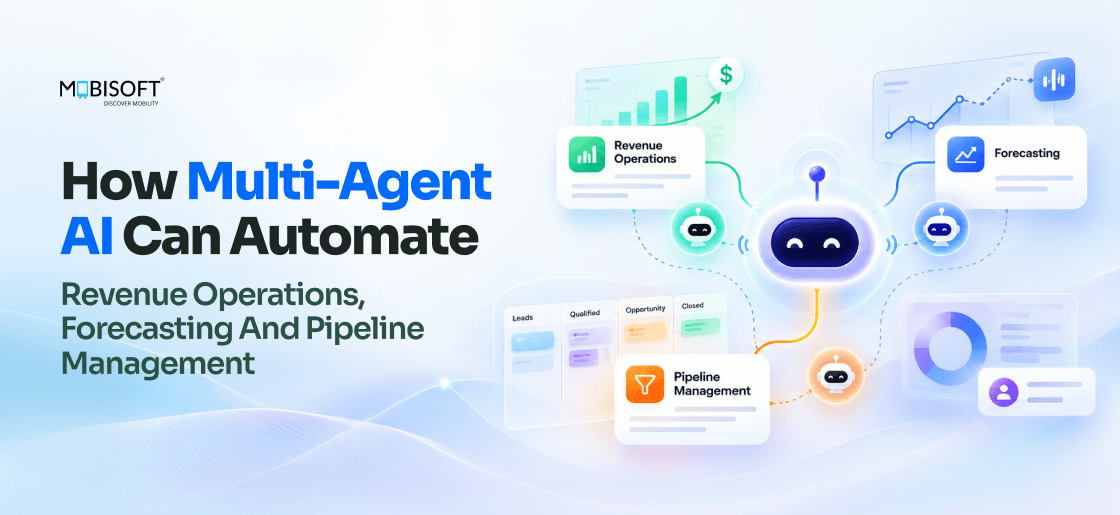
Multi-agent AI closes that delay. A set of narrow agents watches every email thread and call recording. One agent scores deal risk, and another builds the forecast. Two more handle CRM cleanup and rep coaching. They all read one shared record of each deal. A flag from one agent reaches the others within minutes.
This guide covers how such a system works and what each agent does. A worked return model for a $40M ARR company follows. Teams still forecasting on rep optimism can start with the phase zero data audit.
What a Multi-Agent RevOps System Does
Revenue operations is the team that reconciles everyone's numbers. Sales reports one pipeline figure and marketing reports another. RevOps spends hours each week making them match. Every call adds notes, and every stage change creates a row. Most teams cope with spreadsheets and Friday reminders, so the forecast leans on instinct, and the pipeline review finds problems late.
Multi Agent AI Systems
Asking one model to forecast the quarter and also deduplicate 4,000 contacts gets both jobs done badly. A multi-agent system gives each job its own agent and its own limits. The forecasting agent cannot edit a contact record. The CRM agent cannot touch the forecast. Teams usually settle those boundaries early, often through AI development services that map the workflow before any build starts.
How an Agent Differs From a Chat Assistant
A chat assistant waits to be asked. An agent does not wait. A buyer replies after ten days of silence. The agent reads the email within minutes and checks it against the deal history. A supervisor then hands the finding to whichever agent should act. So the weekly review stops being the only checkpoint.
What Counts as an Agent
Plenty of tools call themselves agents. A simple test separates real agents from rebranded scripts.
- It runs on its own and never waits for a prompt
- It has its own data access, limited to what the job needs
- It controls its own reasoning loop
- It can take defined actions, like updating a field or sending an alert
A scheduled script fails the first test. A chatbot fails the second. Both are useful, but neither is a true AI sales agent.
A Monday Morning With the Agents Running
Picture a 30-rep company where the agents ran all weekend. By Monday morning, the forecast already includes Friday's calls. Three deals show risk flags, and one of them was marked commit on Friday. Each flag carries a suggested next step. Two stale close dates were corrected overnight with a note explaining why. The sales director opens the review with decisions because the fact-gathering already happened.
Who Benefits Most
The best fit looks like this.
- ARR somewhere from $5M to $500M
- At least ten quota-carrying reps
- A CRM that reps open daily, even when the data is messy
- One named owner of forecast accuracy, usually a CRO or RevOps director
Results to Expect
Results depend on data quality. Typical ranges look like this.
- Forecast accuracy improves by 15 to 25%
- Rep selling time grows by 20 to 30%
- Win rates rise 18 to 35% on deals that get AI coaching
Numbers like these explain why AI revenue operations now appears on so many CRO agendas.
Where Revenue Teams Lose Money Today
Five problems explain most of the lost revenue. Each carries a price tag that few teams ever calculate.
Forecasts That Miss by Wide Margins
What a Miss Costs
Benchmark research says four in five revenue leaders miss forecasts by over 10%. For a $50M ARR company, that is a $5M swing either way. A $5M shortfall that follows a hiring push puts the headcount plan under board review.
Why the Number Keeps Missing
Reps commit the deals they believe in. Managers add up those commits and call the total a forecast. Nothing checks the number against win rates or deal speed. Buyer engagement never enters it either. Self-reported confidence correlates with actual close rates at just 0.24. That is a weak signal to build a quarter on.
Check Your Own Misses
Pull your last four quarterly forecasts. Put each one next to the revenue you closed. If two of those four missed by over 10%, treat it as a pattern. Better AI sales forecasting swaps rep sentiment for measured signals. Reply speed and days in stage are two of them.
Stale Data and Lost Selling Time
CRM data decays quietly because a close date slips and no one edits it. A champion changes jobs, and the contact record stays the same. A competitor joins the evaluation, and the notes never mention it. By the weekly call, the data is a few weeks old. Analysts put the cost of that decay near $1.9M a year for every $100M of ARR. Most of it hides in deals that an earlier warning could have saved.
Keeping the CRM current also eats the rep's week. Research puts non-selling work at 28% of a typical rep's time. Most of it goes to CRM updates and forecast prep. The rest goes to hunting for the right deck. At $180,000 fully loaded, each rep wastes about $50,400 a year on it. A 30-rep team loses $1.5M of selling capacity. AI sales automation targets exactly that time.
Deals Go Quiet Before Anyone Notices
Most enterprise deals never end with a clear no. They fade over several weeks, and the data shows it early. The first signs usually look like this.
- Emails that go unanswered
- A champion who stops joining calls
- A competitor named in a call transcript
- A decision date that passes with no procurement conversation
A deal that goes quiet after a security questionnaire is a classic case. The buyer's IT team stalls and the rep never notices. Open your pipeline and count the deals with no buyer reply in ten days. That number is the blind spot in your weekly review.
Three Teams, Three Definitions of Qualified
Marketing calls a lead qualified after a demo request. Sales wants budget and a named buyer. Customer success calls an account healthy until the logins stop. The result is a 38% rejection rate on leads that marketing hands to sales. Renewal teams also close accounts that churn within 90 days. The usage warnings never reached their call. Each team measures what its own tool records, so handoffs turn into arguments. A shared data model ends the argument. The agents need one anyway.
What the Failures Cost
The table prices each failure and shows when teams usually notice it.
| Failure Mode | Business Impact | Typical Detection |
| Forecast miss above 10% | $5M per $50M ARR | End of quarter |
| Stale close dates | Inflated coverage ratio | Weekly review |
| Champion goes dark | 2.8 times higher loss risk | 10 to 14 days after last contact |
| Rep time on admin | $50,400 per rep each year | Never tracked |
A scoping exercise with enterprise AI consulting is one way to build this number. The result becomes the baseline for judging every agent.
Multi Agent AI Architecture
Multi-agent AI systems are stacked with six layers.
- Integration bus, the pipe that carries live and nightly data from every tool
- Data normalisation, the step that merges duplicates into one deal graph per opportunity
- Shared memory, where every agent reads and writes deal context
- Worker agents, each with its own tools and reasoning loop
- Supervisor, which routes tasks and settles conflicts
- Output layer, the messages and screens a rep sees
A rep only ever sees the top layer. Most engineering hours go into the bottom three. Everything above them trusts what they hand up.
How Data Flows In and Gets Shared
Events stream in from the CRM and the engagement tools. Nightly batches fill in history, and call recordings and calendars add context. A normalisation step merges duplicates. A contact who lives in three tools becomes one person. The output is a deal graph with one timeline per opportunity.
Every agent reads that graph and writes back to it. When risk climbs on a deal, the forecasting agent sees the change at once. A champion goes quiet, and the coaching agent has a draft email ready within minutes. Without it one agent believes a deal closes in March while another says June. The supervisor ends up refereeing. That is why revenue operations automation breaks wherever the data does.
Transcripts and deal history go into a vector database for semantic search. Pipeline metrics live in a relational database.
Multi-Agent AI Orchestration
The supervisor does no RevOps work itself. It routes tasks and tracks dependencies. It also pulls in a human analyst when confidence drops. A buyer's reply gets handled in minutes. The hygiene sweep waits for the nightly batch. If two agents disagree, the supervisor trusts the one with fresher evidence and logs why.
The Supervisor Loop
Every pass follows the same six steps.
- Ingest new events from the integration bus
- Decide which agents need to act on each one
- Dispatch the tasks
- Collect the outputs
- Resolve any conflicts between agents
- Publish the results to the output layer
What Reaches the Rep
Results arrive inside the tools people already use.
- CRM field updates written back automatically
- Chat alerts for at-risk deals
- Forecast commits ready before each call
- Review briefs for managers
- Executive dashboards showing live coverage and linearity
Delivery inside familiar tools keeps AI agents for sales from becoming one more login.
The Six Worker Agents
Each agent has set duties and its own tools. It also has a clear limit on what it may decide alone.
Forecasting and Pipeline Health
Forecasting Agent
This agent produces two numbers. The first is the rep commit roll-up. The second is an adjusted forecast built from evidence. The distance between them shows where optimism crept in. Here is what feeds the adjusted number.
- Stage, close date, amount, and forecast category from the CRM
- A year of win and loss history covering 200 or more closed deals
- Emails, calls, and meetings logged on each deal in the last 30 days
- Call sentiment and confirmed next steps from conversation intelligence
- Days in stage compared with the historical average for that deal size
- Multi-threading, meaning the number of unique contacts engaged per account
Most teams begin with AI-powered sales forecasting. This agent comes first because the rest feed it. Take a $90,000 deal marked commit. It has spent 41 days in stage against a 28-day average for that size. The adjusted forecast discounts it while the roll-up still shows the rep's call.
Pipeline Health Agent
This agent audits every open opportunity all day. It looks for four kinds of trouble.
- Close dates that have passed or moved more than once
- Stage criteria that were skipped or never verified
- Missing stakeholders, such as no economic buyer or legal contact
- Coverage ratios that fall behind the quarterly target by segment
The rep gets the alert within minutes while the details are fresh. That daily inspection is the core of AI pipeline management.
Deal Risk and Activity Intelligence
Deal Risk Agent
Each open deal carries a risk score that moves as signals arrive. The score weighs these warning signs together.
- Silence from the champion or economic buyer
- A single contact carrying the whole deal
- Close dates pushed more than once
- Competitors named in calls or emails
- Procurement or legal steps that missed their date
Suppose a $60,000 deal depends on one contact. Nine days pass in silence. Then a competitor shows up on a call. Any one signal looks minor. Together they cross the alert line. The rep gets a suggested move instead of a vague warning. Catching trouble this early is the clearest use of agentic AI in sales.
Activity Intelligence Agent
Every email thread leaves a trace. So does every meeting and every document view. This agent reads them together and looks for patterns a person would miss.
- A proposal opened six times by someone who never replied
- A buying committee stuck at two people
- A rival named for the first time on the latest call
Those patterns feed the risk and forecasting agents.
CRM Data and Rep Coaching
CRM Data Agent
Every other agent trusts the CRM, and bad records spoil every result downstream. For that reason, this agent is the quiet foundation of the whole system. It works through a standing list of fixes.
- Filling missing fields from email, calendars, and enrichment sources
- Merging duplicate contacts and accounts
- Logging meetings and calls without rep input
- Flagging records that fail completeness rules for human review
Rep Coaching Agent
Reps meet this agent in their chat tool or inside the CRM. Each message carries one action only. It might say the buyer has been silent for nine days and only one contact is engaged. It then suggests asking for an introduction to finance. Compare that with a generic reminder to follow up. The first gets done and the second gets muted.
Frame every nudge as help with the rep's own deal. A rep who feels watched starts logging fake activity. Send three or four nudges a day at most, ranked by deal value. Past a handful of alerts a day, reps stop reading any of them. Reps trust an AI sales agent that helps with a live deal.
How the Agents Hand Work to Each Other
One event can touch all six agents within minutes. Say a champion stops replying. The activity agent spots it first. The risk agent raises the score while the forecast cuts the deal's weight. The coaching agent drafts an email for the rep and the CRM agent logs the chain. No human asked for any of it.
What Each Agent May Do on Its Own
Write the limits down before launch and revisit them every quarter. Agents can act alone on low-risk work.
- Filling blank CRM fields
- Logging meetings and calls
- Creating tasks for reps
- Drafting follow-up emails for rep review
Anything with outside impact needs a person to approve it.
- Changing a forecast category
- Rewriting a close date on a late-stage deal
- Sending any message to a customer
- Closing a deal as lost
Connecting the Revenue Tech Stack
Most B2B companies run eight to fifteen revenue tools. Each tool has a different API and a different refresh schedule. Reliable multi-agent AI systems for enterprise automation start by mapping every one of them.
Systems the Agents Connect To
- CRM, through REST APIs and webhooks plus a nightly full sync
- Sales engagement tools, refreshed every 15 minutes for email, call logs, and sequence activity
- Conversation intelligence within four hours of each call, for transcripts and sentiment
- Calendar and email every 30 minutes, for meeting history
- Marketing automation hourly, for lead scores and MQL handoffs
- ERP and finance daily, for actuals, invoices, and renewal dates
- Product analytics daily, for usage and health scores
Moving Data Between Tools
The CRM is the hub. Agents reach it three ways.
- Streaming events for instant triggers, such as a stage change
- Scheduled bulk reads for history and nightly reconciliation
- Write-back through the REST API for field updates, tasks, and notes
Agents also pull transcripts and sentiment scores through the conversation platform's API. This plumbing earns no praise, yet AI sales automation stalls without it. A managed streaming service moves events between more than ten systems. A schema registry keeps their formats consistent. Priority rules decide what runs first. A competitor named on a call triggers action at once. Monthly attribution jobs wait for their schedule.
What Your Data Needs Before Kickoff
Models learn from history and agents need clean records. Confirm these basics before kickoff.
- Twelve months of closed-won and closed-lost data
- At least 200 closed opportunities for statistical reliability
- Consistent stage definitions across teams
- Activity capture from email, calendar, and calls
- A named owner for each integration, so broken connectors get fixed fast
Missing items do not block the project. They set the order of work.
Inside the Forecast
A CFO deciding in June whether to hire six reps leans on the forecast. A number 12% too high means a hiring mistake. A number 12% too low means missed growth. AI-driven revenue forecasting exists to remove that guesswork.
Where Rep Roll-Ups Go Wrong
Every rep submits a commit and a best case. Managers add those numbers up and pass the total to finance. The flaw is bias, because reps commit the deals they like and no one tests that feeling against data. A rep with happy ears will commit a deal that has not had a call in two weeks.
Three Models Working Together
Three models run side by side inside the forecasting agent.
- A rep-adjusted historical model that corrects each rep's known bias
- An opportunity-level machine learning model that scores every deal on its own signals
- A time-series model that projects closes from seasonal patterns
Back-testing on history sets the weights for the blend. The ensemble beats any single model and the traditional roll-up. The agent attaches a confidence interval to every forecast. A narrow band means the models agree. A wide band tells leaders to probe before committing spend.
Take a $75,000 deal marked commit. The historical model knows this rep closes only 70% of commits. The opportunity model sees two contacts and falling email replies. The seasonal model sees a slow quarter for that segment. The blend lands below the full commit value, and accuracy climbs with each added layer.
| Forecast Method | Accuracy Within 5% | Human Input |
| Rep commit roll-up | 21% of forecasts | Weekly call |
| Opportunity-level model | 52% of forecasts | None |
| Ensemble of three models | 67% of forecasts | None |
| Ensemble plus deal risk signals | 74% of forecasts | None |
Going from 21% to 74% decides whether leadership trusts the number. Adding deal risk signals to AI sales forecasting accounts for the last seven points.
Watching Forecast Linearity
The agent also tracks how closes spread across the quarter. Healthy quarters book 30 to 35% of revenue in each of the first two months. The remaining 30 to 40% lands in month three. A pile of closes in the last two weeks is a warning because late deals tend to close at lower rates and on worse terms.
Say a weekly report shows 64% of commits landing in the last three weeks. The agent might recommend moves like these.
- Pull procurement forward on the three largest deals
- Offer an end-of-month incentive on two deals that need urgency
- Bring a qualified deal forward from next quarter
Pipeline Management Without the Weekly Scramble
A weekly pipeline review is a long meeting. Managers and reps walk through open deals and argue about close dates. The process eats hours and varies by manager and runs on week-old data. AI pipeline management replaces that cycle with inspection on every event.
Checks That Run on Every Event
The pipeline health agent runs a short set of checks on each new event.
- Does the close date make sense for this stage and this many days in it?
- Is there proof that the exit criteria for the current stage were met?
- Has the economic buyer or a legal contact appeared in any thread?
- Is engagement rising, flat, or falling over the past 14 days?
- Does the account name a rival that the CRM never recorded?
A failed check becomes a task for the rep. Managers see the pattern each Friday in a summary.
Scores and Briefs for Every Deal
A health score from 0 to 100 combines three inputs. Engagement draws on reply rates and meeting frequency, and contact breadth counts too. Stage compliance looks for evidence behind each exit criterion. Velocity compares days in stage with similar deals of the same size. A manager can sort the whole book by that number. Reps see the reasons behind their own scores. That makes sales pipeline management less of an opinion contest.
The score also feeds a brief that the agent builds before each meeting.
- Deal summary with account, size, close date, stage, rep, and days in stage
- The health score and what moved it this week
- Active risk flags and the count of close date slips
- The last three interactions, with dates and short descriptions
- Questions the manager should ask, based on the flags
- One action the rep should take within 48 hours
Briefs change what a review meeting is for. Managers used to spend the first half hour gathering data. With sales pipeline automation doing that preparation, the hour goes to decisions.
Tracking Pipeline Generation
The agent also watches how fast new qualified opportunities appear.
- New qualified opportunities created per week, by segment
- Conversion from first meeting to opportunity
- Pipeline coverage against target, by stage
Suppose early October shows Q4 coverage at 2.8x against a 4.0x target. The agent flags the shortfall on day one and lists fixes.
- Raise SDR outbound sequence volume by 40%
- Re-engage the 24 deals lost in the past 90 days with fresh messaging against the rival that won
- Push the content syndication campaign aimed at enterprise IT buyers
Rolling It Out in Phases
Teams tend to build too many agents at once. They also underestimate data quality and skip the sales team. Sequence matters more than speed when you roll out AI agents for sales.
Phase 0 Is a Two-Week Data Audit
Before anyone writes agent code, audit what you have.
- CRM completeness by field, especially stage, amount, and close date
- Twelve months of win and loss history, with at least 200 closed deals
- An inventory of every integration and its API limits
- A feasibility score for each model you plan to build
Weeks 3 to 24 in Four Phases
In weeks 3 to 8, the CRM data agent starts cleaning records. A forecasting MVP runs beside the rep commit roll-up. It passes if its number beats manual commits by 8%.
Weeks 7 to 14 add activity intelligence and deal risk scoring. Pipeline health and the supervisor arrive in the same window. The first real test is a risk alert that a manager acts on. In weeks 13 to 18, the coaching agent joins. The forecast becomes a three-model blend. Reps start getting daily briefings in their chat tool. Weeks 18 to 24 are for measurement. An A/B test shows whether win rates moved.
Habits of Rollouts That Work
- Fix CRM data quality first, because all revenue operations automation depends on it
- Secure sales leadership backing before reps see a single nudge
- Set target metrics for each agent before launch
- Run every agent in shadow mode for four to six weeks
- Keep a holdout group of deals the coaching agent never touches
- Revisit prompts weekly, because version one is never the best version
Shadow Mode and the Sales Team
In shadow mode, an agent makes recommendations that no one acts on. You compare each call with what happened next. After four to six weeks, you know which agents deserve real authority. The ones that miss stay in shadow until their prompts improve.
The system works only if reps use it. Treat them as partners from day one.
- Involve two or three respected reps in design reviews
- Show each rep what they get back, such as fewer update tasks
- Share early wins in the weekly sales meeting
- Explain exactly which data the agents read
Where These Projects Go Wrong
Most failures trace back to a short list of causes.
- Agents trained on stage history that no one cleaned, so the model learns the wrong lessons
- Alerts sent to every rep at once, which teaches the whole team to mute them
- A forecast shown to leaders before it has been tested beside the commit call
- Write access granted too early, so one bad rule edits hundreds of records overnight
All four are cheap to prevent and expensive to repair after launch.
Build or Buy
A packaged platform suits one company and a custom multi-agent AI build suits another. Stack complexity and data volume usually decide which.
| Factor | Packaged Platform | Custom Build |
| Time to value | 4 to 8 weeks | 16 to 24 weeks |
| Forecast accuracy gain | 15 to 20% | 20 to 30% with company-specific training |
| Three-year cost | $150,000 to $600,000 | $200,000 to $500,000 |
| Data ownership | Vendor-hosted, so read the DPA | Fully owned, self-hosting possible |
Data ownership deserves extra scrutiny in vendor reviews. Read the data processing agreement for retention terms. Look for clauses on model training and deletion.
When a Packaged Platform Fits
A packaged platform tends to fit when these conditions hold.
- Your RevOps process follows standard stage definitions
- You need results within a quarter
- Your CRM is one the platform supports natively
When a Custom Build Wins
A custom build usually wins in these situations.
- Your stage definitions and qualification criteria differ sharply from standard models
- Your sales motion involves channel partners, multiple products, or land and expand
- You hold proprietary competitive or ICP data that must stay private
- You plan to offer RevOps AI as a feature to your own customers
- You need deep product usage integration for a product-led motion
Either path can deliver AI sales agent results when the data foundation is sound.
What the Return Looks Like
Take a hypothetical Series C SaaS company with $40M in ARR. Every assumption below is deliberately cautious.
The Starting Profile
- 20 account executives at $160K OTE and 5 SDRs at $80K OTE
- Quarterly new ARR target of $3.2M
- Average deal size of $48,000 and an 87-day sales cycle
- Win rate of 22% from pipeline to closed
- Forecast misses averaging 12% below target, with 21% of forecasts within 5%
- 34% of deals lost after Stage 3
- A three-person RevOps team at an average $110K salary
Where the Value Comes From
Four quarters of target at a 22% win rate implies $58.2M in pipeline. Now raise the win rate from 22% to 27%. That adds about $2.9M in closed ARR. Early risk intervention rescues another $2.97M. That assumes half of Stage 3 losses are recoverable and 30% get saved. Together, the two effects make AI sales automation worth roughly $5.87M a year. The effects overlap a little, so read that figure as a ceiling.
Better forecasts carry value too. A 12% miss on a $3.2M quarter is a $384K error. At 2.5%, the same quarter misses by only $80K. Planning risk drops by $304K every quarter.
Recovered selling time adds more value. Reps spend 11.2 hours a week on admin work, and halving that returns 5.6 hours to each rep. Across 20 reps and 46 selling weeks, that is 5,152 hours worth roughly $358K at OTE rates. The RevOps team gains capacity too.
- 1.2 FTE freed from manual forecast prep, worth $132K
- 0.75 FTE freed from hygiene work, worth $82,500
- 1.95 FTE in total redirected to process and analysis, worth $214,500
The Year-One Summary
| Item | Year One |
| Revenue benefit | $5.87M |
| Efficiency benefit | $573K |
| Investment, build plus operation | $540K |
| Net benefit | $5.90M |
Halve the revenue gain and year one still repays its cost five times over.
Costs and Assumptions to Test
Year one costs $420,000 to build and $120,000 to run. Two more years of running costs lift the three-year total to $780K. That budget funds AI revenue operations for all 25 sellers.
Three inputs move the result more than any others.
- The win rate lift, which this example sets at 5 points
- The share of Stage 3 losses that are recoverable, set at 50%
- The save rate on recoverable deals, set at 30%
Replace each with your own history before presenting to finance.
How Mobisoft Infotech Builds These Systems
Mobisoft Infotech builds agent systems around your CRM and your sales motion. Where you start depends on how clean your data is today.
- A two-week readiness assessment that covers CRM data quality, integrations, win and loss history, an ROI model, and a build-or-buy call
- An eight-week forecasting MVP with a rep-adjusted model and basic pipeline health checks
- An 18 to 24 week platform build with all six agents, a coaching layer, dashboards, and 90 days of hypercare
- A managed service for retraining, monitoring, quarterly calibration, and new agents
Conclusion
Picture the first sixty days. Week one is an audit of stage history and closed deals. By week eight, a forecasting MVP runs beside the rep commit roll-up. Test it on a holdout set of deals. If it wins by 8%, you have proof worth showing the board. Start with a third of your reps and widen access only after the numbers hold up.
Add risk and health agents next. Coaching comes last because reps need to trust the numbers first. Each stage gets a pass or fail target before launch. Nothing reaches a customer without a human sign-off. A well-built AI sales agent flags a quiet champion in days instead of the 10 to 14 days it takes today. Leaders then walk into the forecast call with a number they believe.
Book a RevOps AI readiness assessment with Mobisoft Infotech.

Frequently Asked Questions
Is my customer data safe with Mobisoft Infotech’s agents?
We give each agent role-based access, so it reads only the fields its job needs. Data stays encrypted in transit and at rest. We also support self-hosted setups, which keep AI revenue operations secure for teams with strict compliance rules.
How does Mobisoft Infotech differ from my CRM’s built-in AI?
CRM add-ons usually see only the data inside that one platform. We connect email, calls, calendars, and finance tools, so every AI sales agent works from the full deal picture. You also get custom rules that match your own stage definitions.
What stops an agent from writing wrong data into my CRM?
We start every agent in read-only shadow mode and grant write access in small steps. Each change carries a log entry, so you can review and reverse any edit. Teams running multi-agent AI systems this way catch errors before they spread.
How do you keep agent accuracy from slipping over time?
We track every agent against clear targets each week and retrain the models each quarter. Buyers, pricing, and sales motions change, so we adjust prompts when results drift. This upkeep keeps agentic AI in sales reliable long after launch.
Will Mobisoft Infotech work alongside my current RevOps team?
Yes. We pair with your RevOps lead from the readiness assessment onward and document every decision. Your team learns the system as we build it, so sales pipeline automation is easy to own after handover.
What skills does my team need to run this?
You need one owner of forecast accuracy and one person who knows your CRM well. We train both on dashboards, alert settings, and agent limits. After that, AI sales automation needs only a light weekly review.
This content is for informational purposes only and may include AI-assisted research or content generation. While we strive for accuracy, information may evolve over time. Readers are advised to independently verify critical information before making decisions.

Nitin Lahoti
Read more
Nitin Lahoti is the Co-Founder and Director at Mobisoft Infotech. He has 15 years of experience in Design, Business Development and Startups. His expertise is in Product Ideation, UX/UI design, Startup consulting and mentoring. He prefers business readings and loves traveling.
 Nitin Lahoti
 October 21, 2026