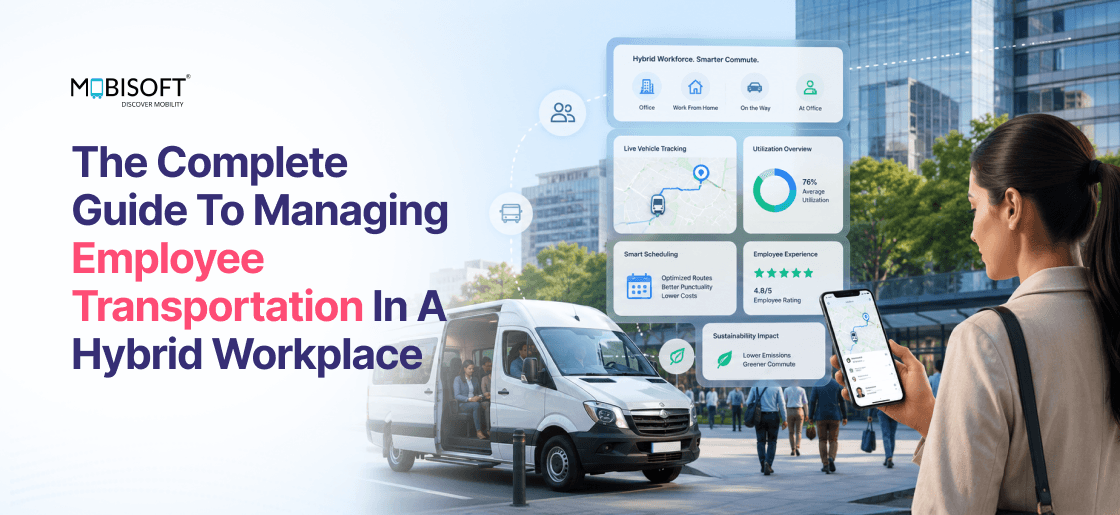
Ask a finance leader what surprised them most about hybrid work, and commuting rarely comes up first. Payroll, real estate, and software licenses do. Employee transportation, meanwhile, has turned into one of the trickiest line items on the operations budget without much fanfare. Most companies are still managing it with the same tools they used when everyone showed up five days a week, and that's the root of the problem.
Predictable attendance made the old approach forgivable. A workforce that clusters on Tuesday and Wednesday, then scatters on Monday and Friday, doesn't behave that way. It needs a transportation model built for variability. Get it wrong, and a company either pays for buses running half full or loses good people who decided the commute simply isn't worth the hassle anymore.
This isn't an introduction to what carpooling or shuttle services are. If you're reading this, you already know the basics. We'd rather walk through how companies doing this well are approaching employee transportation solutions in 2026. What the underlying numbers say about why this matters more than most people assume. And what a genuinely modern corporate transportation program looks like once it's built around cost efficiency instead of habit.
Why Transportation Turned Into a Finance Conversation
Transportation used to sit inside facilities or HR budgets, mostly unexamined, because the pattern behind it barely changed year over year. Hybrid work disrupted that pattern, and finance teams took notice fast.
Look at what commuting really costs one employee. A 2026 analysis built on U.S. Census and EPA figures put the number at close to $13,832 a year for someone earning fifty dollars an hour who commutes five days a week. That figure combines fuel, vehicle wear, and the value of time spent traveling. Parking, tolls, and the fatigue of sitting in traffic before a full workday even starts aren't in that figure.
That cost shows up differently once you zoom out from a single employee commute to the company level. CBRE's 2026 office attendance research adds a sharper detail. Tuesday is the busiest office day for 73% of organizations, with Monday and Friday trailing well behind. This isn't a scheduling curiosity. Most transportation programs were built before this pattern existed, and it shows.
A few consequences follow directly from a workforce clustering on two or three days a week.
- A shuttle fleet sized for daily peak demand sits half empty on the quiet days, which means the company is paying full fleet cost for a fraction of the ridership.
- A carpool policy built around fixed pairs stops working the moment one person's in-office day changes, since the whole arrangement depends on both people showing up together.
- A reimbursement model that assumes steady mileage starts generating monthly costs nobody in finance can predict, because the mileage itself is no longer steady.
Employee transportation deserves the same scrutiny companies already apply to real estate utilization or software licensing. It stopped being a perk once attendance became unpredictable. Now it behaves like any other variable cost, rising or falling with how the hybrid policy is designed in practice. Companies that treat it as background noise tend to discover the wasted spend later rather than sooner.
The Balancing Act Behind Every Transportation Decision
Every hybrid transportation decision carries the same underlying tension. Support the commute too lightly, and employees grow tired of it, especially on days when public transport runs late or the parking lot fills up by nine. Support it too broadly with a generic, one-size answer, and the company ends up paying for routes, vehicles, and schedules that see barely any use.
One operations leader described this to us as trying to hit a moving target blindfolded, and that description has stuck with us because it's accurate. There isn't a single formula that solves this cleanly. What works is closer to a framework, something built to flex as attendance patterns move from one month to the next, rather than a fixed policy set once and left alone.
Three questions tend to separate the companies handling this well from the ones still reacting after problems surface.
- Do you have data on the most demanding days, routes, and departments for transport? Is planning still based on assumptions from last year instead?
- Is the program flexible enough to scale down on quiet days to save resources, and then efficiently scale up on peak days?
- Does the current setup give real visibility into utilization, or do problems only surface once employees start complaining?
A "no" to any of these usually points to a weakness in process or technology that's costing more than leadership realizes.
A Transportation Model Built to Flex With Attendance
A resilient corporate transportation program starts with data rather than vehicles. Before adding shuttles, signing new cab tie-ups, or expanding the carpool network, someone needs a clear read on who is traveling, on which days, and from where.
Most companies already hold this information somewhere. Badge swipe systems know who's in the building. Calendars know who was supposed to be there. HR records know who works where. The trouble is nobody owns the job of pulling those three sources into a single answer, so planners end up guessing at demand instead of reading it off a screen. A dedicated employee transport management system fixes that specific gap. It sits on top of the calendar, using attendance signals and trip requests to alert the planner.
Tier One: High-Density, Predictable Routes
Picture the routes where thirty or forty employees live within a few kilometers of each other and show up on the same two or three days. Fixed-route shuttles and charter buses make sense here, not because they're the default option, but because ridership stays high enough that the cost per seat actually beats what a fleet of individual cabs would run.
An employee shuttle service only stays cost-effective if someone keeps checking it against reality. A route built around thirty employees near one suburb can look completely different eight months later, after half that group shifts to a different in-office day, for instance. Reviewing each quarter to catch that kind of drift is therefore reasonable.
Tier Two: Flexible, Lower-Density Demand
Plenty of employees don't fit neatly into Tier One. Maybe they live too far from any shuttle route, or their attendance days don't line up with enough colleagues to justify a fixed run. Ridesharing, carpooling, and on-demand cabs pick up that slack.
The catch with carpooling specifically is that it tends to work fine on paper and fall apart in practice, because two colleagues agreeing to share a ride only holds until one of their schedules shifts. A comprehensive corporate carpooling solution gets around this by rematching people based on who's actually coming in that week, not who agreed to carpool back in March.
Tier Three: Safety-Critical and Edge-Case Trips
Late-night duty, early starts, client visits, and any trip where an employee is traveling alone at an odd hour deserve their own approach, separate from cost optimization. Female-only cab services and verified driver programs belong here. Trust is the return on this investment, and once it's lost, it's slow to rebuild.
What Fleet Utilization Data Reveals
Most transportation waste has nothing to do with owning the wrong vehicles. It comes from not tracking how the existing ones get used.
A bus running at 40% capacity three days a week doesn't need more buses added to the route. It needs its schedule and demand matched properly, usually through consolidating routes, adjusting departure windows, or moving a portion of riders onto something more flexible like ridesharing.
An automated bus scheduling system is built precisely to surface this kind of blind spot for a corporate shuttle service running several routes at once. Instead of having a pre-organized schedule that is not changed again for months at a time, scheduling needs to be flexible and adjusted according to actual booking numbers. If on Wednesdays there are twice as many passengers as on Thursdays, then the schedule should take that into account.
Many companies underinvest here because transportation planning gets treated as a one-time setup task rather than something reviewed continuously. Closer to how a retailer tracks stock turnover, in other words, than how a facilities team sets a policy once a year and moves on.
Utilization data cuts both ways, too. A route running consistently over capacity is a signal that demand has outgrown the current plan. Catching that early stops the kind of overcrowding that pushes employees back toward driving themselves, which undoes the entire point of running a shared program in the first place.
Holding Transportation Vendors to a Standard
Most companies negotiate hard on the initial contract with a shuttle operator or cab partner, then stop measuring anything once the vehicles start running. That's a mistake, and an easy one to fix.
Set Numbers Before You Sign
Before signing with a vendor, agree on what "good" looks like in measurable terms. On-time performance above a set threshold, a maximum acceptable cancellation rate, a response window for complaints. Vague service language in a contract tends to produce vague service on the road.
Review Performance the Way You'd Review Any Supplier
A transportation vendor is a supplier like any other, and most companies wouldn't accept quarterly silence from a software vendor or a facilities contractor. Treating a shuttle operator any differently, just because the relationship predates the move to hybrid work, leaves money and service quality on the table.
Something as simple as a monthly scorecard gives a company leverage at renewal. This includes on-time rate, complaint volume, average booking-to-pickup time, etc. It also acts as an early warning long before employees start complaining directly. Vendors under supervision naturally perform more efficiently, unlike those who operate without oversight.
The Booking Habit Nobody Accounts For
Underneath most of this inefficiency sits a simpler, more human problem. Employees book transportation late, or skip booking altogether, and expect a ride to be there regardless.
Fleet managers cannot size a shuttle or allocate cabs sensibly if requests land an hour before departure. A shuttle service booking software fixes part of this by making booking simple enough that employees genuinely use it, rather than treating it as one more bureaucratic step. Booking through an app in fifteen seconds, instead of a phone call or an email chain, tends to raise compliance noticeably.
Software alone won't close a behavioral problem on its own, though. Policy has to meet the tool halfway. A modest advance-notice rule, booking by the evening before for a next-morning trip, gives planners enough runway to allocate vehicles sensibly. It doesn't ask employees to plan a week out, which almost nobody does in practice.
Pairing a simple booking rule with an app people genuinely enjoy using tends to produce the highest voluntary compliance. Relying on policy alone, without making the booking process easy, usually means watching employees stop following it within a few weeks, without much noise or explanation.
Why One Policy Rarely Fits Everyone
Designing a single transportation policy and applying it company-wide is tempting, mostly because it's simpler to write. It's worth resisting anyway. A salesperson visiting client sites all week has little in common, transportation-wise, with a finance analyst working a fixed schedule at headquarters.
Staff transportation segmentation tends to work best along three lines.
- Department and role, since a night-crew operations team needs safety-first options and later pickup windows that a daytime office team never touches.
- Work timing, because a hybrid marketing team anchored around Tuesday and Wednesday needs strong coverage on exactly those two days and very little elsewhere.
- Geography, since field-facing roles often need flexible, on-demand access rather than any fixed schedule at all.
Segmenting this way takes more setup work upfront, no question. But it avoids the costlier mistake of building one generic plan that underserves half the workforce while overserving the other half.
Sustainability Has Become a Cost Question, Not Just an Ethics One
Workforce mobility in 2026 can't really be discussed without the environmental angle, mostly because it's tied to cost now rather than sitting apart from it. Fleet operators are accelerating electrification globally, and several 2026 industry sustainability reports point to the same conclusion. Companies blending electric vehicles with traditional ones, matched to route length and charging access, are seeing stronger long-term cost outcomes than those waiting for one perfect all-electric answer to appear.
For corporate transportation, using EVs for short, predictable routes near depots with charging access is an effective option. Keeping combustion vehicles on longer or less predictable trips saves costs.
Younger employees especially notice whether a transportation program reflects any environmental awareness at all. It's rarely the reason someone accepts a job offer, but it does turn up in engagement surveys and employer brand perception, particularly when candidates are comparing two otherwise similar offers.
Communication Costs Almost Nothing and Fixes the Most
Of everything covered so far, this is what companies most consistently underinvest in, despite it being close to free to get right. A technically well-designed transportation program can still fail if employees don't trust it, or simply don't understand how it works.
Real-time updates carry more weight than most planners assume. An employee standing at a pickup point wondering whether the bus is even coming is a worse experience than one who got a notification that the shuttle is running fifteen minutes late. Route changes deserve the same treatment. Two weeks of notice instead of two days heads off a wave of complaints that better timing would have avoided entirely.
Treating this as a one-way broadcast misses half the value, though. The transportation programs that work best tend to include a feedback loop, some simple way for employees to flag a route that's consistently late or a pickup point nobody uses. That input matters, because the people riding the route every day often notice a problem long before it shows up on a utilization dashboard.
What a Modern Transportation Program Requires
Pulled together, a genuinely modern approach to employee transportation services rests on a small set of connected principles rather than a checklist of vendors to sign once and forget.
- Visibility first. Attendance-linked demand data should drive routing and scheduling decisions, not assumptions carried over from last year.
- Flexibility next. A tiered mix of shuttles, carpooling, and on-demand rides that mirrors how hybrid attendance genuinely behaves, rather than forcing attendance to bend around a rigid schedule.
- Continuous review. Routes and fleet allocation adjusted quarterly, not set once at launch and left untouched for years.
- Booking that's genuinely easy. A policy nobody follows isn't really a policy.
- Communication that's honest and frequent, because trust gets built through reliability, not through a policy document sitting unread in a handbook.
The technology to support each principle already exists. The companies adopting it early are the ones setting the bar for what workforce mobility should look like as hybrid work keeps evolving, rather than settling into one fixed pattern.
Why This Matters Even More for Smaller Companies
Most of what's covered here applies just as strongly, arguably more so, to companies with a few hundred employees as it does to large enterprises running thousands. Smaller organizations often assume this level of transportation planning is reserved for big campuses with dedicated fleet teams. That assumption tends to work against them.
With a smaller headcount, every underused shuttle seat or mismatched carpool pairing eats up a larger share of the total transportation budget. A company running three shuttles instead of two, simply because nobody reviewed utilization in eight months, feels that waste far more sharply than a company running thirty shuttles ever would.
The entry point for better tooling has also dropped considerably. A full enterprise rollout isn't required to see benefits. Even a simple booking app paired with basic attendance data can meaningfully improve utilization within a single quarter, well before a bigger platform investment is even on the table.
Getting This Right Comes Down to Intent
Transportation isn't just a cost to squeeze wherever possible. It's an investment in whether a hybrid policy functions the way leadership meant it to when they first designed it. A well-written hybrid policy on paper falls apart quickly if getting to the office three days a week is genuinely difficult for a meaningful share of the workforce.
The companies pulling ahead here usually aren't spending more overall. They're spending with more intent, using real data to match supply with demand instead of leaning on habit or a vendor contract signed years ago and never revisited. That distinction, spending more versus spending deliberately, is probably the single biggest lever available to any company serious about getting employee transportation right in a hybrid world.
A setup still running on spreadsheets, guesswork, and old vendor contracts is worth a second look. The question worth asking is simple. Is the transportation program built for how people work today, or for how they used to work five years ago?

Frequently Asked Questions
How do we calculate the actual ROI of an employee transportation program?
Start with the number finance already tracks, total transportation spend, and hold it up against what's in ground reports. Are shuttles running near capacity or half empty? Is absenteeism lower on the days transportation support is strongest? These aren't hard to check if utilization data exists. The harder yet more important number to pin down is retention. A handful of exit interviews mentioning the commute as a factor is worth more than a spreadsheet, and most HR teams already have that data from past exit surveys. Put together, a properly sized program tends to pay for itself within a year, mostly because the savings show up as fewer people leaving and fewer wasted seats.
Should smaller companies invest in transportation technology, or is that only worthwhile at scale?
Smaller companies often assume this technology is built for large enterprises, but the logic runs the other way at a smaller scale. With fewer employees and tighter budgets, every wasted shuttle seat or mismatched carpool pairing represents a larger share of total transportation spend. A lean booking and scheduling platform prevents that waste from compounding over time. The investment doesn't need to be elaborate. Even a straightforward booking app paired with clear attendance data can meaningfully improve utilization for a company with fifty or hundred employees.
How often should we review and restructure our transportation routes?
Quarterly evaluations work well since monthly reviews cause too much interference for employees who have organized their schedules according to existing routes, while annual reviews allow too many inefficiencies to accumulate. Quarterly evaluations give enough information to make changes to the attendance of a route or the development of a residential cluster without constantly changing employees' schedules. Changes to policy related to hybrid work, such as reducing mandatory time in the office, require an off-cycle evaluation, regardless of when a company evaluates its routes on a quarterly basis.
How does employee transportation affect retention in a hybrid workplace?
The connection isn't always obvious because nobody quits over a late shuttle. What happens instead is smaller and slower. A commute that's unreliable a few times a month starts to color how someone feels about the whole in-office day, even before they've admitted that to themselves. Ask around, and you'll usually hear some version of "it's not that big a deal," right up until that same person takes a call from a recruiter offering a fully remote role and says yes faster than anyone expected. Transportation isn't going to be the headline reason someone leaves. It's one of several small frictions that make an otherwise good job feel slightly less worth the trouble, and it happens to be the one most within a company's control to fix.
Is it better to build transportation infrastructure in-house or partner with a specialized platform?
For most companies, partnering with a specialized platform makes more sense than building internal tools from scratch. Transportation logistics involve routing complexity, real-time tracking, and booking behavior patterns that take specialized platforms years to refine properly. Building this in-house usually means pulling engineering resources away from a company's core business to solve a problem established platforms have already solved well. The exception is very large enterprises with genuinely unique logistics needs, where a hybrid approach, licensing core technology while customizing specific workflows, often works better than either extreme alone.
This content is for informational purposes only and may include AI-assisted research or content generation. While we strive for accuracy, information may evolve over time. Readers are advised to independently verify critical information before making decisions.

Nitin Lahoti
Read more
Nitin Lahoti is the Co-Founder and Director at Mobisoft Infotech. He has 15 years of experience in Design, Business Development and Startups. His expertise is in Product Ideation, UX/UI design, Startup consulting and mentoring. He prefers business readings and loves traveling.
 Nitin Lahoti
 February 12, 2024