You've spoken with many leaders, and their starting point is familiar. They want a quick, simple solution to begin their chatbot journey. Off-the-shelf platforms appeal directly to this desire, promoting rapid deployment and manageable initial costs for teams exploring AI Chatbot Development Services. For a short while, this approach might even seem perfect.
Yet a consistent, difficult realization eventually surfaces. That seemingly economical initial choice often becomes the more costly long-term path. Why does this happen? The technology itself isn't the primary issue. Instead, the initial decision is based on an incomplete perspective. It focuses on immediate convenience while inadvertently accepting future constraints and hidden expenses. This early framing sets the stage for the challenges we will explore next, where short-term gains subtly give way to long-term compromises. The true cost of "quick and simple" is rarely found in the first invoice. It unfolds slowly, across the ensuing months and years of operation, when who owns chatbot intelligence is not clearly defined.
If you’re evaluating long-term ownership and scalability, explore our AI Chatbot Development Services to see how enterprises build intelligence they fully control.
Most Chatbot Decisions Are Framed as Tooling Decisions
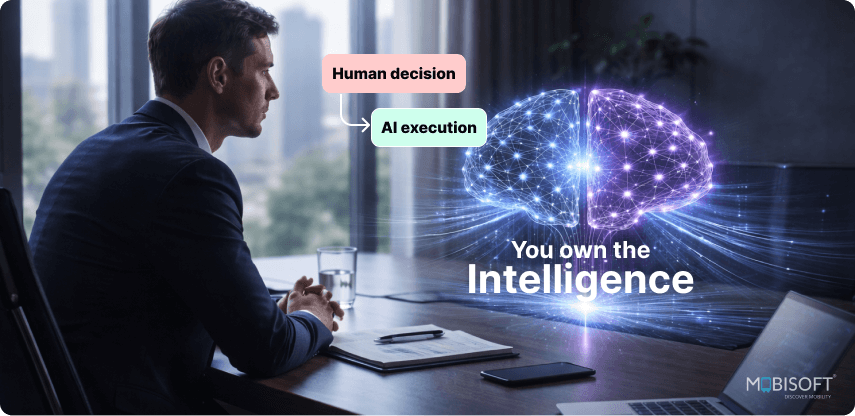
This is our common starting point. We evaluate platforms based on features, price, and deployment speed. We are shopping for a tool to deploy an AI Chatbot for Business. This feels practical and immediate.
Misplaced Priorities
This tooling mindset prioritizes immediacy. It seeks to solve a discrete pain point, like deflecting FAQ tickets, with minimal fuss. The focus rests on the capability of the software itself, not on its deeper relationship with your company's unique processes and data. The question is "what does it do," not "how does it become part of us," including how enterprise chatbot data ownership is handled.
Hidden Operational Costs
Viewing AI as a tool leads to predictable outcomes. You get a discrete application, not an integrated system. It creates another point solution that your team must manually bridge to other systems. This fragmentation generates ongoing maintenance, limits automation scope, and transforms a potential asset into perpetual overhead common in many Conversational AI Solutions.
Architecting for Scale
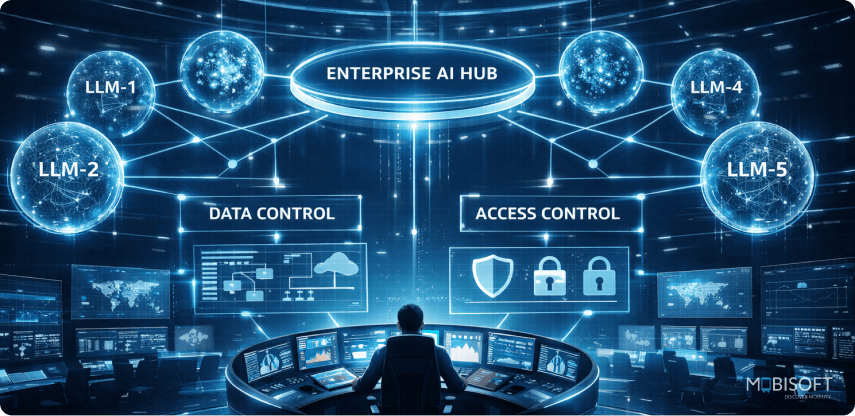
The alternative is to frame the decision as one about strategic infrastructure. You are not procuring a tool. You are architecting a new intelligence layer for your operations through Custom AI Chatbot Development. This shifts every evaluation criterion. You now prioritize native integration depth, ownership of logic, and scalability of capability within an Enterprise AI chatbot architecture. The goal is not to install software, but to engineer a core component of your business.
A scalable architecture starts with the right foundation. See how our enterprise AI chatbot platform enables multi-LLM orchestration, native integrations, and enterprise-grade control.
The Hidden Cost Nobody Budgets For: Integration Debt
That attractive off-the-shelf chatbot promises a quick start. What it does not mention is the integration debt silently accumulating beneath the surface.
The New Silo Problem
Your enterprise likely already manages a collection of disconnected applications. Introducing another isolated tool rarely solves this. It often becomes just another silo, forcing your team to build and maintain bridges to your core systems.
The Real Cost: Developer Time
The immediate expense is measured in developer hours. Teams can spend a significant portion of their effort on forcing an external tool to communicate with your CRM or ERP. This is the real AI tax. It includes unplanned work for data preparation and ongoing API management.
Continuous Debt vs. Compounding Value
Custom integration presents a different calculus. It requires more consideration upfront. Yet it builds compounding value by weaving the chatbot directly into your operational fabric using an LLM-powered chatbot. The critical difference is this. With generic solutions, integration is not a one-time project. It becomes a continuous operational debt, demanding constant patches and workarounds. This is a recurring fee paid in diverted developer hours and lost strategic opportunity.
To avoid long-term integration friction, many teams begin with structured planning through AI strategy consulting services before committing to automation investments.
We Are Entering an Agentic AI Era - Most Bots Aren’t Built for It
We are moving from simple chatbots to what analysts call Agentic AI. This isn't an incremental improvement. It is a new paradigm where AI doesn't just answer, it acts. Off-the-shelf bots, including a Generative AI Chatbot, designed for conversational scripting, are fundamentally unprepared for it.
Reactive vs Proactive AI
Pre-built solutions operate on fixed rules and are reactive. A custom agentic architecture is built for proactive reasoning. It is imbued with your unique business logic, allowing it to make context-aware decisions. This is the core architectural gap.
Workflow Orchestration Layer
Most advanced AI applications will soon rely on multi-agent systems. These are teams of specialized AI working together. A custom solution can autonomously produce workflows across your CRM, ERP, and databases for a scalable AI Chatbot for Business. A generic bot, however, will reach its limit and hand the task to a human.
Beyond Question Answering
You are no longer automating responses. You are automating entire complex processes. The enterprises building custom architectures now are not just solving today's problems. They are preparing for a near future, where autonomous, intelligent operation is the main differentiator supported by AI Chatbot Development Services.
Agentic systems work best when backed by broader innovation layers. Discover how enterprises scale intelligence with end-to-end artificial intelligence services.
The Most Valuable Knowledge in Your Company Isn’t Documented
Your company's expertise lives in the minds of your veteran employees, in their nuanced understanding of problems and their intuitive solutions. It is your organization's true intellectual capital inside an Enterprise AI Chatbot strategy. Standard bots, built for common questions, cannot comprehend this deep, contextual knowledge.
The Limits of Generic Bots
- These tools are designed to find documented answers. They navigate knowledge bases, but the wisdom that comes from experience is often undocumented in typical Conversational AI Solutions.
- It exists in stories, in past decisions where the reasoning mattered more than the outcome, and in specialized problem-solving patterns unique to your company.
- An off-the-shelf system has no framework to capture this in an AI Chatbot for a business environment. It cannot model the 'why' behind a veteran's choice.
Capturing Expert Reasoning
- A custom conversational AI changes this dynamic through Custom AI Chatbot Development. It can be designed to learn from these interactions.
- Imagine a system that engages with experts, capturing their thought processes and contextual nuances during real problem-solving.
- New hires could query it not for a manual, but for guided reasoning based on decades of accumulated institutional experience.
Turning Insight Into Value
- This moves the function from cost-saving to value creation with AI Chatbot Development Services. It actively preserves the expertise that forms your competitive edge.
- While generic tools manage information, a custom solution can curate and perpetuate understanding.
- It turns operational memory into a strategic asset, ensuring that vital wisdom remains within the organization, accessible and actionable for the future.
Many organizations start by modernizing service workflows. Learn how AI customer support automation with chatbots improves resolution speed while preserving institutional knowledge.
Standardization Is Efficient, but It Also Makes You Forgettable
Optimizing solely for efficiency often standardizes the very experience you are trying to elevate. When multiple competitors use identical off-the-shelf platforms, their customer interactions converge. Your brand becomes indistinct across many Generative AI Chatbot implementations.
- Generic bots utilize uniform templates, restricting your unique conversational logic and heritage.
- Custom solutions architect dialogue flows that mirror your proven customer engagement principles.
- This encodes your specific escalation pathways and tonal adaptability into the system's core.
- It guarantees every automated exchange reinforces your brand's particular values and expertise.
- The bot evolves into a consistent digital ambassador, building recognition and implicit trust.
- You protect a key competitive moat by ensuring your automated voice is unmistakably yours.
Consequently, this is a strategic choice when selecting a Chatbot Development Company. An off-the-shelf bot completes tasks. A custom chatbot, however, deliberately advances your brand's position with every single interaction it conducts. It is the difference between being heard and being remembered in modern AI Chatbots for Business adoption.
The Three-Year View Changes Everything in AI Chatbot Strategy
We must move beyond initial price tags. The true financial picture of a chatbot emerges across years, not quarters. Quick deployment narratives are seductive but often misleading. A clear-eyed view of Total Cost of Ownership reveals a different story.
License Costs Over Time
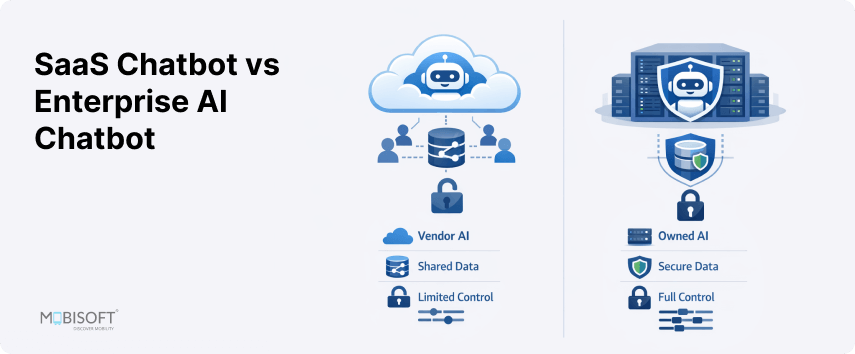
Off-the-shelf models hinge on recurring fees that scale directly with your usage. You are renting capability, not building an asset in an AI Chatbot for a business environment. More importantly, significant integration costs remain. You still pay for custom connectors and inevitable workarounds, essentially paying twice to make a generic tool fit.
The Capability Ceiling
These platforms have a firm automation ceiling, often well below what modern businesses require from an Enterprise AI Chatbot. Handling only straightforward queries means complex, valuable tasks remain manual. You subsequently invest in additional tools, creating a fragmented and costly patchwork of solutions.
Three-Year ROI View
Compare a $25,000 annual subscription to a $150,000 custom build through Custom AI Chatbot Development. The first-year math seems obvious. By year three, things look much different. The custom solution, fully owned and integrated, operates without escalating licenses. Its deeper automation handles more complex workflows, compounding in value.
Evaluating this like a software subscription is a mistake. Forward-thinking CFOs assess it as strategic capital expenditure. The higher initial investment is not merely a cost. It is the foundation for sustained capability and control, delivering superior long-term economics and eliminating vendor dependency common with many Conversational AI Solutions.
As automation expands beyond text, many enterprises are also investing in enterprise voice AI workflows and intelligence to orchestrate actions across channels and systems.
When Off-the-Shelf Chatbots Do Make Sense
A balanced view is important. Generic platforms can be suitable in certain scenarios. The decision is less about right or wrong and more about alignment with specific business needs when adopting a Generative AI Chatbot:
- An off-the-shelf bot works for validating core chatbot concepts without a major capital commitment upfront.
- It can capably manage simple, repetitive information requests that require no deep system integration.
- Smaller organizations with linear processes and fewer than fifty employees may find it sufficient.
- It functions as a useful interim solution while you architect a long-term, custom AI strategy.
- The approach struggles when you need nuanced intelligence embedded within complex B2B sales cycles.
- It becomes a risk in regulated fields where compliance must be designed into the core logic.
- Any serious multi-platform integration effort quickly reveals the architectural limitations of a generic framework.
- If your customer experience is a key brand differentiator, you likely need your own solution.
Use an off-the-shelf model for initial learning, then transition. This phased move allows you to build strategic custom assets informed by real experience, not just theory, while clarifying who owns chatbot intelligence. The important question is whether you are buying a tool or building a capability?
The Decision That Actually Matters in Enterprise AI Chatbot Architecture
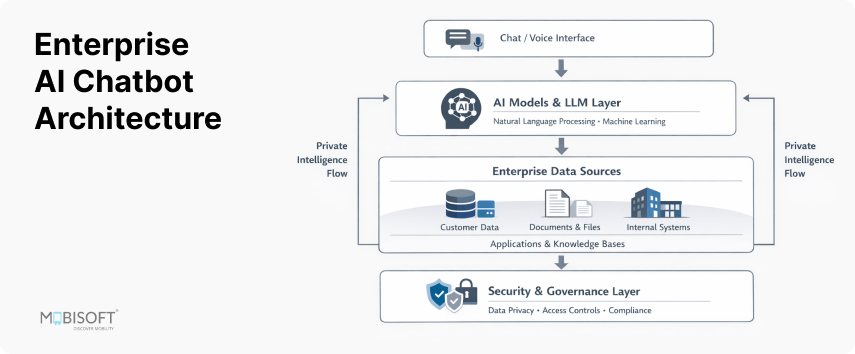
A pre-built chatbot functions as external middleware in many AI Chatbot for Business setups. It sits apart from your core systems, relying on constant bridges and connectors. This creates observable latency and recurring maintenance. A custom solution is developed as a native intelligence layer within an Enterprise AI chatbot architecture. It uses unified APIs and encodes your proprietary business logic directly into its reasoning models. This allows for genuine workflow orchestration, not just programmed responses.
The first option prioritizes rapid deployment. The second is designed for capability compounding, where each new integration increases the system's overall utility and autonomy. You are evaluating a finished product against an adaptable platform often delivered by a Chatbot Development Company.
Ultimately, this is an infrastructure decision. Lasting competitive advantage in the coming phase will belong to organizations that own their reasoning and workflow automation stack with Custom AI Chatbot Development. This control is not a feature you can purchase. It is a strategic outcome you engineer by choosing to build a foundational component, rather than outsourcing a point solution. Before locking into a single vendor, it’s useful to review AI chatbots alternatives and their comparison. It will help understand how platforms differ in control, extensibility, and long-term flexibility.
Key Takeaways for AI Chatbot Development Services
- Off-the-shelf solutions incur continuous integration debt, demanding ongoing resources for connectors and workarounds that a unified custom architecture avoids.
- Custom development provides the necessary foundation for agentic AI, enabling systems that orchestrate workflows rather than just retrieving information.
- Capturing nuanced institutional knowledge requires a custom framework built for contextual learning and proprietary knowledge graph development.
- Generic platforms dilute brand identity; a custom conversational engine directly embeds your unique brand logic and compliance standards.
- A three-year financial analysis typically reveals the greater long-term value of a custom-built, owned asset over a licensed tool.
- The decision should be guided by an assessment of your operational complexity, strategic differentiation, and compliance needs.
- Standard bots are valid for temporary pilots or for organizations with very simple, isolated processes and no scalability requirements.
- The most pragmatic path is often a phased hybrid approach, using initial off-the-shelf deployment to inform the specifications for a permanent custom solution.

Frequently Asked Questions
What is the single biggest financial miscalculation companies make when choosing a chatbot?
To figure out TCO, you need to count developer time for custom hookups, ongoing API upkeep, and data flow fixes that a basic bot needs. These running costs often eat up 30% or more of a dev team's time make an off-the-shelf fix cost twice as much within two years.
Isn't integration a challenge for any software, regardless of being custom or off-the-shelf?
Building your own system creates a custom, all-in-one API layer just for your setup. Ready-made options force you to build and keep up a tricky middle layer of outside connectors and scripts common in Custom vs SaaS chatbot models. This leads to shaky, one-to-one hookups that make your whole system more fragile and harder to fix every time you add a new tool.
We keep hearing about Agentic AI. Is this just another buzzword our strategy can ignore?
Ignoring it risks architectural obsolescence. Agentic readiness requires a foundation of orchestration logic, a secure action registry, and dynamic reasoning layers. These are core architectural components, not modular features. An off-the-shelf conversational UI cannot be retrofitted with the deep autonomy found in an On-premise AI chatbot. Building custom allows you to incrementally implement this capability as your processes mature.
How can a chatbot truly capture undocumented institutional knowledge?
It requires a structured methodology beyond simple Q&A. The process involves designing targeted NLP training on internal communications, building a proprietary knowledge graph schema to map relationships between entities and processes, and implementing a continuous feedback loop where expert corrections directly train the model in an Enterprise AI Chatbot. This creates a living system, not a static document.
Our needs aren't complex now. Can't we just start off-the-shelf and switch later?
You can, but only with a deliberate migration protocol. Treat the initial phase as a discovery sprint to log every integration pain point, user query fallback, and process exception for your AI Chatbot for Business. This data becomes your core functional specification. Without this enforced rigor, "switching later" means starting from scratch, having gained only superficial operational experience.
Beyond cost savings, what metrics prove the value of a custom chatbot?
Move from efficiency metrics towards strategic capability indicators. Measure the reduction in process hand-off points, the increase in fully automated complex workflow completion, and the consistency score for brand-compliant and regulatory-approved responses delivered by a Generative AI Chatbot. These track how the system enhances operational cohesion and institutional governance, not just ticket deflection.

Nitin Lahoti
Read more
Nitin Lahoti is the Co-Founder and Director at Mobisoft Infotech. He has 15 years of experience in Design, Business Development and Startups. His expertise is in Product Ideation, UX/UI design, Startup consulting and mentoring. He prefers business readings and loves traveling.
 Nitin Lahoti
 February 5, 2026