The overwhelming choice in AI agent SDKs can confuse engineering teams and waste important hours. You face a dozen options, each promising to be the definitive solution. This noise makes it difficult to see the genuine trade-offs. It is not about finding the “best” SDK among so many options. The real question is which one fits your specific problem and your team’s context.
This blog analyzes five leading AI agent frameworks through the lens of concrete implementation. It offers a direct view of what each tool truly delivers, where it excels, and where it might create unexpected friction for your project.
Teams exploring agent-based systems often start by aligning use cases with broader artificial intelligence services to ensure long-term scalability and business impact.
The Evaluation Lens: What Matters for Production AI Agent Frameworks
Choosing a framework goes beyond comparing feature lists. You need to account for real operational constraints. The wrong choice can introduce technical debt, security risks, or brittle AI agents for automation that are hard to scale. Before diving into the SDKs, apply this simple lens. It highlights the factors that matter most when building production-ready systems. This will also help you choose the right AI agent development services to build your own AI agent.
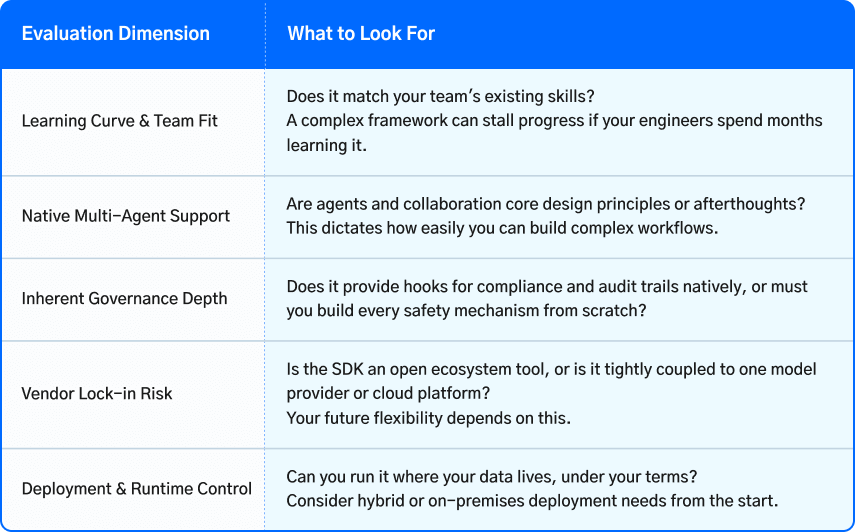
These dimensions help you see beyond the marketing. They turn a technical decision into a strategic one.
Many modern agent frameworks rely heavily on foundation models, making generative AI services a critical layer in production-ready automation strategies.
Deep-Dive: AI Agent SDKs and Frameworks to Cover
LangGraph (LangChain Ecosystem) – Open Source AI Agent Framework
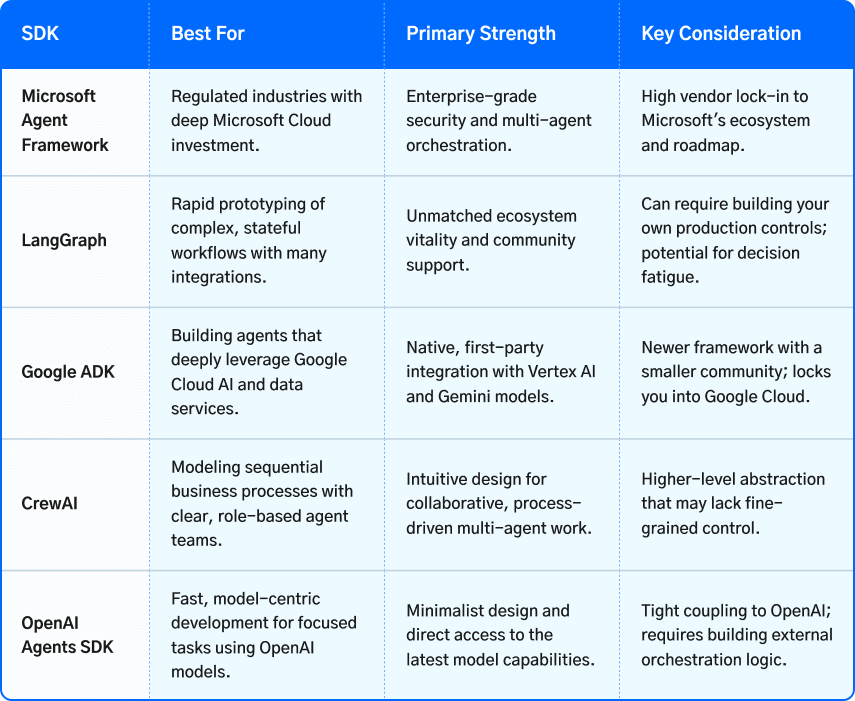
Think of this duo as the versatile workshop of agent tools within modern AI agent frameworks. The LangChain SDK provides the foundational blocks for connecting models, data stores, and APIs. LangGraph adds the precise blueprint for designing complex, stateful workflows. Their great strength is ecosystem vitality.
Key Features & Strengths
- A broad ecosystem with a community-built connector for nearly any service.
- Strong design patterns for complex, stateful, and cyclical workflows.
- Massive community support for troubleshooting and accelerated prototyping.
When It’s The Right Choice
Think retrieval-augmented tasks or multi-step document workflows. It's ideal if your team needs quick prototyping. You'll appreciate the vast library of pre-built connectors. The community support alone can be a deciding factor when you need answers fast.
Limitations & Considerations
The very breadth of the ecosystem can be a challenge. You might face decision fatigue navigating numerous options for similar tasks. For production, you may also need to build more of your own governance and operational controls, as the framework offers great flexibility rather than rigid, out-of-the-box enterprise policies.
These focused agents are commonly deployed as part of AI chatbot development services for customer support, research assistance, and internal productivity workflows.
Microsoft Agent Framework – Enterprise AI Agent Orchestration
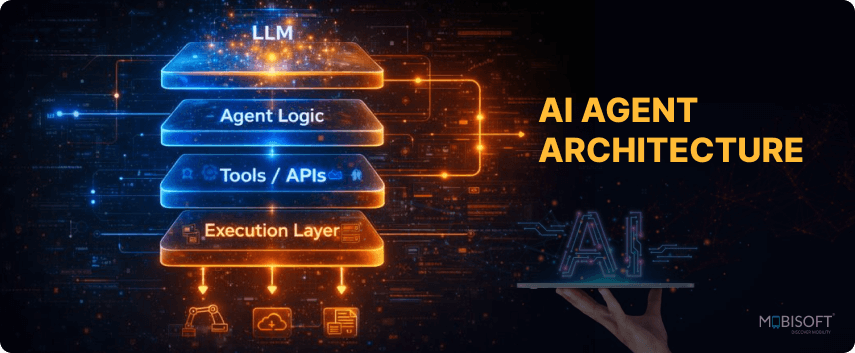
This pairing is engineered for complex, secure, and governed automation scenarios in enterprise-grade AI agents for automation, deeply integrated into the Microsoft universe. Its core strength is a sophisticated multi-agent conversation framework. Microsoft Agent Framework allows you to orchestrate specialized agents that collaborate, while Semantic Kernel provides the secure plumbing to enterprise data and services on Azure.
Key Features & Strengths:
- Built with an enterprise security posture from the ground up.
- Sophisticated, conversational multi-agent orchestration patterns.
- Deep, native alignment with Azure cloud services and the broader Microsoft toolchain.
When It’s The Right Choice
The ideal use cases live in regulated industries or within large organizations needing complex, knowledge-driven automation that ties into existing Microsoft Cloud investments. Pick this when your organization values deep Microsoft ecosystem alignment, requires rigorous governance controls, and is tackling intricate multi-agent problems.
Limitations & Considerations
The primary consideration is inherent vendor alignment. Your architecture becomes closely coupled with Microsoft's roadmap and services. The learning curve can also be steeper due to the conceptual weight of its powerful orchestration models. It is a formidable tool, but it asks for a significant commitment.
OpenAI Agents SDK – Lightweight AI Automation SDK
This offering takes a minimalist and pragmatic approach among AI automation SDKs. The OpenAI Agents SDK provides a streamlined API focused on core agent primitives: reasoning, tool use, and iterative execution. The strength here is developer clarity and velocity. You are not navigating a vast framework. Instead, you get well-documented, powerful building blocks that work seamlessly with the latest OpenAI models. (AgentKit represents a similar, pattern-driven approach from OpenAI for structured task execution).
Key Features & Strengths:
- Fast prototyping with a low-configuration, API-centric design.
- Direct integration and compatibility with the newest OpenAI model capabilities and updates.
- Clear, example-driven patterns that reduce initial learning time.
When It’s The Right Choice
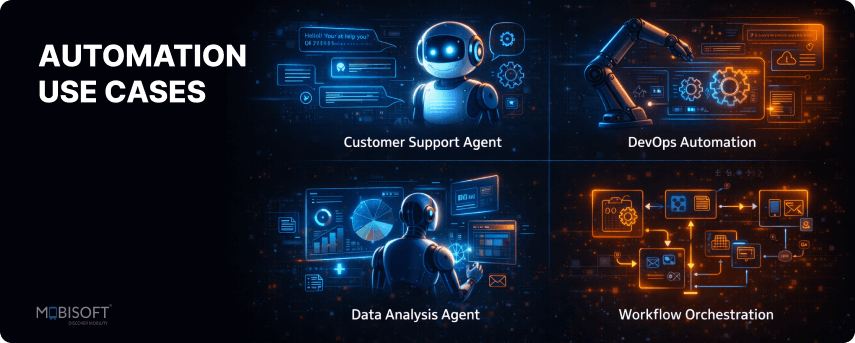
It is an excellent choice for building focused agents for customer support triage, deep prospect research, or internal developer productivity tools. Consider this SDK when you want a lean, focused toolkit for moving from prototype to production with minimal overhead, and when you want to closely track and leverage rapid model upgrades from OpenAI.
Limitations & Considerations
The primary limitation is its tight coupling to the OpenAI ecosystem. Your agent's capabilities are intrinsically linked to OpenAI's model roadmap and API. For complex multi-agent orchestration or deep enterprise integrations, you will likely need to build more surrounding architecture yourself. Its simplicity is a strength, but it trades away the higher-level orchestration features of other frameworks.
As agent workflows scale, techniques like quantization in LLMs become essential for managing performance and inference costs.
Google Agent Development Kit (ADK) – Google AI Agent SDK
The Google ADK is designed to be the native pathway into Google's generative AI stack and serves as Google’s official AI agent SDK. It provides structured, high-level primitives for agentic reasoning that connect seamlessly with Vertex AI models, Gemini APIs, and key services like Google Search and Workspace. The architecture encourages a clear separation of planning, tool use, and execution tailored for Google Cloud.
Key Features & Strengths:
- Deep, official integration with the Vertex AI platform, including grounding with Google Search and enterprise data.
- First-class support for Gemini models and a clear roadmap aligned with Google's AI releases.
- Built-in components for web navigation and interaction with Google's suite of tools and APIs.
When It’s The Right Choice
This is the right choice when your organization is all-in on Google Cloud and needs cloud-native AI-powered workflow automation grounded in Vertex AI or Workspace data. It is ideal for building cloud-native agents that require deep grounding in Google's ecosystem or that use Google Workspace and search as a primary tool in environments.
Limitations & Considerations
The most significant consideration is, of course, vendor lock-in to the Google Cloud ecosystem. The framework is relatively newer, so its community and third-party tooling are less extensive than those of more established players. You are betting on Google's long-term commitment to this specific toolkit.
CrewAI Framework – Role-Based Agentic AI Tools
CrewAI emphasizes human-readable, collaborative agent teams and stands out among agentic AI tools focused on orchestration clarity. The CrewAI framework revolves around defining clear roles, goals, and tasks for each agent, then structuring how they hand off work in a process-driven workflow. It abstracts some lower-level complexity to focus on agent interaction and task completion.
Key Features & Strengths:
- Intuitive, role-based design that maps well to business processes and human team structures.
- Built-in mechanisms for task delegation, sequential execution, and collaborative decision-making between agents.
- A process-driven approach that can make complex multi-agent workflows easier to conceptualize and orchestrate.
When It’s The Right Choice
This framework shines when your automation mirrors a clear, sequential process. It's a compelling choice for cross-team handoffs, content pipelines, or research workflows. You get a readable, almost story-like structure for agent collaboration. That clarity is its superpower.
Limitations & Considerations
The trade-off for that high-level clarity is fine-grained control. You might find it less flexible than a graph-based approach for managing minute data flows. Its role-and-task model is wonderfully intuitive, but it can feel restrictive for problems that don't fit that mold. Simply put, it's powerful for orchestration but talks less about the nuts and bolts of tool integration.
For a practical walkthrough of this role-based approach, see our guide on building AI agents with CrewAI
How to Make Your Decision on AI Agent SDKs
Start with an honest look inward. Ignore the hype around emerging AI agent SDKs and assess your team’s actual skills first. Can they comfortably navigate a complex framework, or do they need a simpler starting point? Next, scrutinize your problem’s true complexity. Is it a single, focused task or a sprawling process needing multiple specialists? Then, layer in your non-negotiable governance needs. Data sovereignty and audit requirements will instantly narrow your field when evaluating modern AI agent frameworks.
Your final choice should emerge from this alignment. It is the tool that fits your people, your problem, and your policies with the least friction. The right SDK feels like a natural extension of your team's capabilities, not a foreign piece of technology they must constantly fight to understand. Organizations often accelerate this decision-making process through AI strategy consulting to align agent adoption with governance, architecture, and business goals.
Conclusion: Choosing the Right AI Agent Framework
In the end, view this not as picking a tool but as making a foundational architectural choice. The optimal SDK acts as a force multiplier for your specific team’s culture and operational cadence, especially when building AI-powered workflow automation. It must conform to your security posture, certainly, but also to the way your engineers solve problems. Does its logic model align with how you think?
We advocate for a deliberate, evidence-led path. A constrained pilot is your best source of truth. It reveals real friction and validates utility before any major commitment. Scaling then becomes an act of confidence.
Select the framework your team can not only build with, but live with. One that they can debug at midnight and confidently extend next quarter. This careful alignment builds adaptable intelligence into your very operational fabric. That is the true outcome of a wise choice among today’s agentic AI tools. Many of these frameworks are already powering real-world AI-powered customer support automation across enterprise environments.
Key Takeaways
- There is no universal best framework. The optimal choice depends on your team’s technical maturity and specific governance requirements when adopting AI agents for automation.
- Always initiate with a tightly scoped, high-impact pilot. This proves value quickly while containing risk.
- Governance and security cannot be implemented afterwards. Design audit trails and operational controls into your foundation from the start.
- True cost extends beyond API tokens. Diligently monitor tool-call frequency, memory usage, and multi-agent coordination overhead.
- Budget for iterative review, prompt tuning, and updates alongside model advancements, as these systems demand ongoing care.
Technology continues to evolve. Monitor smarter tool selection, hybrid architectures, and standardized observability as key AI automation trends in 2026.

FAQs on AI Agent SDKs and Frameworks
Which SDK has the gentlest learning curve for a team skilled in traditional software?
The OpenAI Agents SDK is often the easiest entry point. Its minimalist, API-centric design feels familiar to developers. You reason about agents in code, not a new abstraction language. This provides a direct path to understanding core agent primitives before considering more complex orchestration frameworks.
How is using an agent SDK truly different from calling LLM APIs directly with our own code?
The SDK provides the essential "glue" you would otherwise build manually: structured tool-calling loops, managed conversation memory, step-by-step reasoning traces, and built-in retry logic. It saves you from reinventing these complex, stateful patterns and lets you focus on defining the business logic and tools themselves.
What is the main practical difference between CrewAI and LangGraph for multi-agent workflows?
Think of it as managerial versus engineering control. The CrewAI framework gives you a high-level, role-based blueprint where collaboration is built in. LangGraph provides a lower-level state machine where you explicitly design every transition and message flow. The former is faster for defined processes; the latter offers more granular control.
How does vendor lock-in actually manifest when using Google ADK or Microsoft Agent framework?
It appears in your deployment infrastructure, your authentication model, your data residency, and your available AI models. Your automation becomes dependent on that cloud platform's specific services, APIs, and even its operational quirks. Migrating away later would mean re-architecting the entire agent runtime, not just swapping a library.
For a high-stakes process like financial approval, which SDK paradigm is safest?
Frameworks with baked-in governance, such as the Microsoft Agent Framework, provide a strong foundation. Their architecture forces you through policy and audit hooks. For other AI automation SDKs, you must deliberately engineer this safety layer yourself. The "safest" choice is the one where guardrails are a core feature, not an optional afterthought.
What is a hidden cost or scaling challenge with the agentic approach that isn't obvious at the pilot stage?
The compounding cost of context and memory. As workflows get longer and more complex, the amount of context retained and processed between steps grows. This can lead to exponentially higher token costs and slower execution unless you implement sophisticated context management and summarization strategies early on.
Do these SDKs handle the underlying infrastructure, like scaling and load balancing, for us?
No. These are AI agent development kits, not platforms. They define agent logic, while you remain responsible for runtime infrastructure, scaling, monitoring, and resilience. The runtime environment that executes the SDK's code. This infrastructure burden is a critical part of your total cost.

Pritam Barhate
Read more
Pritam Barhate, with an experience of 14+ years in technology, heads Technology Innovation at Mobisoft Infotech. He has a rich experience in design and development. He has been a consultant for a variety of industries and startups. At Mobisoft Infotech, he primarily focuses on technology resources and develops the most advanced solutions.
 Pritam Barhate
 December 24, 2025